
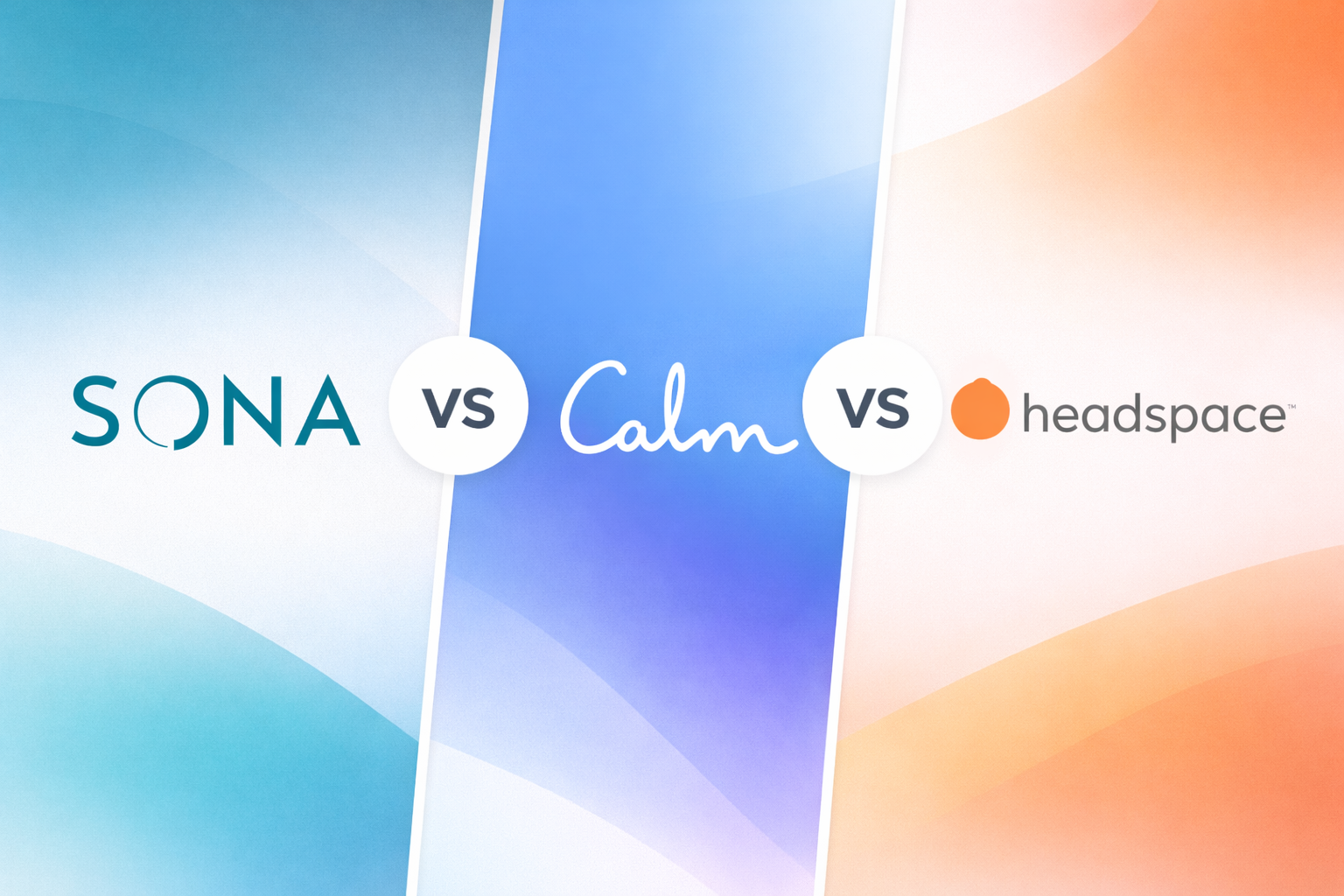
The best sleep apps in 2026 combine different approaches to address various sleep challenges: SONA leads with AI-powered vagus nerve stimulation for physiological intervention, whilst Calm and Headspace excel at meditation-based relaxation. Sleep Cycle provides complete tracking, and free options like Insight Timer offer accessible mindfulness tools. Your ideal choice depends on whether you need direct nervous system regulation, guided meditation, or sleep pattern insights.
The sleep technology landscape has evolved dramatically. Where traditional apps once relied solely on ambient sounds and basic meditations, today's solutions incorporate sophisticated physiological interventions, AI personalisation, and evidence-based protocols. SONA's approach using AI-adaptive vagus nerve stimulation marks a shift from passive content consumption to active nervous system regulation.
This comprehensive comparison examines each category's effectiveness, from apps that directly influence your autonomic nervous system to those offering extensive meditation libraries. We'll explore pricing models, scientific backing, and real-world results to help you choose the most effective solution for your specific sleep challenges.
Key Takeaways
- SONA uses AI-powered vagus nerve stimulation to directly regulate your nervous system, whilst traditional apps rely on meditation and soundscapes
- One-time purchase models (SONA: £695) may offer better long-term value than ongoing subscriptions (Calm/Headspace: £50-70/year)
- Sleep tracking apps provide insights but lack intervention capabilities: combine with active treatments for best results
- Free apps like Insight Timer and Pzizz offer quality content but lack personalisation and advanced features
- Research on transcutaneous VNS suggests improvements in sleep onset and sleep architecture for people with stress-related sleep disturbance
Understanding Sleep App Categories and Technologies
Sleep apps in 2026 fall into distinct categories, each targeting different aspects of sleep improvement through varied technological approaches.
Physiological intervention apps like SONA use direct nervous system modulation through vagus nerve stimulation (VNS). This approach works by activating the parasympathetic nervous system (your body's 'rest and digest' response) through targeted electrical pulses synchronised with your breathing and heart rhythm. Research demonstrates that VNS can increase HRV and sleep quality by promoting vagal tone, the strength of your vagus nerve's signal.
In contrast, mindfulness-based approaches employed by apps like Calm and Headspace work through cognitive pathways. These platforms use guided meditations, sleep stories, and breathing exercises to quiet mental chatter and reduce pre-sleep anxiety. The mechanism here involves shifting brain wave patterns from active beta waves to calmer alpha and theta states conducive to sleep.
Sleep tracking technologies represent a third category, focusing on measurement rather than intervention. Apps like Sleep Cycle use your phone's accelerometer or microphone to detect movement and breathing patterns, inferring sleep stages throughout the night. Whilst valuable for identifying patterns, these apps cannot actively improve sleep without pairing with intervention strategies.
The important distinction lies in personalisation capabilities. AI-powered systems like SONA adapt in real-time to your physiological signals, adjusting stimulation patterns based on your current heart rate variability and breathing patterns. Traditional apps offer one-size-fits-all content, though some now include basic personalisation through user preferences and sleep goals.
When choosing between categories, consider your primary sleep challenge. If racing thoughts keep you awake, meditation apps excel. For those whose nervous systems struggle to downregulate (often seen in chronic stress or burnout) physiological interventions prove more effective. Tracking apps work best for identifying patterns and optimising sleep hygiene rather than treating underlying issues.
SONA: AI-Powered Vagus Nerve Stimulation for Sleep
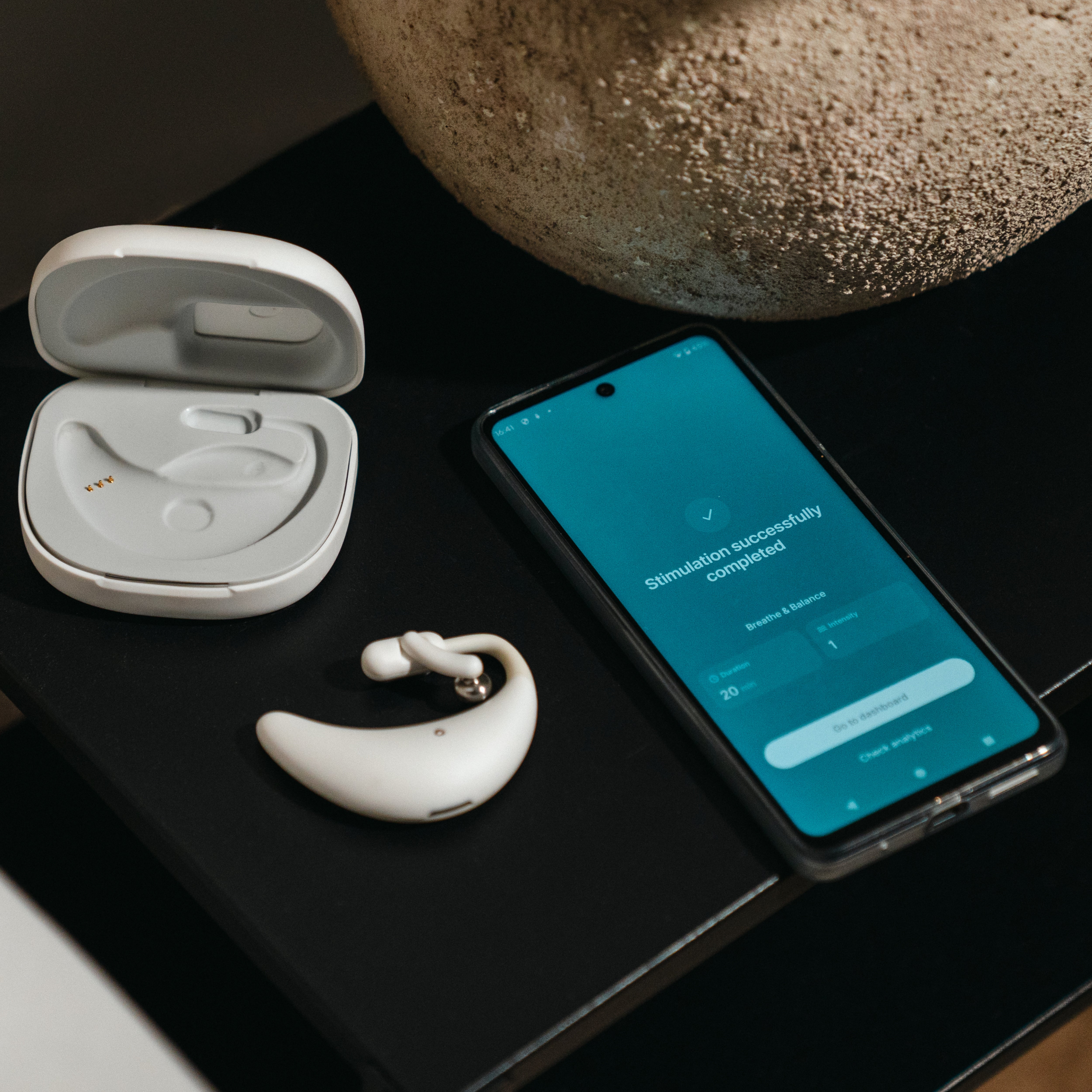
SONA takes an AI-adaptive approach to sleep improvement through its closed-loop vagus nerve stimulation system that reads and responds to your body's signals in real-time.
The device's time-locked delivery system synchronises electrical pulses with your heart rhythm and breathing patterns: imagine pushing a swing at precisely the right moment to maximise momentum. This synchronisation amplifies the calming effects on your nervous system, promoting the parasympathetic state essential for quality sleep. Studies on transcutaneous VNS in people with stress-related insomnia have reported meaningful improvements in sleep onset latency and time spent in deep sleep, alongside gains in heart rate variability.
What sets SONA apart is its adaptive AI technology. Rather than delivering preset programmes, the system continuously monitors your heart rate variability and breathing patterns, adjusting stimulation parameters every few seconds. This means each session is uniquely tailored to your current physiological state: whether you're wired from a stressful day or already somewhat relaxed.
The pricing model reflects a different philosophy from subscription apps. At £695 for the device with lifetime app access, SONA requires a larger upfront investment but eliminates ongoing fees. Over five years, this works out to approximately £11.60 per month: significantly less than premium meditation app subscriptions. The package includes the stimulation device, conductive ear clips, and full access to personalised protocols without additional charges.
Integration capabilities enhance SONA's sleep-specific benefits. The device can be used 15-20 minutes before bed as part of your wind-down routine, with optimal timing varying based on individual circadian rhythms. The companion app tracks your session history and sleep quality improvements, allowing you to identify which protocols work best for your unique physiology.
The published evidence base supporting non-invasive VNS for sleep is growing. Trials of transcutaneous auricular VNS in chronic insomnia have reported clinically meaningful improvements in self-reported sleep quality scores. The mechanism involves reducing sympathetic nervous system activity whilst enhancing parasympathetic tone, creating better conditions for restorative sleep.
Traditional Meditation Apps: Calm and Headspace
Calm and Headspace have dominated the meditation app space for years, each offering extensive libraries of sleep-focused content with distinct approaches to promoting restful nights.
Calm positions itself as the premium sleep story platform, featuring over 250 bedtime stories narrated by celebrities like Matthew McConaughey and Mary Berry. The app's Sleep Stories combine soothing narration with carefully crafted soundscapes, designed to occupy your mind just enough to prevent anxious thoughts whilst allowing natural drowsiness to emerge. Beyond stories, Calm offers sleep meditations, breathing exercises, and customisable sound mixes. The annual subscription costs £49.99, with lifetime access available for £299.99.
Headspace takes a more structured, educational approach to sleep improvement. Their Sleepcasts (45-55 minute audio experiences) blend storytelling with mindfulness techniques, teaching users to observe thoughts without engagement. The app's sleep courses address specific issues like racing mind, physical restlessness, or shift work challenges. Headspace's scientific credibility shines through partnerships with academic institutions, having published peer-reviewed studies on their programmes' effectiveness. Annual pricing stands at £49.99, similar to Calm.
The scientific backing for meditation's sleep benefits is substantial. Research in JAMA Internal Medicine (2015) demonstrated that mindfulness meditation improved sleep quality comparably to sleep hygiene education, with particular benefits for reducing sleep disturbance and daytime fatigue. The mechanism involves decreased cortisol production and reduced activity in the brain's default mode network: the source of repetitive, anxious thoughts.
User experience differs notably between platforms. Calm emphasises exploration and variety, with new content added weekly and minimal structure. Users can jump between different teachers, styles, and content types based on mood. Headspace provides more guidance, recommending specific programmes based on your goals and tracking progress through courses. Both apps excel in accessibility, offering closed captions, adjustable playback speeds, and offline downloads.
For a detailed comparison of how these meditation apps stack up against SONA's physiological approach, our deeper analysis examines effectiveness across different sleep challenges.
Sleep Tracking Apps: Sleep Cycle and Competitors
Sleep tracking apps promise insights into your nocturnal patterns, but understanding their capabilities and limitations proves important for setting realistic expectations.
Do sleep tracking apps actually work? The answer depends on what you're measuring. Apps like Sleep Cycle, which use your phone's accelerometer and microphone, can reliably detect movement patterns and breathing sounds to estimate sleep stages. However, compared to clinical polysomnography, accuracy varies significantly: studies show 60-80% agreement for basic sleep/wake detection but only 40-60% accuracy for specific sleep stages like REM or deep sleep.
Sleep Cycle leads the category with its intelligent alarm feature, waking you during lighter sleep phases within a customisable window. The app analyses movement patterns throughout the night, generating detailed sleep quality scores and identifying factors affecting your rest. Premium features (£29.99/year) include sleep aid sounds, wake-up mood tracking, and long-term trend analysis. The app integrates with Apple Health and various wearables for enhanced accuracy.
Competing options each offer unique approaches. SleepScore uses sonar technology through your phone's speaker and microphone, claiming medical-grade accuracy without body contact. Pillow excels at Apple Watch integration, providing more precise heart rate and movement data. Sleep as Android offers extensive customisation for Android users, including anti-snoring features and lucid dreaming tools.
Integration with wearables significantly improves tracking accuracy. Devices like Apple Watch, Fitbit, or Oura Ring provide continuous heart rate monitoring and more sensitive movement detection than phones alone. These wearables can differentiate between sleep stages more reliably by analysing heart rate variability patterns alongside movement.
Privacy considerations deserve attention when choosing tracking apps. Your sleep data reveals intimate health information: from breathing irregularities suggesting sleep apnoea to movement patterns indicating restless leg syndrome. Review each app's privacy policy carefully, noting whether data stays local or uploads to cloud servers. European users benefit from GDPR protections, but data handling varies significantly between apps.
The primary limitation of pure tracking apps remains their passive nature. Whilst identifying poor sleep patterns has value, these apps cannot actively improve sleep quality without pairing with intervention strategies. They work best as diagnostic tools to understand your baseline and measure improvements from active treatments like meditation or nervous system regulation.
Free Sleep Apps: Best Options Without Subscription
What is the best free sleep app? Based on features, content quality, and user reviews, Insight Timer stands out as the most complete free option, offering over 100,000 guided meditations including thousands specifically for sleep: all without paywalls or time limits. Close runners-up include Pzizz for its psychoacoustic soundscapes and Noisli for customisable ambient sounds.
Quality free sleep apps prove that better rest shouldn't require a premium subscription, though they typically lack the personalisation and advanced features of paid alternatives.
Insight Timer operates on a donation model, providing unlimited access to its vast meditation library. The sleep section includes guided sessions from renowned teachers, sleep stories, and binaural beats. Whilst the core content remains free, optional paid courses and offline downloads generate revenue. The app's community features (live events and group meditations) create accountability without cost.
Pzizz uses psychoacoustic principles to create dreamscapes that adapt slightly each night, preventing habituation. The free version includes core sleep modules with gentle limitations: premium unlocks additional soundscapes and customisation options. Clinical studies at Northwestern University showed Pzizz improved sleep quality and reduced time to fall asleep.
Budget-friendly alternatives worth considering include Sleepa, offering high-quality nature sounds and white noise without ads, and Relax Melodies, which allows custom sound mixing in its free tier. Brain.fm provides limited free sessions of its scientifically designed audio for sleep, backed by peer-reviewed research on neural entrainment.
However, significant limitations exist in free apps. Advanced features like detailed sleep tracking, personalised recommendations, and offline access typically require payment. Free versions often include advertisements: particularly jarring when you're trying to relax. Content libraries, whilst substantial, rarely match the variety and production quality of premium platforms.
The most effective approach combines free apps strategically. Use Insight Timer for guided bedtime meditations, Pzizz for falling asleep, and complement with a free tracking app like Sleep Cycle's basic version to monitor improvements. This combination provides comprehensive sleep support without ongoing costs, though it lacks the smooth integration and personalisation of premium solutions.
Pricing Comparison: One-Time Purchase vs Subscriptions
The economics of sleep app investment reveal surprising long-term differences between subscription models and one-time purchases.
Subscription-based apps dominate the market, with annual costs ranging from £30-70. Calm and Headspace both charge £49.99 yearly, whilst premium versions of tracking apps like Sleep Cycle cost £29.99. Over five years, these subscriptions total £150-350: and that's assuming no price increases. Monthly subscriptions cost even more, often £12.99 per month or £155.88 annually.
SONA's one-time purchase model at £695 initially appears expensive but includes lifetime app access without recurring fees. Breaking this down over typical device lifespan (5-7 years) equals £8.27-11.58 monthly: less than a single month of most premium app subscriptions. The hardware investment also provides tangible value through medical-grade components and AI processing capabilities impossible with software alone.
Hidden costs in subscription apps often surprise users. Family plans require additional fees: Calm's family subscription costs £89.99 yearly for up to six accounts. Want to try multiple apps? Costs multiply quickly. Some apps lock essential features behind higher tiers; Headspace Plus at £89.99 yearly includes coaching and advanced courses unavailable in standard subscriptions.
Value assessment extends beyond pure cost calculations. Subscription apps excel at content variety, regularly adding new meditations, stories, and features. This suits users who enjoy exploration and variety. One-time purchases like SONA provide consistent, personalised treatment without content fatigue: the AI ensures each session adapts to your current state rather than relying on fresh content for engagement.
Consider your usage patterns when evaluating options. If you'll use sleep support nightly for years, one-time purchases offer compelling value. For occasional use or those wanting to sample different approaches, monthly subscriptions provide flexibility. Many users start with subscriptions to identify what works, then invest in long-term solutions once they've found their ideal approach.
Effectiveness Comparison: What Actually Works?
Scientific evidence reveals meaningful differences in effectiveness between sleep app categories, with physiological interventions showing some of the strongest clinical outcomes.
Vagus nerve stimulation shows promising results in peer-reviewed research. Reviews of transcutaneous auricular VNS for sleep have reported improvements in sleep efficiency and reductions in sleep onset latency, alongside gains in deep sleep duration in chronic insomnia populations. The mechanism (direct parasympathetic activation) addresses the underlying physiological barriers to sleep rather than symptoms alone.
Meditation apps show moderate but consistent benefits. The landmark JAMA Internal Medicine study (Black et al., 2015) reported effect sizes around 0.50 for sleep quality improvement: clinically significant, with benefits appearing strongest for stress-related insomnia and racing thoughts. However, adherence remains challenging; available data suggest a majority of users abandon meditation apps within three months.
Success factors vary by individual physiology and sleep challenges. Those with anxiety-driven insomnia often respond well to meditation apps' cognitive approaches. Individuals with dysregulated nervous systems (common in burnout, PTSD, or chronic stress) typically see better results from physiological interventions like VNS. Sleep hygiene issues (irregular schedules, poor environment) benefit most from tracking apps that identify problematic patterns.
Real-world effectiveness differs from clinical trials. User reviews suggest combination approaches work best: using VNS or meditation for sleep induction, tracking apps for pattern awareness, and environmental optimisation based on data insights. SONA users commonly report falling asleep faster after two weeks of consistent use, whilst meditation app users describe more gradual improvements over 4-6 weeks.
Limitations exist across all categories. No app can overcome serious medical conditions like sleep apnoea or restless leg syndrome without proper treatment. Shift workers face unique challenges that apps address imperfectly. Effectiveness also depends on consistency: the best app unused helps nobody. This explains why ease of use and integration into existing routines often matters more than theoretical effectiveness.
Feature Comparison Table
| Feature | SONA | Calm | Headspace | Sleep Cycle | Insight Timer |
|---|---|---|---|---|---|
| Approach | VNS + AI | Meditation | Mindfulness | Tracking | Meditation |
| Price Model | £695 one-time | £49.99/year | £49.99/year | £29.99/year | Free (donations) |
| Personalisation | Real-time adaptive | Basic preferences | Goal-based | Sleep patterns | Minimal |
| Offline Access | Full functionality | Premium only | Premium only | Limited | Paid downloads |
| Family Sharing | Device sharing | £89.99/year | Included | Not available | Individual only |
| Scientific Backing | Clinical VNS studies | Published research | University partnerships | Sleep lab validation | Community-based |
| Content Library | Adaptive protocols | 250+ stories | 500+ meditations | Sound library | 100,000+ tracks |
| Sleep Tracking | HRV monitoring | Basic logging | Basic logging | Complete | Manual only |
| Wearable Integration | Built-in sensors | Apple Health | Multiple devices | Extensive | Limited |
| Time to Results | 1-2 weeks | 4-6 weeks | 4-6 weeks | Immediate data | Variable |
| Best For | Nervous system regulation | Variety seekers | Structured learning | Data enthusiasts | Budget-conscious |
Key differentiators emerge in this comparison. SONA's physiological approach and one-time cost model suit those seeking evidence-informed, long-term solutions. Traditional meditation apps excel at content variety and gentle, cognitive approaches. Tracking apps provide insights but require pairing with active interventions. Free options like Insight Timer offer surprising value but lack advanced features and personalisation.
The 'best' choice depends entirely on your specific needs, budget, and sleep challenges. Many users find success combining approaches: using SONA for physiological regulation, free apps for variety, and basic tracking to monitor progress.
How to Choose the Right Sleep App for You
Selecting the ideal sleep app requires honest assessment of your sleep challenges, lifestyle, and intervention preferences.
Start by identifying your primary sleep issue. Do racing thoughts keep you awake? Traditional meditation apps like Calm or Headspace excel here. Is your nervous system stuck in sympathetic overdrive from chronic stress? Physiological interventions like SONA's VNS approach target this directly. Unsure what's disrupting your sleep? Begin with tracking apps to identify patterns.
Consider your commitment level and consistency. The most sophisticated app helps nothing if unused. If you struggle with meditation consistency, guided programmes in Headspace might provide needed structure. Prefer set-and-forget solutions? SONA's 15-minute sessions require less active participation than 45-minute meditations. Enjoy variety? Calm's vast library prevents content fatigue.
Evaluate your budget realistically. Calculate total costs over your expected usage period. Heavy, long-term users often save money with one-time purchases like SONA or lifetime Calm access. Occasional users benefit from monthly subscriptions' flexibility. Remember to factor in family members: shared devices or family plans affect overall value.
Match features to your lifestyle. Frequent travellers need strong offline access. Apple Watch users should prioritise apps with watchOS integration. Privacy-conscious individuals might prefer apps with local data storage over cloud-based systems. Shift workers require apps addressing circadian rhythm challenges specifically.
Consider trying multiple approaches through free trials or money-back guarantees. Most premium apps offer 7-14 day trials. SONA provides a 60-day return window. Use this time intensively: don't let trials expire unused. Track your sleep quality scores, time to fall asleep, and morning alertness across different apps.
Remember that sleep improvement rarely comes from apps alone. Combine your chosen technology with sleep hygiene basics: consistent schedules, cool/dark rooms, and limited screen exposure. The most effective approach often involves multiple tools working synergistically rather than seeking a single perfect solution.
Frequently Asked Questions
What is the most effective type of sleep app?
Apps using physiological interventions like vagus nerve stimulation show some of the strongest clinical evidence, with studies reporting meaningful improvements in sleep efficiency and onset latency. However, effectiveness depends on your specific sleep challenges: meditation apps work well for anxiety-driven insomnia, whilst tracking apps help identify and correct poor sleep habits.
Are paid sleep apps worth the money?
Paid apps typically justify their cost through advanced features, personalisation, and higher-quality content. Calculate value based on usage frequency: daily users often find one-time purchases like SONA (£695 = £11.58/month over 5 years) more economical than ongoing subscriptions (£49.99/year). Free apps can be effective but lack personalisation and the advanced features of premium options.
Can sleep apps replace medical treatment for insomnia?
No, sleep apps cannot replace medical treatment for clinical insomnia or underlying conditions like sleep apnoea. They work best as complementary tools alongside proper medical care. If you experience chronic insomnia lasting over three months, consult a healthcare provider for complete evaluation and treatment options.
How long before I see results from sleep apps?
Results vary by app type and individual factors. VNS devices like SONA typically show improvements within 1-2 weeks of consistent use. Meditation apps generally require 4-6 weeks for noticeable benefits. Sleep tracking provides immediate data but doesn't actively improve sleep without behavioural changes based on insights.
Which sleep app has the best sleep sounds?
Calm offers the most extensive sleep sound library with over 100 ambient soundscapes plus celebrity-narrated sleep stories. For free options, Noisli excels at customisable sound mixing. However, passive sound apps show less clinical effectiveness than active interventions like meditation or vagus nerve stimulation.
Conclusion
The sleep technology landscape in 2026 offers sophisticated solutions for every sleep challenge and budget. SONA's AI-powered vagus nerve stimulation sits at the leading edge of physiological sleep intervention, whilst established players like Calm and Headspace continue refining their meditation-based approaches.
The key insight from this comparison: no single app suits everyone. Your ideal solution depends on whether your sleep issues stem from an overactive mind (favour meditation apps), a dysregulated nervous system (consider VNS devices), or poor sleep habits (start with tracking). Many find success combining approaches: using physiological intervention for sleep induction and tracking apps for optimisation.
Looking at long-term value, one-time purchases like SONA often prove more economical for committed users, whilst subscriptions offer flexibility for those exploring different options. Free apps provide surprising quality but lack the personalisation and advanced features that can make the difference between modest and meaningful sleep improvement.
The most effective approach treats sleep holistically. Whether you choose high-tech VNS or simple breathing exercises, consistency matters more than sophistication. Start with your most pressing sleep challenge, commit to regular use for at least 30 days, and track your progress objectively. Quality sleep forms the foundation of health: investing in the right tools pays dividends in energy, mood, and overall wellbeing.
Ready to take a different approach to sleep? See how SONA's AI-powered vagus nerve stimulation can support your nights and your days. Explore SONA or read more on The Science behind our approach to better sleep.
Disclaimer
**DISCLAIMER:** Sona is a wellness device and is not a medically regulated product. The information in this article is for educational purposes only and does not constitute medical advice. We do not make any claims about Sona's ability to diagnose, treat, cure, or prevent any medical condition. Vagus nerve stimulation research referenced in this article relates to the broader field of VNS and may not be specific to any particular consumer device. Always consult a qualified healthcare professional before making decisions about your health.
Sources
- Black DS et al. (2015) — Mindfulness Meditation and Improvement in Sleep Quality and Daytime Impairment Among Older Adults. JAMA Internal Medicine.
- Hasan A et al. — Clinical trials of transcutaneous auricular vagus nerve stimulation for insomnia and sleep quality.
- Northwestern University — Pzizz psychoacoustic sleep study.



Share:
Vagus Nerve Stimulation for PTSD: Evidence-Based Guide 2026
Best Wellness Apps for Stress Relief 2026: Tested & Ranked