

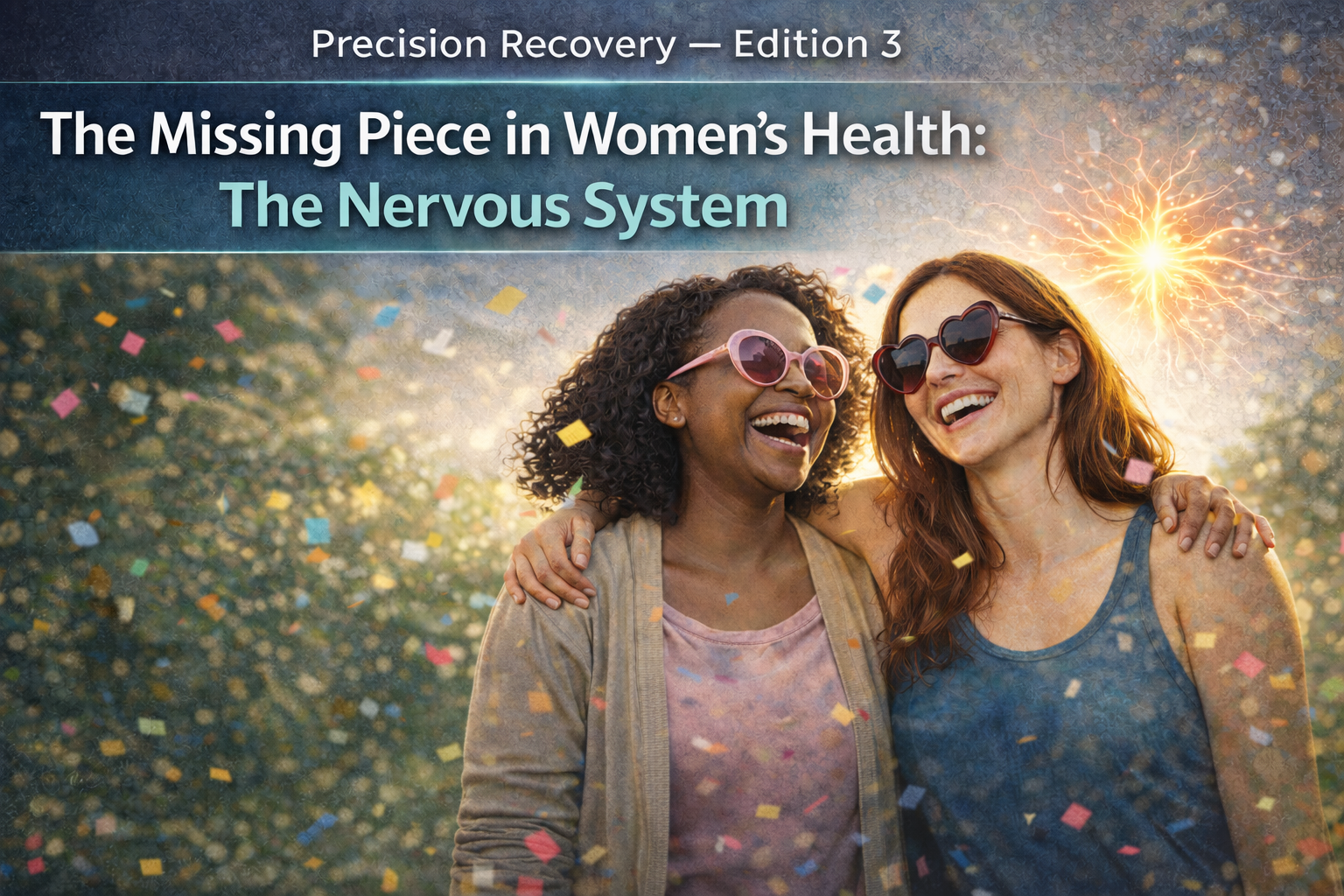
Over the past few months I began to notice something curious.
A growing number of women were ordering SONA, and when I started speaking with them it quickly became clear that many of them were looking for help with the same underlying problem. Their diagnoses were often completely different, fatigue, autoimmune disease, anxiety, perimenopause, long COVID, yet the way they described what was happening inside their bodies sounded remarkably similar.
One woman told me she felt as if her system had lost the ability to switch off. Another said her body seemed permanently “on”, as though an alarm somewhere deep inside her had been triggered years ago and no one had remembered where the off switch was. Several described months, sometimes years, of searching for explanations before quietly giving up on the healthcare system altogether. Not because they didn’t want answers, but because too often they had been told nothing was wrong.
That loss of trust came up again and again in our conversations. Many of these women were not ordering SONA because a doctor had recommended it. Quite the opposite. They were doing so because, after years of feeling dismissed or misunderstood, they had started looking for ways to understand their bodies themselves.
As a scientist, moments like this always make my ears prick up. When people with completely different diagnoses begin describing the same underlying experience, it usually means there is a deeper pattern hiding somewhere in the background.
So I began asking more questions.
And slowly a picture began to emerge.
The pattern did not sit neatly inside any one medical specialty. It crossed the boundaries between immunology, endocrinology, neurology and psychiatry. But when I stepped back and looked at the whole picture, one system kept appearing at the centre of it all.
The nervous system.
Once you start looking at women’s health through the lens of the nervous system, a number of things suddenly become difficult to ignore.
Autoimmune diseases affect women roughly four times more often than men. In conditions like lupus or Sjögren’s syndrome the ratio climbs closer to nine to one. Chronic fatigue syndrome affects far more women than men. Fibromyalgia is overwhelmingly female. Even long COVID, particularly the kind that involves lingering fatigue, dizziness and heart palpitations, shows a strong female skew.
For years medicine has tried to explain these differences in pieces, hormones here, immune function there, psychology somewhere else. But increasingly researchers are beginning to suspect that something more fundamental may be involved.
The control system of the body itself.
Most of us are used to thinking about health in terms of organs. The heart, the thyroid, the immune system, the gut. But running quietly underneath all of those systems is something far more powerful: the autonomic nervous system. It is the body’s master regulator, the network that continuously adjusts heart rate, blood pressure, inflammation, digestion, metabolism and sleep without us ever consciously thinking about it.
At the centre of this system is the vagus nerve, one of the most fascinating structures in human biology. It runs like a communication highway between brain and body, carrying information back and forth between organs and the brainstem. What many people don’t realise is that about eighty percent of the fibres in the vagus nerve carry information from the body to the brain, not the other way around. In other words, the brain spends a remarkable amount of time listening to signals coming from the body.
When this system is working well, it gives the body extraordinary flexibility. We can mobilise energy when needed and then return to a calm, restorative state afterwards. The heart rate slows, digestion resumes, inflammation settles, sleep deepens.
But when the nervous system loses that flexibility, something subtle but profound happens. The body begins to live in a state that biologists sometimes describe as sympathetic dominance, a nervous system tilted permanently toward alertness and survival.
The engine is always running.
And engines that never switch off eventually start to break things.
Female biology adds another layer to this picture, and it is one that medicine has historically underestimated.
Hormones don’t just influence reproduction; they interact directly with the nervous system. Estrogen, for example, enhances vagal tone, one reason women often show higher heart rate variability than men. Heart rate variability, or HRV, is one of the clearest indicators scientists have of how flexible and resilient the nervous system is.
But hormones are not static. They rise and fall across the menstrual cycle in a carefully choreographed rhythm. During the luteal phase, after ovulation, estrogen drops and progesterone rises. For many women this temporarily reduces vagal tone, nudging the nervous system toward a more activated state.
For someone with a robust nervous system this fluctuation is barely noticeable.
But for someone already carrying chronic stress, trauma or inflammation, that monthly shift can push the system closer to instability. Suddenly the week before menstruation feels like the body has become someone else’s.
What we casually call PMS may sometimes be the nervous system briefly losing its balance.
The immune system also joins the story in surprising ways.
Women generally mount stronger immune responses than men. In evolutionary terms this is helpful; historically it made women more resilient to infection. But stronger immune responses also come with a downside. Sometimes the immune system becomes too vigilant.
Imagine a guard dog that has been trained to protect the house. Now imagine the trainer disappears. The dog continues doing its job, only now it barks at everything.
In autoimmune disease the immune system begins attacking the body’s own tissues. And increasingly researchers are finding that the vagus nerve, which normally helps regulate immune activity, plays a crucial role in keeping that guard dog calm.
When the nervous system loses its regulatory influence, the immune system can become jumpy and unpredictable.
Then comes perimenopause, one of the most misunderstood transitions in medicine.
For decades estrogen has quietly supported the nervous system. Then, sometimes quite suddenly, that hormonal support becomes erratic. Some days estrogen surges. Some days it crashes.
The nervous system, which has relied on that stability for years, now has to recalibrate in real time.
Many women describe this period as though their bodies have been taken over by a mischievous electrical engineer. Sleep stops behaving. The heart occasionally races for no obvious reason. Hot flashes appear out of nowhere. Brain fog rolls in like a weather system that refuses to leave.
Seen through the lens of the nervous system, these symptoms begin to make a different kind of sense. They are signals of a regulatory system trying, and sometimes struggling, to find a new equilibrium.
Another thread that runs quietly through many women’s health stories is trauma.
Women experience certain forms of trauma, particularly sexual violence and intimate partner abuse, at disproportionately high rates. Trauma doesn’t simply leave emotional memories behind; it reshapes the nervous system itself.
The neuroscientist Stephen Porges describes this through his polyvagal theory, which explains how trauma can push the nervous system into persistent states of hypervigilance or shutdown. For many people living with complex trauma, the nervous system never fully learns what safety feels like.
It remains watchful.
And a nervous system that remains watchful for years has very little energy left for healing.
The frustrating part of this story is that modern medicine rarely measures the nervous system directly.
Most tests focus on chemistry, hormones, inflammatory markers, thyroid levels. These measurements are useful, but they only tell part of the story.
Regulation is something different.
A person can have perfectly normal blood tests and still have a nervous system that has lost much of its flexibility. One of the simplest ways to see this is through heart rate variability. Low HRV is increasingly recognised as a marker of nervous system strain, and it shows up again and again in conditions such as chronic fatigue, depression, autoimmune disease and long COVID.
It is as though the body’s control system has quietly lost its ability to stabilise itself.
The encouraging part of all this is that the nervous system is remarkably adaptable.
It learns.
It rewires.
And when the nervous system begins to stabilise again, the body often follows. Sleep deepens. Energy slowly returns. Inflammation begins to settle. The system remembers how to regulate itself.
The body, after all, is not fragile.
It is adaptive.
But like any complex system, it needs the right signals to find its balance again.
If there is one idea I hope readers take away from this blog, Your body is not broken. Sometimes it is simply stuck in a pattern that no longer serves it. And patterns, especially biological ones, can change.
Next month we’ll explore another emerging mystery in nervous system health: why some people recover from COVID in days while others remain ill for months or even years.
Until then, take care of your nervous system.
It is quietly running far more of your life than you might think.
Jane Ollis
Founder, SONA
If this article resonated with you, feel free to share it with someone whose nervous system might be asking for a reset.


Share:
The Inflammation Connection: Why Your Immune System Won't Turn Off
Best Conductive Gels for Vagus Nerve Stimulation: 4 Tony-Approved Picks (2026)