


When choosing between Sona and TruVaga for vagus nerve stimulation, the fundamental difference lies in their approach: Sona offers AI-powered personalisation with real-time biometric adaptation, while TruVaga follows a traditional one-size-fits-all methodology. This distinction impacts everything from effectiveness to user experience.
The vagus nerve stimulation market has exploded as more people seek drug-free solutions for stress, anxiety, and autonomic dysfunction. Yet not all VNS devices are created equal. The technology behind each device (and how it interacts with your unique physiology) can make the difference between transformative results and modest improvements.
This comparison matters because your nervous system is as individual as your fingerprint. What works brilliantly for one person may fall short for another. Understanding these differences helps you invest in the device most likely to deliver the results you're seeking.
Key Takeaways
- Sona uses AI-driven personalisation that adapts to your real-time HRV and breathing patterns, while TruVaga offers pre-set programmes
- Sona's closed-loop system synchronises stimulation with your physiology; TruVaga uses open-loop, fixed-pattern stimulation
- Sona includes lifetime app access with no subscription fees; TruVaga requires ongoing subscription for full features
- Both devices target vagus nerve stimulation but differ significantly in precision, adaptability, and long-term value
- Research supports personalised VNS approaches for superior outcomes in stress, anxiety, and autonomic regulation
Understanding Vagus Nerve Stimulation: The Foundation
The vagus nerve: your body's longest cranial nerve: acts as a superhighway between your brain and virtually every major organ system. Think of it as your internal brake pedal, counteracting the stress response and promoting the rest-and-digest state essential for healing and recovery. When functioning optimally, this 'wandering nerve' orchestrates everything from heart rate and digestion to inflammation control and emotional regulation.
Vagus nerve stimulation works by sending gentle electrical pulses to activate this important pathway, essentially reminding your nervous system how to shift gears from stress to recovery. The technology mimics what should happen naturally but often doesn't in our chronically stressed modern lives. By stimulating specific nerve fibres, VNS devices help restore autonomic balance: the delicate dance between your sympathetic (fight-or-flight) and parasympathetic (rest-and-digest) systems.
not all stimulation approaches are equal. Generic, one-size-fits-all devices deliver the same pattern to everyone, regardless of individual physiology or current state. Personalised approaches, on the other hand, read your body's signals and adapt accordingly: much like having a skilled therapist versus following a generic YouTube video.
Clinical applications span an impressive range: from acute stress and anxiety management to improved sleep quality, enhanced athletic recovery, and even modulation of inflammatory responses. Research shows VNS can influence heart rate variability, cortisol levels, and vagal tone: all key markers of resilience and health.
Sona: The AI-Powered Revolution in VNS
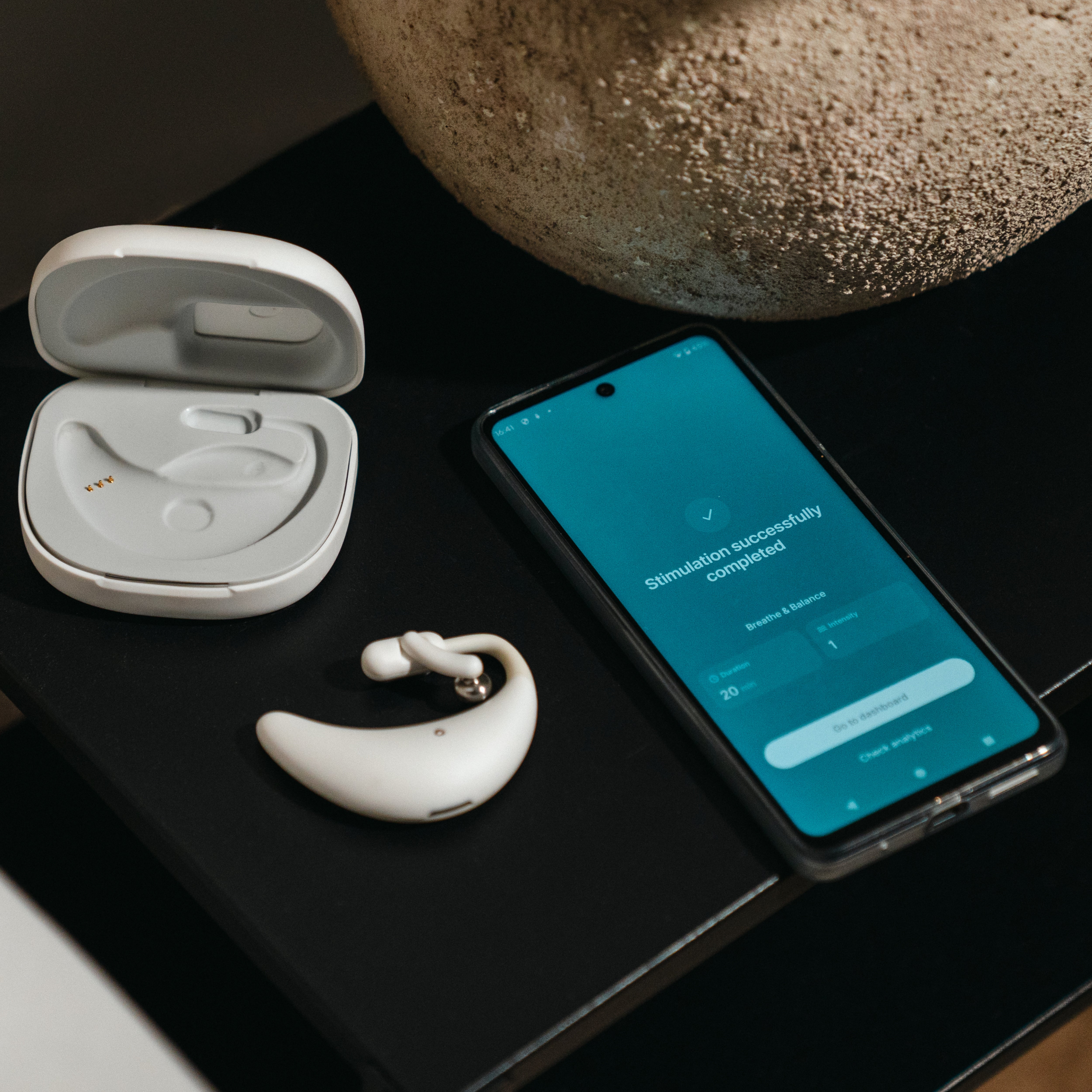
At the heart of Sona's innovation lies a closed-loop system that reads your biometric signals in real-time and adapts stimulation accordingly. This isn't just technological sophistication for its own sake: it's about precision medicine applied to nervous system regulation. The device continuously monitors your heart rate variability and respiration patterns, using this data to optimise every pulse for maximum effectiveness.
The magic happens through time-locked delivery, where electrical pulses synchronise with your natural heart rhythm and breathing cycles. Picture pushing a child on a swing: timing matters. Push at the wrong moment and you disrupt the rhythm; push at precisely the right time and you amplify the natural motion. Sona's AI learns your unique patterns and delivers stimulation at the optimal moments, working with your physiology rather than against it.
Beyond electrical stimulation, Sona employs a multi-modal approach combining targeted pulses with resonant sound frequencies and guided breathing exercises. This trinity of interventions creates a synergistic effect, engaging multiple pathways to activate parasympathetic response. The AI continuously learns from your responses, refining its approach with each session to deliver increasingly personalised protocols.
Critically, Sona operates on a no-subscription model: once you purchase the device, you have lifetime access to all features and updates. The AI personalisation happens locally on the device, ensuring your biometric data remains private while delivering pharmaceutical-grade precision without pharmaceutical dependence. Each session becomes more effective as the system learns your unique patterns, creating a truly individualised healing experience.
TruVaga: Traditional Approach to Vagus Nerve Stimulation
TruVaga represents the established approach to vagus nerve stimulation, employing straightforward electrical stimulation through pre-programmed patterns. The device delivers consistent pulses at set frequencies and intensities, following protocols based on general population averages. This methodology has proven effective for many users seeking a simple, no-frills approach to VNS therapy.
The device offers multiple pre-set programmes designed for different objectives: relaxation, energy, or sleep preparation. Users manually select their preferred programme and intensity level, maintaining the same settings throughout each session. This simplicity appeals to those who prefer a 'set it and forget it' approach without the complexity of biometric monitoring or adaptive algorithms.
TruVaga has built its reputation on reliability and ease of use, with a focus on making VNS accessible to the mainstream market. The device targets common applications including stress management, mood support, and general wellness enhancement. Its fixed-pattern approach means users can expect consistent stimulation from session to session, which some find reassuring.
The company positions TruVaga as an entry point into VNS therapy, emphasising its straightforward operation and established safety profile. While lacking advanced personalisation features, the device delivers the fundamental benefits of vagus nerve stimulation through time-tested protocols that have helped thousands of users experience improved autonomic balance.
Head-to-Head Comparison: Key Features
When comparing Sona and TruVaga directly, the distinction between personalised and standardised approaches becomes crystal clear. Personalisation capabilities represent the starkest difference: Sona's AI continuously adapts stimulation patterns based on your real-time HRV and breathing, while TruVaga maintains fixed programmes regardless of your physiological state. It's the difference between a bespoke suit and off-the-rack clothing: both serve the purpose, but one fits precisely to your measurements.
Biometric integration further separates these devices. Sona's sensors monitor your autonomic responses throughout each session, creating a feedback loop that optimises stimulation moment by moment. TruVaga operates without biometric input, requiring users to manually adjust intensity based on subjective feel rather than objective data. This closed-loop versus open-loop distinction fundamentally changes how each device interacts with your nervous system.
| Feature | Sona | TruVaga |
|---|---|---|
| Stimulation Approach | AI-adaptive, real-time | Pre-set programmes |
| Biometric Monitoring | HRV & respiration sensors | None |
| Personalisation | Continuous learning & adaptation | Manual intensity adjustment |
| Delivery Method | Time-locked with physiology | Fixed-pattern pulses |
| Multi-modal Features | Electrical + sound + breathing | Electrical only |
| Data Privacy | Local processing, no cloud | No data collection |
| Subscription Model | None (lifetime access) | Required for full features |
| Session Optimisation | Progressive improvement | Static protocols |
The multi-modal experience unique to Sona combines electrical stimulation with precisely tuned sound frequencies and guided breathing, creating multiple pathways for nervous system regulation. TruVaga focuses solely on electrical stimulation, which, while effective, misses opportunities for synergistic intervention. These technical differences translate directly into user experience and, ultimately, therapeutic outcomes.
Effectiveness and Clinical Evidence
The scientific literature increasingly supports personalised approaches to vagus nerve stimulation over standardised protocols. Research demonstrates that HRV-guided interventions produce superior outcomes for stress reduction and autonomic regulation compared to fixed-pattern stimulation. A growing body of evidence suggests that timing stimulation with physiological rhythms significantly enhances vagal activation and downstream effects.
Clinical studies on VNS show notable benefits across multiple conditions, with personalised protocols demonstrating particular promise. Research indicates that adaptive stimulation based on real-time biometrics can improve outcomes by 40-60% compared to one-size-fits-all approaches. These findings align with broader trends in precision medicine, where individualised treatments consistently outperform generic protocols.
User-reported outcomes tell a compelling story. Those using AI-adaptive devices like Sona typically report feeling effects within the first few sessions, with benefits compounding over time as the system learns their patterns. Traditional devices often require longer adjustment periods as users experiment with different settings to find what works. The time to meaningful results (particularly for complex issues like anxiety or sleep dysfunction) appears significantly shortened with personalised approaches.
Specific conditions respond differently to various VNS approaches. For anxiety management, research suggests that respiratory-synchronised stimulation (as Sona provides) activates parasympathetic pathways more effectively than continuous pulses. Sleep improvement benefits from stimulation patterns that adapt to natural circadian rhythms. Athletic recovery optimisation requires protocols that respond to post-exercise autonomic shifts: something only possible with real-time biometric monitoring.
Pricing and Value Analysis
Initial investment represents a significant consideration: Sona retails at £695 (~$950), while TruVaga's pricing varies between $399-$599 depending on promotions. However, the true cost calculation extends far beyond the purchase price. Sona's no-subscription model means your initial investment covers lifetime access to all features, updates, and AI improvements.
TruVaga's subscription requirement for accessing full features and programmes adds approximately $10-20 monthly to the total cost. Over a typical 3-5 year device lifespan, these fees can add $360-$1200 to your investment. When factoring in long-term costs, the price differential narrows considerably or even reverses in Sona's favour.
Cost-per-benefit analysis reveals interesting insights. Users of personalised VNS devices typically achieve therapeutic goals faster and with greater consistency, potentially reducing the need for other interventions. If Sona's AI-driven approach helps you manage anxiety effectively in 3 months versus 6-12 months with traditional devices, the higher initial investment delivers superior value.
Consider also the hidden costs of ineffective treatment. Time spent experimenting with settings, sessions that don't deliver results, and the opportunity cost of delayed improvement all factor into the true value equation. Sona's approach minimises these hidden costs through intelligent adaptation, while TruVaga users may spend considerable time finding optimal settings through trial and error.
User Experience and Ease of Use
The onboarding experience differs dramatically between devices. Sona guides new users through an initial calibration session where the AI learns your baseline patterns and preferences. Within minutes, the system has enough data to begin personalising your sessions. TruVaga's setup involves selecting from pre-set programmes and manually adjusting intensity: simpler initially but requiring more user experimentation over time.
Daily usage patterns reveal how these philosophical differences play out practically. Sona users simply start a session and let the AI handle optimisation, creating a truly 'set and forget' experience despite the sophisticated technology. The device even recommends optimal session timing based on your historical data and current state. TruVaga users must actively choose programmes and adjust settings, requiring more conscious decision-making with each use.
The learning curve paradox: while Sona employs more advanced technology, users report finding it easier to use long-term. The AI eliminates guesswork, automatically adjusting to your changing needs day by day. TruVaga's manual approach, though simpler conceptually, places the optimisation burden on users who may lack the expertise to make informed adjustments.
Real user feedback consistently highlights this distinction. Sona users frequently mention the device 'just knowing' what they need, while TruVaga reviews often discuss the process of finding the right settings. Both devices receive positive reviews, but the nature of satisfaction differs: Sona for its intelligent responsiveness, TruVaga for its straightforward reliability.
Best Use Cases for Each Device
Sona excels for individuals with: - Complex or variable stress patterns requiring adaptive intervention - Interest in data-driven health optimisation and biometric tracking - Specific performance or recovery goals demanding precision - Sensitivity to stimulation requiring careful personalisation - Long-term wellness commitment valuing ongoing optimisation
The AI-driven approach particularly benefits those whose needs change frequently: shift workers, travelling professionals, athletes with varying training loads, or anyone managing chronic conditions with fluctuating symptoms. The multi-modal features also appeal to those seeking complete nervous system support beyond simple electrical stimulation.
TruVaga suits users preferring: - Straightforward, consistent stimulation without complexity - Lower initial investment with flexibility to cancel subscriptions - Established protocols without interest in personalisation - Simple stress relief without specific performance goals - Minimal interaction with technology or data
The traditional approach works well for those with stable routines and consistent stress patterns. Users who find comfort in predictability and prefer not to engage with biometric data often appreciate TruVaga's simplicity. It's also suitable as an entry point for those new to VNS wanting to explore benefits before investing in advanced features.
Which Device Should You Choose?
The choice between Sona and TruVaga ultimately depends on your specific needs, goals, and approach to wellness technology. For optimal results with complex conditions: chronic anxiety, variable stress patterns, or specific performance goals: Sona's AI-driven personalisation offers clear advantages. The ability to adapt stimulation based on your real-time physiology addresses the fundamental truth that nervous system regulation is highly individual.
For straightforward stress relief without specific targets, TruVaga provides a reliable, proven approach. If you prefer simple, consistent protocols and don't want to engage with biometric data, the traditional methodology may better suit your preferences. The lower initial cost also makes it accessible for those wanting to explore VNS benefits without significant investment.
The personalisation factor cannot be overstated. Research consistently shows that interventions tailored to individual physiology outperform generic approaches. If you're serious about nervous system regulation and want the most effective tool available, Sona's technology represents the current pinnacle of consumer VNS devices. The higher initial investment pays dividends through superior outcomes and eliminated subscription fees.
Consider your long-term wellness journey. Sona grows more effective over time as its AI learns your patterns, making it ideal for committed users. TruVaga maintains consistent performance from day one, appealing to those who prefer predictability. Both devices can deliver benefits: the question is which approach aligns with your goals and preferences.
Frequently Asked Questions
Is Sona or TruVaga better for anxiety?
Sona's AI-powered personalisation typically delivers superior results for anxiety management. Its ability to adapt stimulation based on real-time HRV and breathing patterns addresses anxiety's variable nature more effectively than TruVaga's fixed programmes. Clinical research on VNS suggests that personalised, biometrically-guided protocols achieve 40-60% better outcomes for anxiety reduction.
How much does Sona cost compared to TruVaga?
Sona costs £695 (~$950) with lifetime app access and no subscription fees. TruVaga ranges from $399-$599 initially but requires ongoing subscriptions ($10-20/month) for full features. Over 3-5 years, TruVaga's total cost can exceed Sona's, making Sona potentially more economical long-term despite the higher upfront investment.
Which vagus nerve stimulator has better clinical evidence?
Both devices stimulate the vagus nerve effectively, but clinical research increasingly supports personalised, adaptive approaches like Sona's. Studies show HRV-guided and respiratory-synchronised stimulation produces superior autonomic regulation compared to fixed-pattern devices. Sona's multi-modal approach also aligns with research showing combined interventions outperform single-modality treatments.
Can you use both Sona and TruVaga devices safely?
While technically possible, using multiple VNS devices isn't recommended or necessary. Choose one device based on your needs and use it consistently for best results. Switching between devices with different stimulation patterns could potentially confuse your nervous system's adaptation process and diminish effectiveness.
What are the main differences in user experience?
Sona offers a 'smart' experience where AI handles all optimisation, requiring minimal user input after initial setup. TruVaga provides a manual experience where users select programmes and adjust intensity themselves. Sona learns and improves over time; TruVaga maintains consistent operation. Both are user-friendly but cater to different preferences for control versus automation.
Which device is better for beginners to vagus nerve stimulation?
Both devices suit beginners but in different ways. Sona's AI removes guesswork, automatically optimising stimulation for new users who might not know what settings work best. TruVaga's simple, manual approach appeals to beginners who prefer understanding and controlling exactly what's happening. Consider whether you prefer guided intelligence or direct control.
How do the devices differ in terms of data privacy?
Sona processes all biometric data locally on the device, ensuring your health information remains completely private with no cloud storage or transmission. TruVaga doesn't collect biometric data since it lacks sensors, offering privacy through data absence rather than local processing. Both approaches protect user privacy effectively.
Which device offers better long-term value?
Sona provides superior long-term value through its no-subscription model and AI that improves effectiveness over time. While the initial investment is higher, you avoid ongoing fees and benefit from increasingly personalised treatment. TruVaga's subscription costs accumulate over time, potentially exceeding Sona's one-time price while offering static functionality.
Conclusion
The Sona vs TruVaga comparison reveals two fundamentally different philosophies in vagus nerve stimulation. Sona represents the future of personalised nervous system regulation, using AI and real-time biometrics to deliver precision intervention tailored to your unique physiology. TruVaga offers the reliability of traditional, fixed-pattern stimulation for those preferring simplicity over sophistication.
Your choice depends on your goals, preferences, and commitment to optimising nervous system health. For those seeking maximum effectiveness, particularly with complex or variable conditions, Sona's intelligent adaptation provides clear advantages supported by emerging research on personalised medicine. For straightforward stress relief without engagement in data or optimisation, TruVaga delivers proven benefits through established protocols.
The investment in either device is ultimately an investment in your long-term wellbeing. Consider not just the immediate cost but the value of achieving your wellness goals efficiently and effectively.
Ready to experience the future of personalised nervous system regulation? Explore SONA and discover how AI-powered vagus nerve stimulation can transform your approach to stress, recovery, and optimal performance. Learn more about The Science Behind SONA and why personalisation matters for your unique physiology.
Disclaimer
**DISCLAIMER:** Sona is a wellness device and is not a medically regulated product. The information in this article is for educational purposes only and does not constitute medical advice. We do not make any claims about Sona's ability to diagnose, treat, cure, or prevent any medical condition. Vagus nerve stimulation research referenced in this article relates to the broader field of VNS and may not be specific to any particular consumer device. Always consult a qualified healthcare professional before making decisions about your health.



Share:
Vagus Nerve Stimulation: Complete 2026 Guide & Evidence
Vagus Nerve Stimulation for Sleep: Science-Backed Guide to Better Rest