

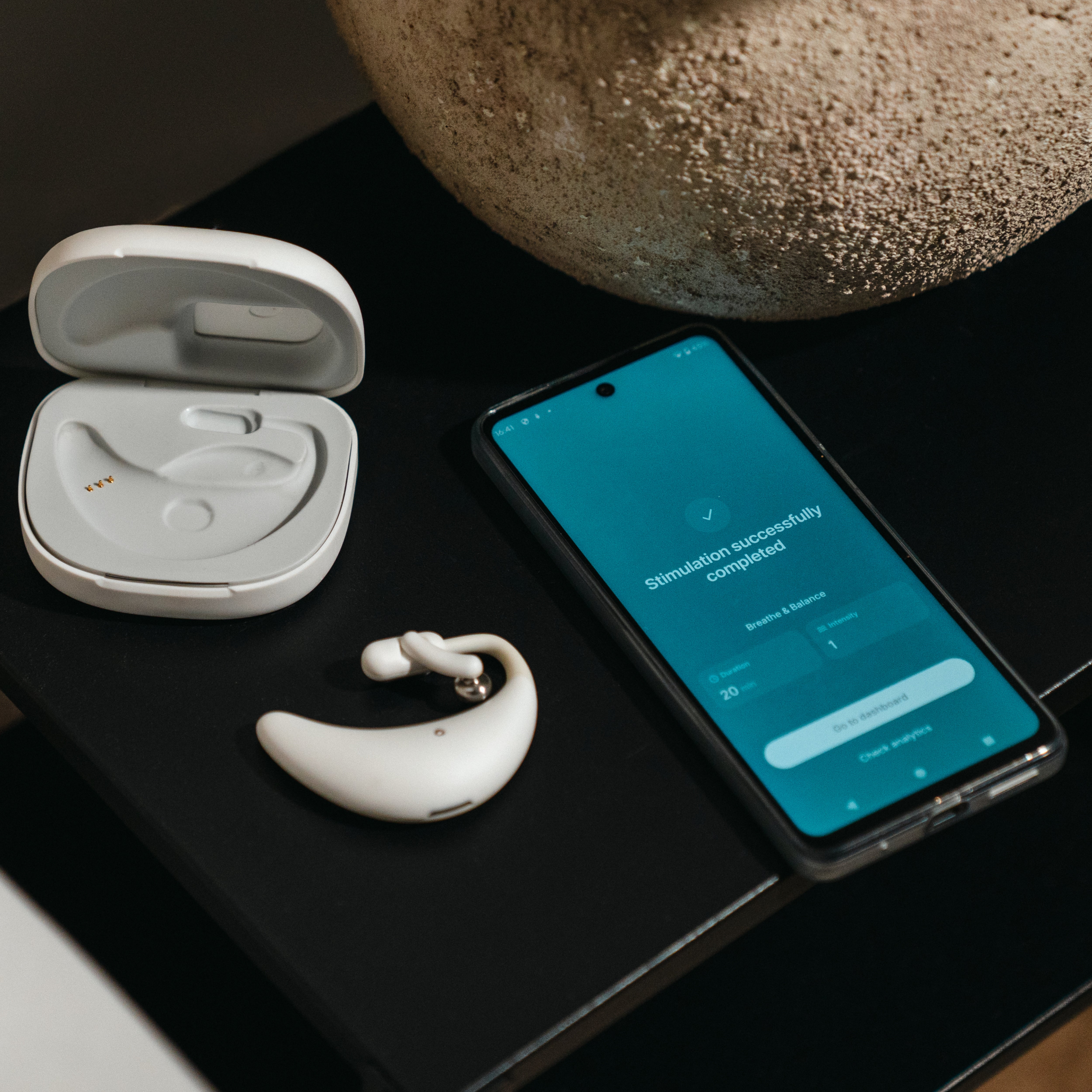
The best conductive gel for SONA is a water-based, pH-balanced electrode gel made for microcurrent or TENS use, ideally in a pump bottle. Our chief scientist Tony Steffert has tested most of what's on the market. Four options stand out, one per region: bleu&marine BRETANIA Conductive Gel 500 ml (UK and France), Nozerix Microcurrent Conductive Gel 300 g (US), and Promed Tensive Electrode Gel 50 g (Australia).
This guide covers why the gel matters for transcutaneous vagus nerve stimulation (tVNS), what to check on a listing before you buy, how to apply it with SONA, and where to buy each option. Amazon prices move around, so we link straight to the listings.
Key takeaways
- Use a water-based, pH-balanced gel made for microcurrent, EMS or TENS. Skip ultrasound coupling gel, aloe vera and lubricant.
- Pump bottles cost slightly more than tubes but stay clean and free up a hand. Worth it for daily use.
- A 500 ml bottle lasts 6 to 12 months at one daily SONA session. 50 g tubes are travel-sized, 4 to 8 weeks.
- Buy from your nearest Amazon. The same product can vary by 30 to 50% once duties and shipping are in.
- Tony's daily pick is whichever 500 ml or 300 g pump bottle is local to you. Ten20 paste and PPG sensor gel are different categories; we cover them briefly at the end.
Why conductive gel matters for SONA
SONA delivers transcutaneous vagus nerve stimulation through electrodes that sit on the skin. The job of the gel is to give that stimulation a low-impedance path from the electrode into the tissue. Without enough gel, or with the wrong kind, you get higher skin impedance, hot spots under the electrode, an unstable signal, and a sensation that ranges from "fizzy" to genuinely uncomfortable.
Skin on its own is a poor conductor compared with the tissue underneath. A water-based gel with dissolved salts (usually sodium chloride or potassium chloride) drops contact impedance by an order of magnitude, spreads the current evenly across the electrode, and keeps the interface stable while you move. It's the same physics that makes electrode gel essential in clinical EEG and ECG, which is why the best products come from medical, beauty and sports-rehab supply chains rather than from wellness brands.
Comfort and longevity matter as much as signal quality. A dry contact pushes you to higher amplitudes for the same vagal response, and over months that means more skin irritation and less consistent training. A few millilitres of the right gel per session is the cheapest upgrade you can make to SONA.
Quick comparison: conductive gels for SONA, by region
| Region | Product | Format | Size | Approx. price | Why we like it | Buy |
|---|---|---|---|---|---|---|
| UK | bleu&marine BRETANIA Conductive Gel | Pump bottle | 500 ml | ~£13–15 | Skin-friendly pH, strong conductivity, made in France, lasts the longest of the four | Amazon UK |
| France & EU | bleu&marine BRETANIA Conductive Gel | Pump bottle | 500 ml | ~€15 | Same product as the UK listing, often cheaper at source | Amazon France |
| US | Nozerix Microcurrent Conductive Gel | Pump bottle | 300 g | ~$15–20 | The cleanest pump dispenser of the four; conducts well and moisturises | Amazon US |
| Australia | Promed Tensive Electrode Gel | Tube | 50 g | ~A$22 | The only readily available local option; built for TENS pads, works fine for tVNS | Amazon Australia |
Prices last sampled 2026-05-07 and may have moved. Click through for current local pricing.
UK and France: bleu&marine BRETANIA Conductive Gel (500 ml)

This is the bottle Tony reaches for first in our UK lab. It's sold as a professional beauty-device gel for radio-frequency, microcurrent, ultrasound, electrolysis and cavitation, which means it's formulated to a higher conductivity standard than the generic "ultrasound gel" you find on a pharmacy shelf. The 500 ml pump is the cheapest option per ml, and it lasts the longest before it runs out.
What it has going for it:
- Strong conductivity, formulated for microcurrent and RF.
- Skin-friendly pH; safe for daily use.
- Slow absorption, so the gel stays put through a full session.
- Repositions cleanly if you adjust the electrode partway through.
- Made in France, short ship to UK and EU buyers.

Where to buy: Amazon UK · Amazon France
US: Nozerix Microcurrent Conductive Gel (300 g pump)

For US users, Nozerix is the easiest of the four to get hold of. It ships in a 300 g pump dispenser, which is a small detail until you've spent a week trying to apply gel one-handed at 6am out of a tube; after that, the pump starts to feel like the whole point. The base is built for facial microcurrent and EMS, so it conducts well, leaves no residue, and is more hydrating on the skin than the bleu&marine option.
Quick reasons it works for SONA:
- High conductivity for microcurrent devices.
- Hydrating base, useful if you have dry skin around the electrode site.
- Pump dispenser; one-handed application.
- 300 g lasts roughly 4 to 6 months of daily use.
Where to buy: Amazon US
Australia: Promed Tensive Electrode Gel (50 g)
Australia is the awkward region for this category. Pump-dispenser microcurrent gels rarely ship locally, and the ones that do are marked up enough that the imports are no bargain. The Promed Tensive 50 g tube is what Tony points AU-based users at. It's made for TENS and EMS electrode pads, which is the closest medical-grade analogue to tVNS, and 50 g lasts several months at one daily session. It's a tube, so squeeze a small bead onto the electrode itself, not the skin.
Why it works for SONA:
- Built for electrode pads (TENS and EMS), which is the same use case as tVNS.
- Stable conductivity over the life of the tube.
- Compact, good for travel.
Where to buy: Amazon Australia
How to choose a conductive gel for SONA (or any tVNS device)
If you want to source a different product to the four above, four properties tell you whether it'll work. Get all four right and you have a SONA-compatible gel. Miss one and you can end up with something that performs worse than the bare electrode.
- Water-based, not silicone-based. Conductivity comes from the water and the dissolved salts in it. Silicone-based ultrasound coupling gels are designed for sound-wave transmission, not electrical current; they reduce SONA's effective amplitude rather than helping it.
- pH 5.5 to 7.0. Skin sits around pH 5.5. Anything strongly acidic or alkaline will sting under the electrode and risk irritation with daily use.
- Listed for microcurrent, EMS, TENS or RF. If a listing only mentions ultrasound, hair removal or facial massage, look for a separate microcurrent rating in the description before you buy.
- No added perfume or active ingredients. Skip gels with hyaluronic acid, retinol, vitamin C or essential oils. Those react in unpredictable ways once you put a current across them.
How to apply conductive gel with SONA
Tony's protocol for the cleanest signal:
- Clean the skin. Wipe the electrode site with a damp cloth or alcohol-free cleanser, then let it dry. Heavy moisturiser or sunscreen lowers conductivity.
- Pea-sized bead. About 0.5 ml on the electrode pad, not on the skin. This keeps the gel where the current flows.
- Spread thinly. A clean fingertip across the conductive face of the electrode. You want a thin, even film, not a puddle.
- Place and hold. Press SONA into position with steady contact for 5 to 10 seconds before you start the session, so the gel forms a stable interface.
- Wipe down after. Gel residue oxidises on the electrode over time. A dry cloth after each session is enough.
If a SONA session feels noticeably more "tingly" or sharp than usual, it's almost always a gel problem: too little, dried out, or the wrong pH. Re-apply, and the sensation should smooth out within a minute.
Related gels: Ten20 conductive paste and PPG sensor coupling gel
Tony's full kit includes two specialist products that are related to the four above but aren't direct substitutes for everyday SONA use:
- Ten20 Conductive Paste. A thicker paste rather than a gel, used in clinical EEG and long-recording protocols where the electrode needs to stay glued in place for hours. Overkill for a daily SONA session, useful if you're running an experiment or a research recording.
- PPG Sensor Coupling Gel. A different category of optical-coupling gel for photoplethysmography sensors (the green-light HRV sensors on smartwatches and chest straps). It's for measuring HRV, not for delivering tVNS. Different physics, different product.
We'll publish standalone notes on each of these soon. For everyday SONA use, the four gels above are what you want.
Frequently asked questions
Can I use ultrasound gel with SONA?
Some ultrasound gels are conductive, but most are formulated for acoustic transmission rather than electrical current. The bleu&marine BRETANIA gel is sold as multi-purpose for ultrasound and microcurrent, which is fine. Avoid pure acoustic-coupling ultrasound gel; it gives a weaker, less stable tVNS signal.
Can I use aloe vera gel or KY jelly?
No. Aloe vera contains plant compounds that can irritate skin under electrical stimulation, and personal lubricants are designed to reduce friction, not to pass current. Use a purpose-made conductive gel.
How long does a 500 ml bottle last?
Roughly 6 to 12 months of daily SONA use, assuming a pea-sized 0.5 ml application per session. Travel-sized 50 g tubes last around 4 to 8 weeks at the same usage.
Is conductive gel safe for daily use?
The four gels listed here are designed for daily microcurrent, EMS or TENS use and are non-irritant on healthy intact skin. Don't apply to broken skin, acne lesions or sunburn, and stop using if you see persistent redness.
Does SONA work without gel?
It does, but skin impedance is much higher dry, so you'll need a higher amplitude for the same vagal response. Over weeks of daily use, gel produces a more comfortable session and a more consistent training signal.
Where can I find conductive gel locally if Amazon is slow?
Microcurrent and EMS gels are stocked by professional beauty suppliers, physiotherapy clinics and sports-medicine retailers. Search for "microcurrent conductive gel" or "TENS electrode gel" plus your city. Avoid pharmacies that only stock ultrasound gel.
The bottom line
The right conductive gel makes every SONA session more comfortable and more consistent, and it costs a fraction of the device. UK and EU users want the bleu&marine BRETANIA 500 ml pump for long-term value. US users should reach for the Nozerix 300 g pump. AU users get the Promed Tensive 50 g tube as the cleanest local option. All four are linked above. All four have been tested with SONA.
Already a SONA user? Pair your gel with our timing guide for vagus nerve stimulation and the HRV primer to get the most out of every session.
Disclaimer
DISCLAIMER: Sona is a wellness device and is not a medically regulated product. The information in this article is for educational purposes only and does not constitute medical advice. Product links are affiliate-eligible Amazon listings; we may earn a small commission at no extra cost to you. Always read the manufacturer's instructions for any third-party product before using it with SONA, and consult a qualified healthcare professional if you have skin conditions, implanted electrical devices, or any concerns about electrical stimulation.




Share:
The Missing Piece in Women’s Health: The Nervous System