


Sona is a wireless AI-powered ear cuff that adapts vagus nerve stimulation to your physiology in real-time, while Nurosym uses a handheld control unit wired to an ear clip for fixed-parameter stimulation. Sona pairs with AirPods or in-ear headphones for multi-modal sessions combining electrical stimulation, sound, and breath guidance. Nurosym offers straightforward, standalone electrical stimulation with no app required.
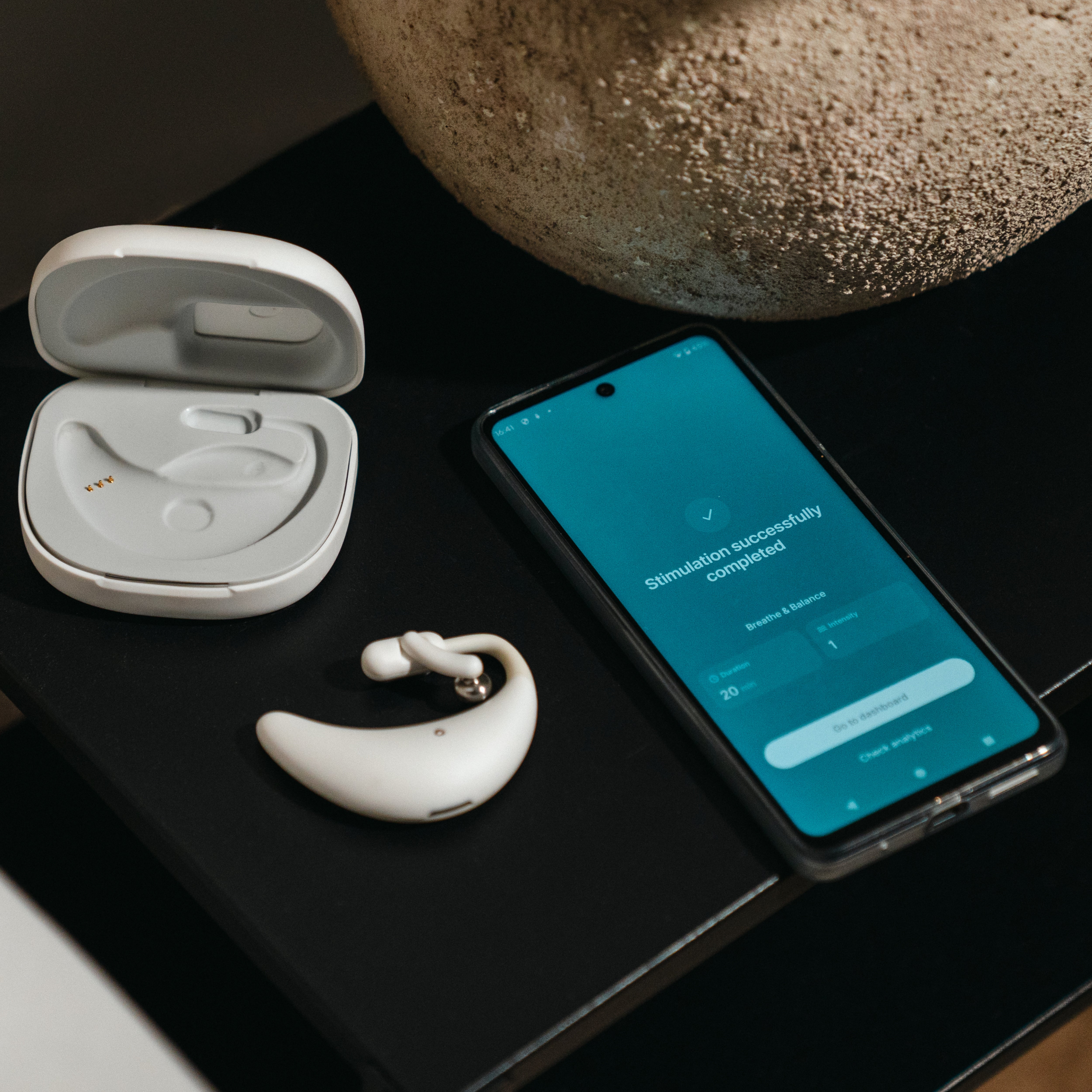
Sona and Nurosym are both transcutaneous auricular vagus nerve stimulators, but their designs and user experiences are fundamentally different. Sona is a single wireless ear cuff — looking more like modern jewellery than a medical device — that connects to a companion app via Bluetooth and uses AI to adapt stimulation in real-time. Nurosym is a two-piece system with a handheld remote control connected by wire to a clip-on ear electrode, delivering fixed-parameter stimulation without an app. Both target stress reduction and autonomic nervous system regulation, but their form factors, technology, and session experiences differ significantly.
Technology and Personalization Approach
The most significant difference lies in how each device delivers stimulation.
Sona uses a closed-loop AI system with embedded biometric sensors. It reads your heart rate variability and respiratory patterns in real-time, then adjusts stimulation timing, intensity, and pattern to match your physiological state. Each pulse is delivered at the optimal moment in your cardiac cycle, synchronizing with your respiratory and cardiac rhythms for optimized parasympathetic engagement. Over time, this precise stimulation aims to retrain unhealthy neural firing patterns and increase neuroplasticity. The device learns your patterns over time and combines electrical stimulation with synchronised sound and breath guidance through paired headphones.
Nurosym uses an open-loop system with fixed parameters. You set intensity on the handheld remote and the device delivers consistent pulses at that level for the duration of your session. There are no sensors, no adaptive algorithms, and no audio component. This approach offers simplicity and predictability, backed by extensive clinical validation across 50+ studies.
Features and Capabilities Comparison
The physical differences between these devices define the daily user experience.
Sona is a wireless ear cuff with a sculpted rechargeable case that provides 8 full recharges (~20 sessions) — ideal for travel and daily use. No wires, no separate control box, no messy gels — just the device on your ear and the app on your phone. Built-in biometric sensors track HRV and breathing in real-time. Because Sona sits on the outer ear (contacting the cymba concha), you can wear AirPods or any in-ear or over-ear headphones simultaneously for the app’s synchronised soundscapes, guided breathing, mindfulness exercises, Yoga Nidra, nature sounds, and calming music. The app recommends personalized daily programs based on your goals, habits, and biometrics, with real-time and trend-based session analytics to track your progress. Sessions run 10–30 minutes.
Nurosym is a handheld remote with LCD screen and physical buttons, connected by wire to a clip-on electrode for the tragus. The wired design and tragus clip placement make it incompatible with in-ear headphones. You set your intensity and timer manually, dampen the tragus with water, and clip on the electrode. No app, no audio integration, no biometric tracking — just reliable electrical stimulation. Sessions run 15–60 minutes. The electrode is a consumable replaced every 18–24 months.
Both devices use medical-grade materials and hold CE certification. Sona’s higher price (£695 vs Nurosym’s ~€559) reflects its AI engine, multi-modal therapy, and continuous biometric monitoring. Neither requires a subscription.
Pricing and Value Models
The pricing structures reflect the different technological approaches and long-term value propositions of each device.
Scientific Foundation and Clinical Evidence
Both devices build upon established research in vagus nerve stimulation, but their approaches to evidence generation and scientific validation differ.
Sona is built on decades of research and intensive R&D in collaboration with leading neuroscientists. The team includes innovators from University of Oxford, Google, NASA, Neuralink, Princeton University, and the London Institute for Healthcare Engineering. Sona's closed-loop, AI-adaptive approach represents the next generation of taVNS technology, building on the extensive clinical evidence base for electrical auricular stimulation.
Nurosym references over 50 clinical studies supporting its open-loop transcutaneous vagus nerve stimulation approach. Their evidence base is well-established for fixed-parameter stimulation protocols, though these studies use standardized settings rather than individually optimized parameters.
User Experience and Practical Considerations
Setup: Sona takes under a minute — remove from charging case, hook over ear, open app, start session. Nurosym takes a few minutes: dampen tragus, clip on electrode, route wire behind ear, power on remote, dial up intensity manually.
During sessions: Sona’s AI adapts continuously — stimulation intensity shifts with your breathing, pulses synchronise to your heartbeat, and the app layers in audio. With AirPods in, it feels like a guided wellness experience. Nurosym delivers consistent fixed pulses while you read, work, or watch TV.
Portability: Sona’s wireless ear-cuff design is discreet enough for a coffee shop or office — no visible wires, nothing to hold. Nurosym’s wired setup with handheld remote is better suited for home or a desk.
Comfort: Sona’s ear-hook design is described as lightweight and ergonomic — users report forgetting it’s there. Nurosym’s tragus clip takes some experimentation to position correctly in the first few sessions.
Choosing Between Sona and Nurosym
The decision between these devices depends on your preferences for personalization, technological sophistication, and approach to wellness optimization.
Frequently Asked Questions
What is the main difference between Sona and Nurosym?
The primary difference is personalization approach. Sona uses AI to automatically adapt stimulation in real-time based on your HRV and breathing patterns, while Nurosym uses manual settings and fixed protocols that you adjust yourself.
Do both devices require ongoing subscription fees?
Neither device requires subscription fees. Sona costs £695 with lifetime app access included. Nurosym is priced at approximately €559 (around £480), also as a one-time purchase with no ongoing costs.
Which device provides better biometric tracking?
Sona offers comprehensive real-time biometric monitoring including HRV, respiratory patterns, and autonomic responses. Nurosym focuses primarily on stimulation delivery with basic session tracking but without continuous physiological monitoring.
How long does it take to see results with each device?
Both devices may show immediate relaxation effects, but optimization differs. Sona's AI learns your patterns over several sessions for increasing effectiveness. Nurosym requires manual experimentation to find your optimal settings, which may take longer to perfect.
Are there any safety differences between the devices?
Both devices use non-invasive transcutaneous stimulation and follow medical device safety standards. Sona's closed-loop system includes safety parameters that prevent overstimulation by monitoring physiological responses in real-time.
Which device is better for stress and anxiety management?
Both target stress through vagus nerve stimulation, but Sona's personalized approach may offer advantages by adapting to your specific stress responses and optimizing stimulation timing based on your autonomic nervous system patterns.
Can I use either device if I have a pacemaker or other medical device?
Both devices have contraindications for certain medical conditions. Always consult your healthcare provider before using any electrical stimulation device, especially if you have implanted medical devices, heart conditions, or are pregnant.
Which device offers better long-term value?
Sona potentially offers superior long-term value through its continuously learning AI algorithm that improves over time, comprehensive biometric tracking, and lifetime software updates, all without additional costs after the initial purchase.
Conclusion
Both Sona and Nurosym represent valuable approaches to vagus nerve stimulation, but they cater to different preferences and needs. Sona's AI-powered personalization offers cutting-edge technology that continuously optimizes your experience based on real-time biometric feedback, making it ideal for those seeking data-driven, automated wellness optimization. Nurosym provides a more traditional approach with manual control, appealing to users who prefer direct parameter adjustment and straightforward protocols. Consider your comfort level with technology, preference for personalization versus manual control, and desire for biometric tracking when making your decision. Both devices offer subscription-free models, but Sona's closed-loop system and continuous learning capabilities may provide superior long-term optimization for most users seeking personalized vagus nerve stimulation.
Ready to experience the future of personalized vagus nerve stimulation? [Explore SONA](/product) and discover how AI-powered optimization can transform your wellness journey, or learn more about [the science](/science) behind our breakthrough closed-loop technology.
Sources
- Badran BW, et al. Neurophysiologic effects of transcutaneous auricular vagus nerve stimulation (taVNS). Brain Stimul. 2018;11(3):492-500.
- Clancy JA, et al. Non-invasive vagus nerve stimulation in healthy humans reduces sympathetic nerve activity. Brain Stimul. 2014;7(6):871-7.
- Farmer AD, et al. International Consensus Based Review and Recommendations for Minimum Reporting Standards in Research on Transcutaneous Vagus Nerve Stimulation. Front Hum Neurosci. 2021;14:568051.




Share:
Pulsetto vs SONA: Honest 2026 Comparison & Review
Apollo Neuro Vs SONA