


Sona and Apollo Neuro represent fundamentally different approaches to vagus nerve stimulation. Sona uses AI-powered electrical stimulation that adapts to your heart rate variability in real-time, while Apollo Neuro delivers gentle vibrations to influence your nervous system through touch therapy rather than direct vagus nerve activation.
Sona and Apollo Neuro represent fundamentally different approaches to vagus nerve stimulation. Sona uses AI-powered electrical stimulation that adapts to your heart rate variability in real-time, while Apollo Neuro delivers gentle vibrations to influence your nervous system through touch therapy rather than direct vagus nerve activation. Both devices aim to improve stress resilience and recovery, but their mechanisms, personalization capabilities, and target outcomes differ significantly. Understanding these distinctions helps determine which approach aligns with your wellness goals and physiological needs.
Technology and Mechanism Comparison
The core difference between these devices lies in their fundamental approach to nervous system modulation.
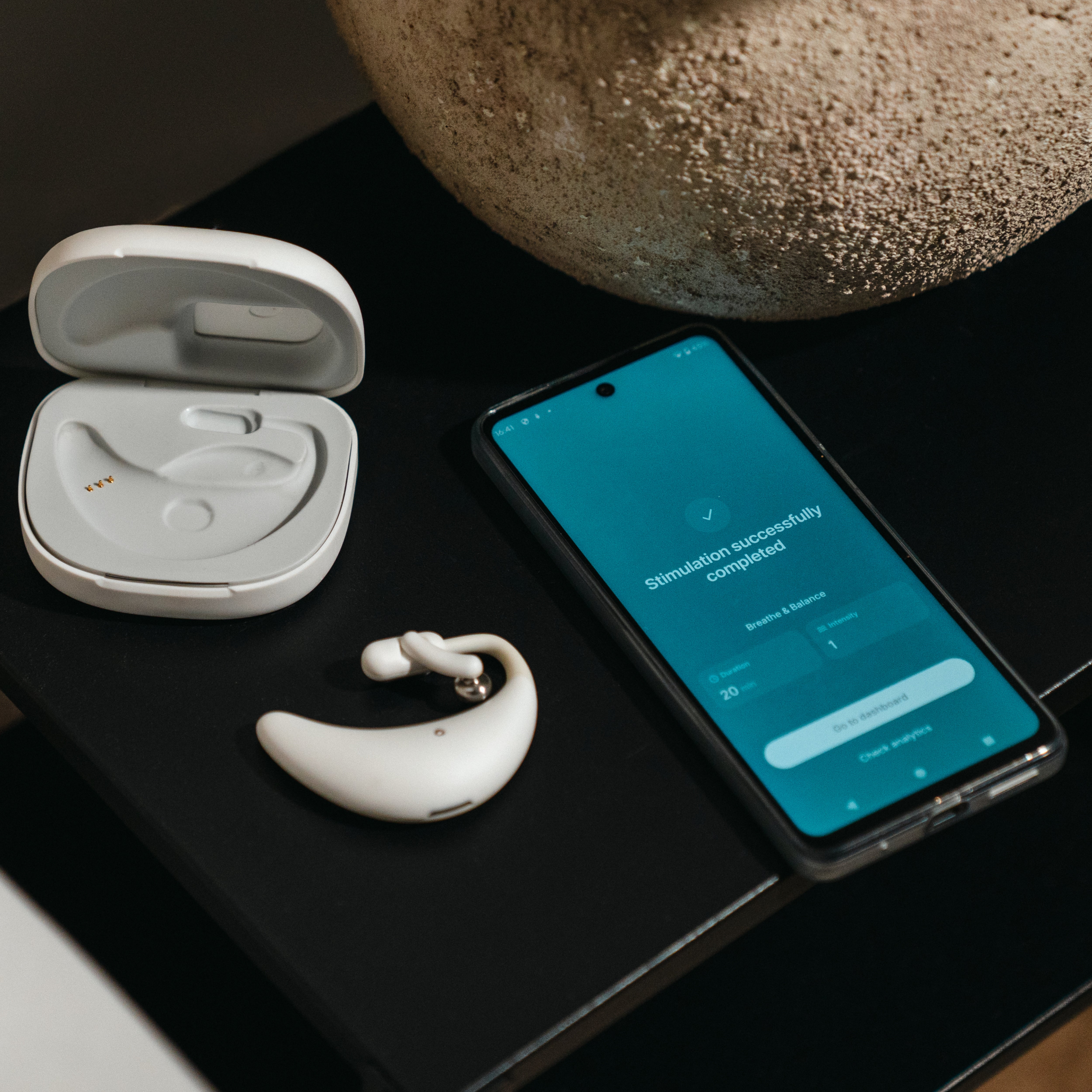
Sona uses transcutaneous auricular vagus nerve stimulation (taVNS) — delivering precise electrical signals through the ear to directly activate the vagus nerve. The device synchronizes stimulation with your breathing and heart rhythm for optimized parasympathetic engagement, aiming to retrain unhealthy neural firing patterns and increase neuroplasticity over time. Each pulse is timed to your cardiac cycle using integrated biometric sensors that read heart rate variability and respiratory patterns in real-time.
Apollo Neuro uses low-frequency vibrations delivered through a wristband or ankle band. Rather than directly stimulating the vagus nerve, Apollo influences the nervous system through somatosensory pathways — your body's touch receptors. This is a fundamentally different mechanism: vibration therapy versus direct electrical vagus nerve activation. Apollo's vibrations are designed to signal safety to the brain, but do not deliver electrical stimulation to vagal afferent fibres.
Personalization and Adaptability
The degree of personalization represents a fundamental distinction between these approaches.
Sona operates as a closed-loop system with adaptive AI. It continuously collects real-time biometric data — heart rate variability, respiratory patterns — and adjusts its stimulation waveform accordingly. The app offers custom adaptive programs based on user goals, habits, and biometrics, with real-time and trend-based session analytics to track your progress over time. The AI learns your patterns across sessions, creating a synergistic loop between your biology and the intervention for increasingly personalized results.
Apollo Neuro offers preset vibration modes (Energy, Social, Focus, Recover, Calm, Sleep, Clear) that deliver fixed vibration patterns. While the optional SmartVibes AI subscription can suggest mode schedules, the vibrations themselves do not adapt to your physiology in real-time. There are no biometric sensors, no adaptive algorithms, and no session analytics — all users receive the same vibration patterns for a given mode.
Feature and Specification Comparison
A detailed comparison reveals significant differences in capabilities, design, and ongoing costs.
Form factor: Sona is a fully wireless, compact ear cuff that sits comfortably and discreetly behind the ear. It comes with a sculpted rechargeable case that provides 8 full recharges (~20 sessions) — ideal for travel and daily use. No wires, no messy gels. Apollo Neuro is a silicone band worn on the wrist or ankle with a USB-C rechargeable module — designed for continuous all-day wear.
Audio integration: Sona works seamlessly with both in-ear and over-ear headphones, offering a built-in library of immersive soundscapes, nature audio, guided meditations, breathwork exercises, mindfulness sessions, and Yoga Nidra. Apollo Neuro has no audio component or headphone integration.
Biometric sensing: Sona has integrated sensors for adaptive stimulation, providing real-time and trend-based session analytics. Apollo Neuro has no biometric sensing capabilities — it does not measure HRV, heart rate, or breathing.
App experience: Sona's app recommends personalized daily programs, offers educational content, and provides progress reporting — pairing 10–20 minutes of daily activity with scientifically backed stress reduction techniques. Apollo's app controls vibration modes and scheduling but lacks biometric feedback or adaptive programming.
Pricing: Sona costs £695 ($950) with lifetime app access and no subscriptions. Apollo Neuro ranges from $349–448 depending on bundle, with an optional premium subscription for SmartVibes AI scheduling features.
Clinical Evidence and Research Backing
Both devices reference scientific literature, but their evidence bases differ in scope and specificity.
Sona is built on decades of transcutaneous auricular vagus nerve stimulation research and intensive R&D in collaboration with leading neuroscientists. The team includes innovators from University of Oxford, Google, NASA, Neuralink, Princeton University, and the London Institute for Healthcare Engineering. Electrical taVNS has extensive clinical evidence demonstrating measurable physiological changes including improved HRV, reduced sympathetic activation, and enhanced parasympathetic tone.
Apollo Neuro references peer-reviewed studies on its vibration technology, primarily focusing on subjective improvements in stress, sleep quality, and HRV. The research base for vibration-based nervous system modulation is newer and less extensive than the decades of electrical vagus nerve stimulation research that underpins Sona's approach.
Which Device Suits Your Needs?
Your choice depends on your wellness goals, lifestyle preferences, and desired level of physiological precision.
Choose Sona if you want clinical-grade, AI-personalized vagus nerve stimulation with real-time biometric feedback, are seeking measurable improvements in HRV and autonomic balance, value a portable wireless design with a travel-friendly rechargeable case, and want a multi-modal experience combining electrical stimulation with guided audio content including breathwork, mindfulness, and Yoga Nidra.
Choose Apollo Neuro if you prefer passive, continuous nervous system support through gentle vibrations, want a device you can wear all day without dedicated sessions, prefer a lower upfront cost, or are looking for a simpler approach to stress management without biometric tracking or direct vagal stimulation.
Frequently Asked Questions
What's the main difference between Sona and Apollo Neuro?
Sona uses AI-powered electrical stimulation that directly targets the vagus nerve and adapts to your real-time physiology, while Apollo Neuro uses gentle vibrations for general nervous system influence through touch therapy.
Which device provides better personalization?
Sona offers superior personalization through its AI engine that continuously adapts to your heart rate variability and breathing patterns, while Apollo uses fixed preset programs across all users.
How do the pricing models compare?
Sona costs £695 ($950) with lifetime app access and no subscriptions. Apollo Neuro costs approximately $349-448 depending on bundle options, with optional premium SmartVibes AI subscription features.
Can you wear both devices throughout the day?
Apollo Neuro is designed for continuous wear on your wrist or ankle, while Sona requires dedicated 10-30 minute sessions with ear placement for optimal electrical stimulation.
Which approach has stronger clinical evidence?
Electrical vagus nerve stimulation (Sona's approach) has decades of clinical research showing measurable physiological changes, while vibration therapy research focuses more on subjective stress and mood improvements.
Do both devices require smartphone apps?
Yes, both require smartphone apps for control and tracking, but Sona's app includes real-time biometric monitoring and AI optimization features that Apollo's does not offer.
Which device is better for anxiety and stress?
Both can help with stress, but Sona's direct vagal stimulation with AI personalization may provide more measurable improvements in stress resilience through HRV optimization, while Apollo offers gentler, continuous stress support.
Are there any safety differences between the devices?
Both devices are designed for consumer safety, but Sona's electrical stimulation requires proper ear placement and has specific contraindications, while Apollo's vibration therapy has fewer usage restrictions.
Conclusion
Sona and Apollo Neuro represent distinct philosophies in nervous system wellness technology. Sona delivers clinical-grade, AI-personalized vagus nerve stimulation for users seeking maximum physiological precision and measurable improvements in stress resilience. Apollo Neuro provides gentle, continuous nervous system support through vibration therapy for those wanting passive, everyday stress management. Your choice ultimately depends on whether you prefer dedicated, high-precision wellness sessions with adaptive AI technology, or continuous, subtle background support throughout your daily activities. Both devices can contribute to nervous system health, but through fundamentally different mechanisms and user experiences.
Ready to experience AI-powered vagus nerve stimulation? [Explore SONA](/product) to discover how personalized electrical VNS can optimize your stress resilience and recovery.
Sources
- Clancy JA, et al. Non-invasive vagus nerve stimulation in healthy humans reduces sympathetic nerve activity. Brain Stimul. 2014;7(6):871-7.
- Farmer AD, et al. International Consensus Based Review and Recommendations for Minimum Reporting Standards in Research on Transcutaneous Vagus Nerve Stimulation. Front Hum Neurosci. 2021;14:568051.
- Badran BW, et al. Neurophysiologic effects of transcutaneous auricular vagus nerve stimulation (taVNS) via electrical stimulation of the tragus. Brain Stimul. 2018;11(3):492-500.




Share:
Nurosym vs SONA
Vagus Nerve Stim Cheatsheet