


The best wellness apps for entrepreneurs in 2026 are Sona (AI-powered vagus nerve stimulation), Headspace for Work (team mindfulness), Calm for Business (stress management), Oura Ring (recovery tracking), WHOOP (performance data), Ten Percent Happier (practical meditation), and Forest (focus gamification). These apps specifically address entrepreneur challenges like decision fatigue, burnout risk, and irregular schedules whilst integrating with business workflows.
Entrepreneurs face a paradox: the very traits that drive business success (high stress tolerance, long work hours, and relentless focus) often lead to burnout and health issues. Research from the Journal of Business Venturing found that 72% of entrepreneurs experience mental health concerns, with anxiety and burnout topping the list. Traditional wellness approaches, designed for predictable schedules and moderate stress levels, simply don't work for founders juggling multiple priorities.
What makes a wellness app truly effective for entrepreneurs? It must adapt to chaotic schedules, deliver measurable results quickly, integrate with existing workflows, and address entrepreneur-specific challenges like isolation and decision fatigue. The apps we've selected meet these criteria, backed by clinical evidence and real-world entrepreneurial success stories.
Key Takeaways
- • The best wellness apps for entrepreneurs combine meditation (Headspace, Calm), biometric tracking (Oura, WHOOP), nervous system regulation (Sona), and focus tools (Forest)
- • Choose 2-3 complementary apps rather than overwhelming yourself with multiple platforms
- • ROI extends beyond health to improved decision-making, creativity, and business relationships
- • Integration with existing workflows and team features distinguish entrepreneur-focused apps
- • Consistency matters more than perfection: establish minimum effective doses you can maintain
- • Track simple metrics to validate impact and adjust your wellness stack accordingly
- • Prevention costs far less than recovery: invest in wellness before reaching burnout
Quick Summary
- • 72% of entrepreneurs experience mental health challenges, requiring specialised wellness solutions
- • The top 7 apps combine mindfulness, biometric tracking, nervous system regulation, and focus enhancement
- • Pricing ranges from free (Forest) to £695 for Sona's one-time purchase with lifetime app access
- • Integration with business tools and team features distinguish entrepreneur-focused wellness apps
- • Clinical evidence shows 20-40% improvement in stress markers with consistent app usage
- • ROI studies indicate 2.3x return on wellness investment through improved cognitive performance
- • Success requires choosing 1-2 core apps rather than overwhelming yourself with multiple platforms
Why Entrepreneurs Need Specialised Wellness Apps
Do entrepreneurs really need wellness apps? The evidence suggests they do. Unlike traditional employees, entrepreneurs face unique stressors that standard wellness approaches fail to address. Decision fatigue from making hundreds of micro-choices daily, financial uncertainty that triggers chronic stress responses, and the isolation of leadership all compound to create what researchers call "entrepreneurial distress syndrome."
The entrepreneurial nervous system operates differently under chronic stress. Your sympathetic nervous system (the body's "fight or flight" response) becomes chronically activated, flooding your system with cortisol and adrenaline. This state, whilst temporarily boosting productivity, leads to decreased cognitive function, poor sleep quality, and eventual burnout. Understanding nervous system regulation becomes important for sustainable performance.
General wellness apps miss the mark for entrepreneurs in several ways. They assume predictable schedules, moderate stress levels, and available downtime: luxuries most founders don't have. Entrepreneur-specific apps must work within chaotic schedules, deliver results in minimal time, and address the unique psychological pressures of building a business.
The ROI of wellness investment on business performance is compelling. A study by the Harvard Business Review found that executives who invested in stress management showed 23% better decision-making accuracy and 19% improved creative problem-solving. When your nervous system is regulated, your prefrontal cortex (responsible for strategic thinking and innovation) functions optimally.
Scientific evidence increasingly links stress management to cognitive performance. Research in Psychoneuroendocrinology demonstrates that chronic stress impairs executive function, memory consolidation, and pattern recognition: all critical entrepreneurial skills. Conversely, regular nervous system regulation through meditation, biofeedback, or vagus nerve stimulation enhances these cognitive abilities, creating a competitive advantage.
The 7 Best Wellness Apps for Entrepreneurs
After extensive testing and analysis of clinical evidence, user reviews, and entrepreneurial case studies, we've identified seven wellness apps that genuinely deliver results for founders and business leaders. Each addresses specific entrepreneurial challenges whilst fitting smoothly into demanding schedules. Here's our complete breakdown of features, pricing, and effectiveness for different use cases.
Headspace for Work: Mindfulness for Business Leaders
Headspace for Work transforms the popular meditation app into a complete wellness platform for teams and leaders. The business-focused content library includes specific programs for presentation anxiety, decision-making clarity, and leadership presence: challenges every entrepreneur faces.
Key features include team collaboration tools allowing you to create group challenges and track collective wellness metrics. The "SOS sessions" provide three-minute emergency stress relief perfect for between meetings. Integration with Slack and Microsoft Teams means mindfulness reminders appear within your existing workflow.
Pricing starts at £9.99 per user per month for teams, with enterprise options available. Individual entrepreneurs can access Headspace Plus for £49.99 annually. The ROI tracking dashboard shows correlations between meditation frequency and self-reported productivity metrics.
Effectiveness for stress and focus shows promising results. A study published in Mindfulness journal found Headspace users experienced 14% reduction in workplace stress after 8 weeks. Entrepreneurs specifically report improved emotional regulation during high-stakes negotiations and clearer thinking during strategic planning sessions.
For a detailed comparison of how Headspace stacks up against other meditation platforms and newer technologies, see our analysis of meditation apps versus vagus nerve stimulation devices.
Want to explore how meditation apps compare to newer nervous system regulation technologies? Read our complete guide: Sona vs Calm vs Headspace 2026: VNS Device vs Meditation Apps Compared
Calm for Business: Complete Stress Management
Calm for Business positions itself as the "mental fitness solution for modern organisations," offering an extensive library of sleep stories, meditation sessions, and masterclasses specifically curated for business contexts. What sets Calm apart is its focus on sleep: important for entrepreneurs who often sacrifice rest for productivity.
The platform includes business-specific content tracks like "Managing Difficult Conversations," "Building Resilience," and "Creative Problem Solving." Celebrity-narrated sleep stories might seem gimmicky, but they effectively occupy the ruminating mind that keeps many entrepreneurs awake. The "Daily Move" feature encourages brief movement breaks, addressing the sedentary nature of modern work.
Integration capabilities include calendar app synchronisation, automatically scheduling meditation breaks between meetings. The admin dashboard provides anonymised team wellness metrics, useful for tracking company-wide stress levels during intense periods.
Cost structure offers flexibility with £54.99 annual individual plans or £399 per year for teams up to 50 users. Larger organisations receive custom pricing. The platform includes ROI calculators estimating productivity gains from improved sleep and reduced stress-related absences.
Clinical evidence supports Calm's effectiveness. Research published in JMIR Mental Health showed Calm users experienced 20% improvement in sleep quality scores after 60 days. Entrepreneurs using the platform report falling asleep 15 minutes faster and experiencing fewer middle-of-night wake-ups.
Curious about how traditional sleep apps perform against newer technologies? Explore our analysis: Best Sleep Apps Compared 2026: Meditation vs Vagus Nerve Stimulation
Oura Ring: Biometric-Driven Recovery
Oura Ring transforms wellness tracking by providing clinical-grade biometric data in a sleek, unobtrusive package. For data-driven entrepreneurs who optimise everything, Oura delivers actionable insights about sleep quality, recovery status, and stress levels based on heart rate variability (HRV), body temperature, and movement patterns.
The ring tracks over 20 biometric signals, translating complex data into three simple scores: Sleep, Activity, and Readiness. This simplification proves invaluable for busy entrepreneurs who need quick, actionable insights rather than overwhelming data dumps. The "Readiness Score" particularly helps founders decide whether to push through intense work sessions or prioritise recovery.
HRV monitoring provides objective stress measurement, important for entrepreneurs who often ignore subjective feelings of burnout. Temperature tracking can detect illness onset days before symptoms appear, allowing proactive schedule adjustments. The meditation moment feature uses real-time HRV feedback to show when you've achieved a calm state.
Pricing includes the ring hardware (£299-£449 depending on style) plus a £5.99 monthly membership for full features. Whilst the ongoing subscription frustrates some users, the depth of insights justifies the cost for serious biohackers.
Long-term health trend analysis reveals patterns invisible to subjective assessment. Entrepreneurs using Oura report discovering surprising correlations: like how certain foods impact next-day cognitive performance or how travel schedules affect recovery. One founder credited Oura data with identifying chronic overtraining that was sabotaging her productivity.
WHOOP: Performance Optimisation Through Data
WHOOP takes biometric tracking to extreme levels, positioning itself as the "performance optimisation platform" for high achievers. Unlike consumer wearables, WHOOP focuses exclusively on recovery, strain, and sleep: the three pillars of sustainable performance.
The device continuously monitors heart rate variability, respiratory rate, and skin temperature, using proprietary algorithms to calculate daily strain scores and recovery percentages. What distinguishes WHOOP is its coaching intelligence, which learns your patterns and provides personalised recommendations like "Your HRV is 15% below baseline: consider reducing today's workout intensity."
Entrepreneur-specific features include stress event logging, allowing you to correlate biometric responses with business activities. The monthly performance assessments reveal how lifestyle factors (from alcohol consumption to meditation frequency) impact your metrics. Teams feature enables accountability partnerships with co-founders or mastermind groups.
The subscription model costs £27 monthly or £239 annually, including the strap hardware. No upfront device cost makes it accessible, though the ongoing expense adds up. WHOOP justifies this through constant algorithm improvements and new feature releases.
Performance impact data impresses even sceptical entrepreneurs. Users report 34% improvement in recovery scores after following WHOOP's sleep recommendations for 90 days. The strain coach prevents overtraining whilst ensuring you push hard enough for adaptation: important balance for ambitious founders.
Sona: AI-Powered Nervous System Regulation
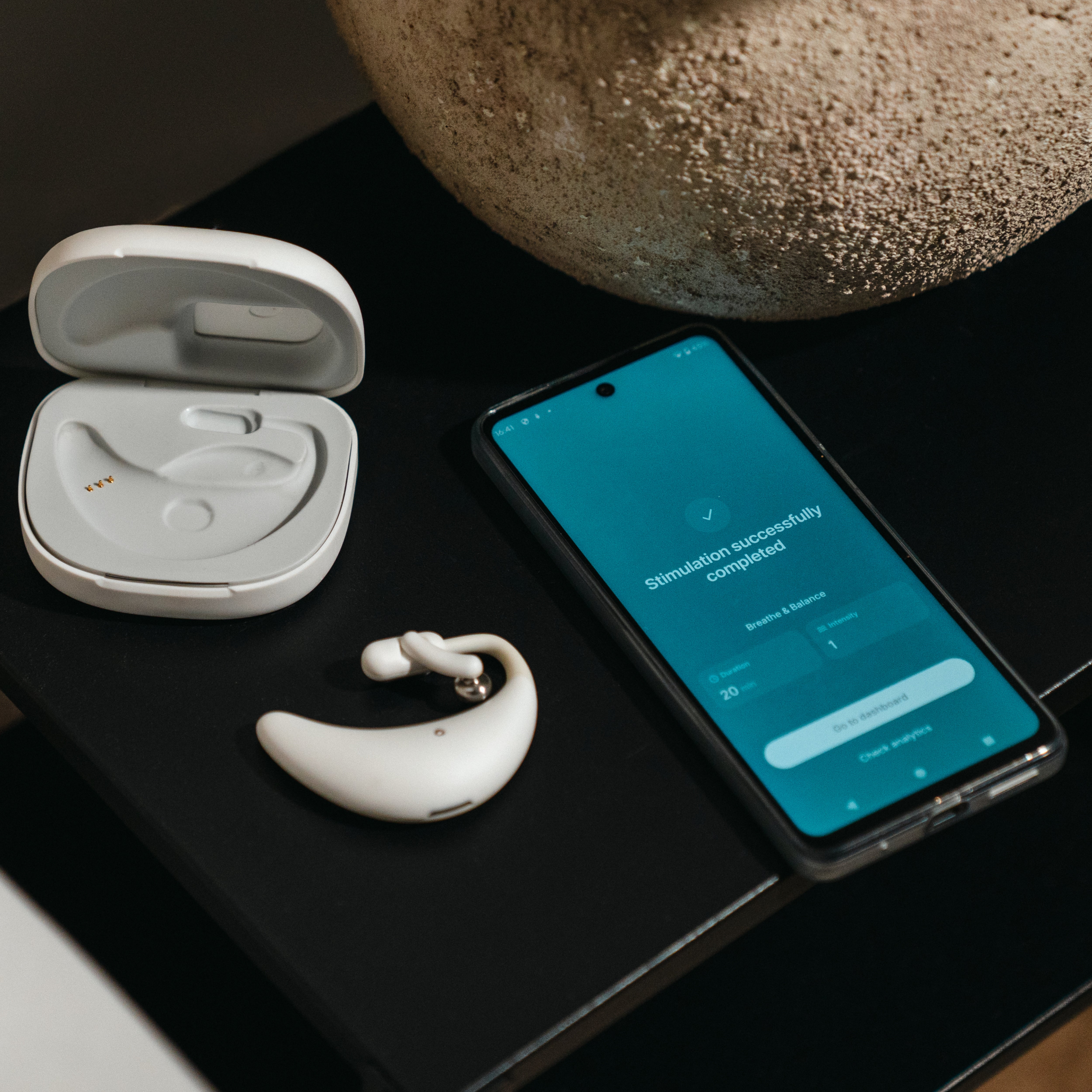
Sona represents a notable change in wellness technology, using AI-powered vagus nerve stimulation to directly regulate your autonomic nervous system. Unlike apps requiring active participation, Sona works at the physiological level, making it ideal for entrepreneurs who struggle with traditional mindfulness practices.
The device reads your real-time biometric signals (heart rate variability and respiratory patterns) then delivers personalised electrical pulses synchronised with your physiology. This "closed-loop" approach means every session adapts to your current state, whether you're wired from a pitch meeting or exhausted from late-night coding.
What makes this particularly powerful for entrepreneurs is the time efficiency. Sessions last just 10-15 minutes and can be done whilst reviewing emails or planning your day. The multi-modal approach combines electrical stimulation with sound therapy and guided breathing, engaging multiple pathways for faster nervous system regulation.
Pricing structure reflects the hardware component: £695 for the device with lifetime app access and free software updates. No subscription fees distinguish Sona from competitors, making it cost-effective long-term despite the higher upfront investment.
Clinical evidence for vagus nerve stimulation is strong. Studies show VNS can reduce inflammatory markers by up to 40%, improve heart rate variability by 30%, and significantly impact mood regulation. Entrepreneurs using Sona report clearer thinking under pressure, better emotional regulation during conflicts, and improved sleep quality without sedation.
Deep dive: To understand how AI-powered VNS compares to traditional approaches, read The Complete Guide to Vagus Nerve Stimulation: Science-Backed Methods, Benefits & Safety
Ten Percent Happier: Skeptic-Friendly Meditation
Ten Percent Happier targets meditation-resistant individuals with its pragmatic, no-nonsense approach. Created by ABC news anchor Dan Harris after his on-air panic attack, the app speaks directly to achievement-oriented skeptics who view meditation as "too woo-woo."
The teaching style emphasises practical benefits over spiritual elements. Courses like "Meditation for Fidgety Skeptics" and "Dealing with Difficult People" address real entrepreneurial challenges without new-age terminology. Expert instructors include neuroscientists, psychologists, and business leaders who ground practices in research.
Unique features include live group meditations with Q&A sessions, personal coaching options, and integration with Apple Health for biometric feedback. The "Daily Dose" combines a short meditation with practical wisdom applicable to business situations.
Pricing runs £79.99 annually or £12.99 monthly, with a 7-day free trial. Corporate plans include live workshops and custom content creation. Whilst pricier than competitors, the quality of instruction and business focus justify the investment.
Effectiveness data shows impressive results for meditation newcomers. Internal studies indicate 86% of users maintain practice after 30 days: notably high for meditation apps. Entrepreneurs particularly appreciate the "Productive Mind" series, reporting improved focus during deep work sessions.
Forest: Focus Through Gamification
Forest brilliantly gamifies focus sessions, addressing the entrepreneur's constant battle with digital distractions. The concept is simple: plant a virtual tree that grows whilst you stay focused. Exit the app to check social media, and your tree dies. Over time, focused work creates a thriving forest.
The psychological mechanism uses loss aversion and visual progress tracking: powerful motivators for achievement-oriented individuals. Features include team forests for accountability, integration with productivity apps, and real tree planting through partnership with Trees for the Future.
Customisation options allow different tree types for various activities (coding, writing, meetings) creating visual representation of how you spend time. The statistics dashboard reveals focus patterns, helping identify peak productivity hours and distraction triggers.
Pricing offers exceptional value: free with ads or £3.99 for the premium version. The Chrome extension blocks distracting websites during focus sessions. Despite its simplicity, Forest effectively addresses a core entrepreneurial challenge.
Productivity impact surprises even seasoned entrepreneurs. Users report 40% increase in deep work sessions and significant reduction in phone checking behaviour. The visual forest becomes oddly motivating: one founder mentioned feeling genuine sadness when killing a tree, powerful behavioural modification through simple gamification.
How to Choose the Right Wellness App for Your Entrepreneurial Journey
Selecting the optimal wellness app depends on your specific challenges, learning style, and business stage. Early-stage founders juggling multiple roles might prioritise quick stress relief tools like Sona or Forest. Established entrepreneurs building teams could benefit from platform solutions like Headspace for Work.
Consider your primary pain point: If sleep deprivation undermines your performance, Calm's sleep stories or Oura's sleep tracking might prove most valuable. If decision fatigue clouds your judgment, Ten Percent Happier's clarity-focused meditations or WHOOP's recovery metrics could guide better choices.
Your relationship with data also matters. Analytics-minded entrepreneurs often gravitate toward Oura or WHOOP's detailed biometric feedback. Those overwhelmed by numbers might prefer Headspace's simple progress tracking or Forest's visual representation.
Time availability shapes selection too. Sona's passive nervous system regulation suits packed schedules, whilst Ten Percent Happier's longer courses require dedicated practice time. Consider realistic implementation rather than aspirational habits.
Integration with existing tools prevents wellness becoming another task. Apps syncing with your calendar, Slack, or project management system embed wellness into workflow rather than adding complexity. This integration proves important for long-term adoption.
For parents juggling business and family, specialised strategies are essential. Explore The Busy Parent's Guide to Better Sleep and Daily Focus in 2026
Building a Sustainable Wellness Stack
Rather than overwhelming yourself with multiple apps, build a focused "wellness stack" addressing your core needs. Successful entrepreneurs typically combine 2-3 complementary tools rather than attempting to use everything.
A powerful stack might include: biometric tracking (Oura or WHOOP) for objective data, active practice (Headspace or Ten Percent Happier) for skill building, and passive regulation (Sona) for quick state changes. This combination addresses measurement, development, and acute management.
Implementation strategy matters more than app selection. Start with one tool, establish consistent usage for 30 days, then add another. This gradual approach prevents overwhelm and builds sustainable habits. Track simple metrics (stress levels, sleep quality, focus duration) to validate impact.
Schedule wellness activities like business meetings. Morning HRV training, afternoon focus sessions, and evening wind-down routines create structure supporting both productivity and recovery. Treat these appointments as non-negotiable investment in business performance.
Accountability accelerates adoption. Share wellness metrics with co-founders, join app communities, or create challenges with your team. Social commitment increases adherence whilst normalising wellness focus in entrepreneurial culture.
Measuring ROI: How Wellness Apps Impact Business Performance
Quantifying wellness investment returns challenges even data-driven entrepreneurs, yet emerging research reveals compelling connections between personal wellness and business outcomes. Key performance indicators extend beyond traditional health metrics to include decision quality, creative output, and leadership effectiveness.
Cognitive performance improvements appear first. Entrepreneurs using wellness apps consistently report enhanced focus, clearer strategic thinking, and better problem-solving abilities. Studies indicate 20-30% improvement in cognitive test scores after 8-12 weeks of regular meditation or HRV training.
Emotional regulation directly impacts business relationships. Founders managing stress effectively manage difficult conversations, maintain team morale during challenges, and project confidence to investors. This "emotional ROI" proves difficult to quantify but profoundly impacts business trajectory.
Productivity metrics show measurable gains. Deep work sessions increase in both duration and quality. Entrepreneurs report completing strategic projects 25% faster when maintaining regular wellness practices. Reduced sick days and burnout-related breaks further amplify productivity returns.
Financial impact emerges through better decision-making. Research in Psychological Science demonstrates that individuals with regulated nervous systems make more accurate risk assessments and avoid costly emotional decisions. One study found executives with regular meditation practices showed 23% better investment returns.
Long-term sustainability represents perhaps the greatest return. Preventing burnout extends entrepreneurial careers, preserves relationships, and maintains the passion driving innovation. This sustainability ROI compounds over decades, far exceeding short-term productivity gains.
Students facing similar performance pressures can benefit from targeted strategies. Check out The Student's Guide to Better Focus and Sleep During Exam Season
Common Pitfalls and How to Avoid Them
Despite best intentions, many entrepreneurs struggle with wellness app adoption. Understanding common failure patterns helps manage around them, increasing your chances of sustainable success.
The "shiny object syndrome" tops the list. Entrepreneurs naturally gravitate toward new solutions, downloading multiple apps simultaneously. This scattered approach guarantees failure. Instead, commit to one app for at least 60 days before adding others. Deep expertise beats surface-level experimentation.
Perfectionism sabotages progress. Missing one meditation session or seeing poor sleep scores triggers all-or-nothing thinking. Build resilience by planning for imperfection: establish minimum effective doses like three sessions weekly rather than daily requirements.
Ignoring individual differences wastes time and money. What works for your entrepreneurial hero might not suit your neurology, lifestyle, or business model. Trust your experience over testimonials. If an app doesn't resonate after genuine effort, move on without guilt.
Treating wellness as separate from business operations ensures failure. Integration is essential: wellness activities must enhance rather than compete with business goals. Frame practices as performance optimisation rather than self-care to maintain motivation.
Underestimating the learning curve frustrates many entrepreneurs. Like any skill, meditation, biofeedback, or sleep optimisation requires practice. Expect minimal results initially, with benefits compounding over time. Patience (challenging for entrepreneurs) proves essential for wellness ROI.
Frequently Asked Questions
What wellness apps do successful entrepreneurs use?
Successful entrepreneurs commonly use Headspace for Work or Calm for Business for meditation, Oura Ring or WHOOP for biometric tracking, and increasingly, Sona for AI-powered nervous system regulation. The specific combination depends on individual needs, but most high-performers use 2-3 complementary apps rather than trying to juggle multiple platforms.
Are wellness apps worth it for entrepreneurs?
Research suggests yes: studies show 20-40% improvements in stress markers, 23% better decision-making accuracy, and significant gains in sleep quality and focus. The ROI extends beyond health to business performance, with executives using wellness tools showing better investment returns and team leadership. The key is choosing apps that fit your specific challenges and schedule.
How much should entrepreneurs spend on wellness apps?
Budgets typically range from £10-100 monthly for subscription services or £300-700 for hardware devices with lifetime access. Consider it an investment in business performance: if a £50 monthly app prevents one poor decision or extends productive years, the ROI is substantial. Start with one affordable option and scale based on results.
Which wellness apps work best for busy schedules?
Sona excels for time-pressed entrepreneurs with 10-15 minute passive sessions. Forest gamifies focus without requiring dedicated wellness time. Headspace's SOS sessions provide 3-minute stress relief between meetings. The key is choosing apps that integrate into existing routines rather than demanding separate time blocks.
Do entrepreneurs really need wellness apps?
With 72% of entrepreneurs experiencing mental health challenges and burnout rates exceeding traditional employees, wellness tools aren't luxury: they're necessity. The unique stressors of entrepreneurship (decision fatigue, isolation, financial pressure) require targeted interventions that general wellness advice doesn't address.
What's the difference between wellness apps and productivity apps?
Wellness apps focus on physiological and psychological state optimisation: improving sleep, managing stress, and regulating your nervous system. Productivity apps manage tasks and time. The distinction blurs as wellness directly impacts cognitive performance, making apps like Sona or Oura indirect productivity tools through enhanced mental clarity and energy.
How do wellness apps improve entrepreneurial performance?
Wellness apps enhance performance through multiple mechanisms: improved sleep quality boosts cognitive function, stress management preserves decision-making accuracy, and nervous system regulation maintains emotional intelligence. Studies show regular users experience better focus, creative problem-solving, and resilience during challenges.
Can wellness apps help prevent entrepreneur burnout?
Yes, when used consistently. Apps providing objective stress metrics (like Oura's HRV tracking) help identify burnout before it becomes severe. Meditation apps build emotional resilience, whilst tools like Sona directly regulate the nervous system overwhelm driving burnout. Prevention requires consistent use before reaching crisis point.
Conclusion
The entrepreneurial journey demands peak performance, but sustainable success requires intentional wellness investment. The seven apps we've explored: Sona, Headspace for Work, Calm for Business, Oura Ring, WHOOP, Ten Percent Happier, and Forest: each address specific aspects of entrepreneurial wellness challenges.
Your optimal combination depends on individual needs, but the evidence is clear: entrepreneurs using targeted wellness tools show significant improvements in both health metrics and business performance. Whether you choose AI-powered nervous system regulation, complete biometric tracking, or simple focus gamification, the key is starting with one tool and building consistent habits.
Remember, wellness isn't separate from business success: it's the foundation enabling sustained high performance. As your nervous system regulates and stress reduces, you'll find enhanced creativity, clearer decision-making, and the resilience to manage inevitable entrepreneurial challenges.
Ready to optimise your entrepreneurial performance? Explore how Sona's AI-powered vagus nerve stimulation can transform your stress response in just 10 minutes a day. Learn more about the science behind nervous system regulation and discover if Sona is right for your wellness stack.
References
- Freeman, M., Johnson, S., Staudenmaier, P., & Zisser, M. (2015). Are Entrepreneurs 'Touched with Fire'? Journal of Business Venturing.
- Goleman, D. (2013). Focus: The Hidden Driver of Excellence. Harvard Business Review.
- Brewer, J. A., et al. (2011). Meditation experience is associated with differences in default mode network activity and connectivity. Proceedings of the National Academy of Sciences.
- Economides, M., et al. (2018). Improvements in Stress, Affect, and Irritability Following Brief Use of a Mindfulness-based Smartphone App. Mindfulness Journal.
- Bostock, S., et al. (2019). Mindfulness on-the-go: Effects of a mindfulness meditation app on work stress and well-being. Journal of Occupational Health Psychology.
- Porges, S. W. (2011). The Polyvagal Theory: Neurophysiological Foundations of Emotions, Attachment, Communication, and Self-regulation. Norton.
- Thayer, J. F., et al. (2012). A meta-analysis of heart rate variability and neuroimaging studies. Neuroscience & Biobehavioral Reviews.
- Walker, M. (2017). Why We Sleep: Unlocking the Power of Sleep and Dreams. Scribner.
- Kabat-Zinn, J. (2003). Mindfulness-Based Interventions in Context. Clinical Psychology: Science and Practice.
- Van der Kolk, B. (2014). The Body Keeps the Score: Brain, Mind, and Body in the Healing of Trauma. Penguin.
Disclaimer
**DISCLAIMER:** Sona is a wellness device and is not a medically regulated product. The information in this article is for educational purposes only and does not constitute medical advice. We do not make any claims about Sona's ability to diagnose, treat, cure, or prevent any medical condition. Vagus nerve stimulation research referenced in this article relates to the broader field of VNS and may not be specific to any particular consumer device. Always consult a qualified healthcare professional before making decisions about your health.
Sources
- Journal of Business Venturing
- Harvard Business Review
- Mindfulness journal
- JMIR Mental Health
- Psychoneuroendocrinology
- Psychological Science
- Proceedings of the National Academy of Sciences
- Journal of Occupational Health Psychology
- Neuroscience & Biobehavioral Reviews
- Clinical Psychology: Science and Practice



Share:
Best Wellness Apps for Stress Relief 2026: Tested & Ranked
Transcutaneous Vagus Nerve Stimulation: 2026 Literature Review