

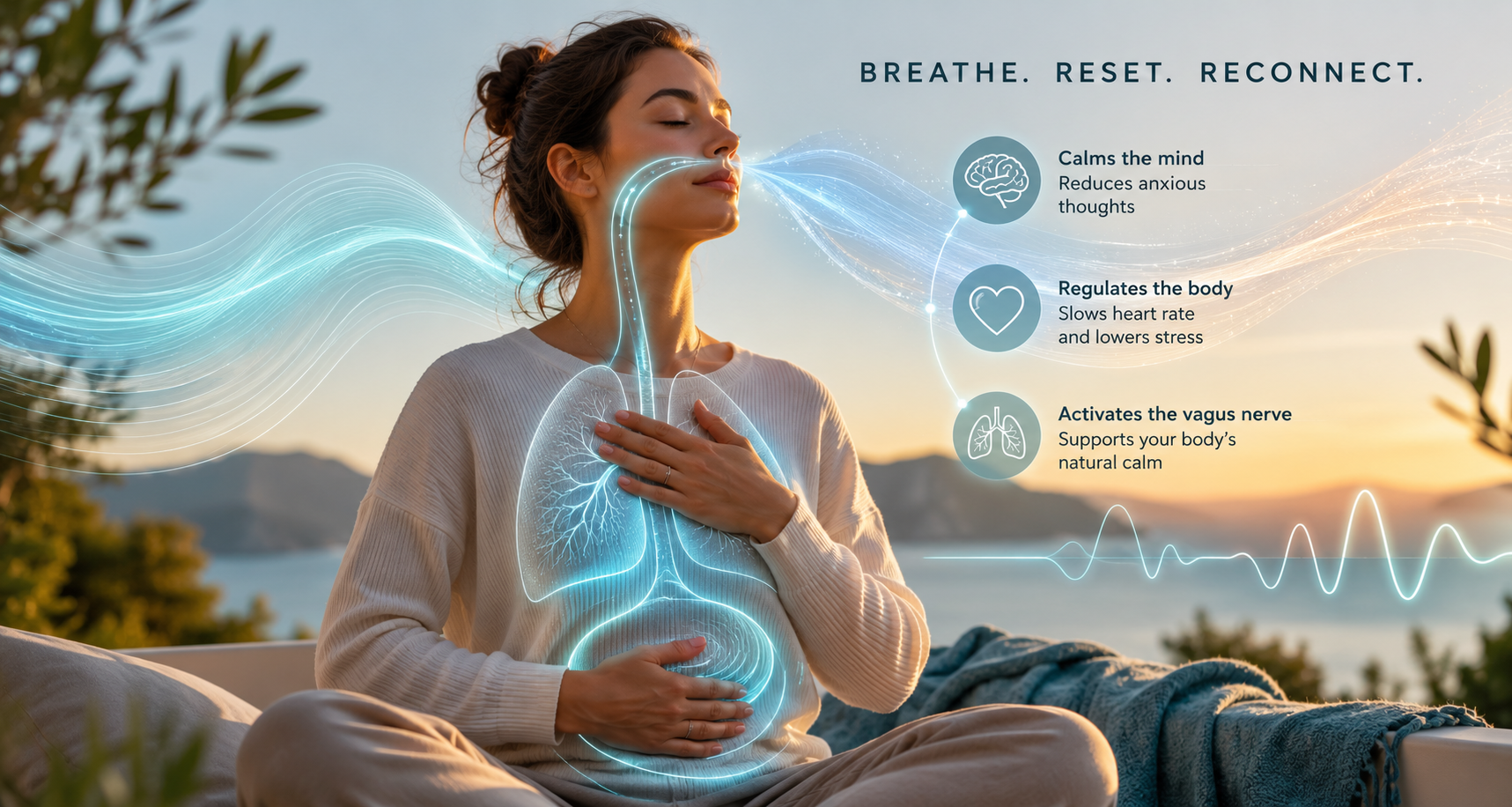
Breathwork for stress relief works because your breath is the fastest, most direct lever you have on your nervous system. By deliberately slowing and structuring your breathing : especially extending the exhale : you activate the parasympathetic "rest-and-digest" response, lowering heart rate and calming the mind within 60 to 90 seconds. Yes, breathwork genuinely reduces stress: it's one of the few tools that produces measurable physiological change almost instantly.
The key pathway is the vagus nerve, the long wandering nerve that connects your brain to your heart, lungs and gut. Slow exhales and rhythmic breathing signal safety along this nerve, shifting you out of fight-or-flight. This is the same mechanism behind vagus nerve stimulation, only powered entirely by your own lungs. For immediate relief, the single most effective technique is the physiological sigh : a double inhale followed by a long exhale. In this guide we'll cover the four best techniques (box breathing, 4-7-8, the physiological sigh and diaphragmatic breathing), how each one works, and how to build both instant resets and a lasting practice.
Key Takeaways
- Breathwork reduces stress by activating the vagus nerve and shifting you from fight-or-flight into rest-and-digest : often within 60-90 seconds.
- The exhale is the powerful half of the breath: longer exhales raise vagal tone, slow the heart and improve heart rate variability (HRV).
- For fastest relief, use the physiological sigh (double inhale, long exhale); for structured calm, use box breathing or 4-7-8.
- Consistency compounds: a few minutes daily builds baseline resilience, while single-breath resets handle acute stress in the moment.
- Breathwork is generally safe, but people with respiratory conditions, cardiovascular issues or a history of fainting should start gently and consult a clinician.
Breathwork for Stress Relief: What You Need to Know
Breathwork is any intentional, structured control of your breathing used to shift your physiological state : and its effect on the nervous system is rapid and measurable. When you slow your breath and lengthen the exhale, you stimulate the parasympathetic branch of your autonomic nervous system, the part responsible for calm and recovery.
The vagus nerve is the key pathway here. Slow exhales and structured rhythms activate it within 60 to 90 seconds, which is why breathwork can pull you out of an acute stress spike faster than almost anything else. The top techniques we cover below are box breathing, 4-7-8 breathing, the physiological sigh and diaphragmatic breathing. This article covers both immediate relief for stressful moments and how to build a longer-term practice that raises your baseline resilience.
What Is Breathwork?
Breathwork is any intentional, structured control of your breathing pattern used to influence how you feel and function. It differs from unconscious breathing : and even from casual "take a deep breath" advice : because it follows specific ratios, rhythms and techniques with defined physiological targets.
So how is breathwork different from regular deep breathing? Regular deep breathing is unguided and inconsistent; breathwork prescribes exactly how long to inhale, hold and exhale, so the effect on your nervous system is predictable and repeatable. That precision is what turns a vague relaxation cue into a reliable tool.
The practice is rooted in ancient traditions : most notably pranayama, the yogic science of breath control : but it is now validated by modern neuroscience and clinical research. What was once framed in spiritual terms is now measurable in heart rate, blood pressure and vagal tone.
Breathwork spans a wide spectrum. At one end sits the single-breath reset, like the physiological sigh, which can calm you in under 30 seconds. At the other end are extended 20- to 30-minute sessions used for deeper regulation and recovery. You don't need the long version to benefit : even one deliberate breath can move the needle.
How Breathwork Reduces Stress: The Nervous System Explained
Breathwork reduces stress by giving you conscious access to an otherwise automatic system. Your autonomic nervous system runs in two modes: the sympathetic branch (fight-or-flight), which floods you with adrenaline and cortisol under threat, and the parasympathetic branch (rest-and-digest), which restores calm. Breathing is the one autonomic function you can control at will : and that control lets you tip the balance deliberately.
The primary highway between your breath and your nervous system state is the vagus nerve. It carries signals in both directions: efferent fibres send calming instructions from brain to body, while afferent fibres : around 80% of the nerve : report back on your internal state. Slow, structured breathing sends a steady stream of "you are safe" signals up these afferent pathways. You can read more on how the vagus nerve works for the fuller picture.
Here's why the exhale matters more than the inhale: during exhalation, the vagus nerve slows your heart via the baroreflex, so longer exhales directly raise vagal tone and lower heart rate. This shows up in heart rate variability (HRV) : the beat-to-beat variation in your pulse and the clearest measurable marker of parasympathetic activation. Research consistently shows that slow-paced breathing (around six breaths per minute) reliably improves HRV. Structured breathing has also been associated with lower cortisol output during and after acute stress, meaning the calming effect outlasts the session itself. In short: yes, breathwork actually reduces stress : and the mechanism is well understood, not mystical.
The Best Breathwork Techniques for Stress Relief
Below are four evidence-informed techniques, ordered roughly from fastest reset to daily foundation. Each has a specific job : learn all four and you'll have the right tool for any moment. Beginners can start with the physiological sigh and box breathing before layering in the rest.
1. The Physiological Sigh (Fastest Reset)
The physiological sigh is the fastest way to calm down, popularised by Stanford neuroscientist Dr Andrew Huberman and colleagues. It uses a double inhale to fully reinflate the lungs' air sacs, then a long exhale to offload carbon dioxide and slow the heart.
How to do it: 1. Inhale through your nose until your lungs feel about 80% full. 2. Take a second, shorter sharp inhale on top to top them off. 3. Exhale slowly and completely through your mouth. 4. Repeat one to three times.
Research on cyclic sighing (Balban et al., 2023) found that a few minutes of this pattern reduced stress and improved mood. One to three physiological sighs can take the edge off an acute stress spike within seconds — ideal before a difficult conversation or when panic starts to rise.
2. Box Breathing (Square Breathing)
Box breathing uses equal counts on all four phases, creating a steady, grounding rhythm. It's a favourite of military personnel and first responders for staying composed under pressure.
How to do it: 1. Inhale through your nose for a count of 4. 2. Hold your breath for a count of 4. 3. Exhale through your mouth for a count of 4. 4. Hold empty for a count of 4. 5. Repeat for 4-6 rounds, or up to five minutes.
Box breathing is best when you need controlled focus rather than a rapid crash-out of stress : think preparing for a presentation or steadying yourself mid-task. If holding feels uncomfortable, shorten the count to 3.
3. 4-7-8 Breathing (For Immediate Calm)
The 4-7-8 technique, popularised by Dr Andrew Weil, front-loads the exhale : making it especially effective for winding down and easing into sleep. The long, slow out-breath is what drives the vagal, calming response.
How to do it: 1. Exhale fully through your mouth. 2. Inhale quietly through your nose for a count of 4. 3. Hold your breath for a count of 7. 4. Exhale slowly through your mouth for a count of 8. 5. Repeat for four cycles to start.
Does 4-7-8 breathing work? The evidence is largely preliminary, but the mechanism is sound: the extended exhale meaningfully lengthens vagal activation, and many users find it reliably reduces pre-sleep anxiety. Keep the ratio, not the exact seconds : the 4:7:8 proportion is what matters.
4. Diaphragmatic Breathing (The Foundation)
Diaphragmatic breathing : also called belly breathing : is the base skill underneath every other technique. Most stressed people breathe shallowly into the chest; shifting to slow, low breathing engages the diaphragm and maximises vagal engagement.
How to do it correctly: 1. Place one hand on your chest and one on your belly. 2. Inhale slowly through your nose, letting your belly rise while your chest stays still. 3. Exhale slowly through your mouth, feeling the belly fall. 4. Aim for roughly six breaths per minute : about a 4-second inhale and 6-second exhale. 5. Practise for 5-10 minutes daily.
Because it targets the slow-breathing "resonance" rate that most improves HRV, diaphragmatic breathing is the technique to build a daily habit around. For a deeper dive into the rhythm behind it, see our piece on the secret rhythm behind HRV.
How Long Should You Practise Breathwork for Stress?
The honest answer: less than you'd think for acute relief, and only a few minutes daily for lasting change. For an in-the-moment stress spike, one to three physiological sighs or two minutes of box breathing is usually enough to shift your state.
For long-term resilience, aim for 5-10 minutes of slow diaphragmatic breathing daily. Studies on slow-paced breathing and HRV biofeedback typically use sessions of around 10-20 minutes, but consistency matters more than duration : a short daily practice beats an occasional long one.
How long does it take to feel results? Immediately for acute calm; for a measurable lift in baseline HRV and stress tolerance, most people notice changes within two to four weeks of consistent practice. Think of it like training a muscle: each session is small, but they compound. Our guide on 11 proven methods to improve HRV naturally covers how breathwork fits alongside other habits.
Acute vs. Chronic Stress: When to Use Breathwork
Breathwork works for both spike-in-the-moment stress and the slow-burn kind : but the approach differs. Matching the technique to the situation is what makes it effective.
For acute stress : a tense meeting, an argument, a wave of anxiety : use fast resets. The physiological sigh is your first responder; box breathing works when you need to hold composure. These interrupt the sympathetic surge before it snowballs.
For chronic stress and workplace pressure : the constant low hum of a demanding job : the answer is a daily practice that raises your baseline. Slow diaphragmatic breathing done consistently strengthens vagal tone over time, so you're less reactive to begin with. Micro-practices help too: try three physiological sighs between meetings, or two minutes of box breathing before opening your inbox. Chronic tension often settles in the body as tight shoulders and jaw clenching, and slow breathing helps unwind that physical holding as it calms the mind.
For those looking to build a broader system around this, our Complete Guide to Stress Resilience: Train Your Nervous System puts breathwork in context with sleep, movement and recovery.
Breathwork vs. Meditation: What's the Difference?
Breathwork and meditation overlap but aren't the same. Meditation is primarily a mental practice : training attention and awareness : while breathwork is a physiological one, directly manipulating your breath to change your body state.
The practical difference: breathwork produces faster, more reliable physiological shifts (lower heart rate, higher HRV) because it acts mechanically on the vagus nerve. Meditation builds long-term attentional and emotional regulation. Many people use breath as the entry point to meditation : a few minutes of slow breathing settles the body enough to make sitting still feel possible.
For stress relief specifically, breathwork tends to be the faster tool when you need to calm down now. You don't have to choose one; they complement each other well.
Common Mistakes to Avoid
Most breathwork setbacks come from trying too hard. Keep these in mind:
- Over-breathing or forcing it. Straining for maximum lung capacity can cause lightheadedness. Breathing should feel controlled, not effortful. - Neglecting the exhale. People instinctively focus on the big inhale, but the exhale drives the calming response. Make it longer than the inhale. - Chest breathing. Shallow upper-chest breathing keeps you in sympathetic mode. Breathe low into the belly. - Expecting perfection. A wandering mind is normal : gently return to the count. - Practising only in crisis. Breathwork is far more powerful when it's already a habit, so your nervous system knows the pattern before you need it.
A note on safety: if you feel dizzy, stop and breathe normally. People with respiratory conditions such as asthma or COPD, cardiovascular issues, or a history of fainting should keep breath-holds gentle and speak to a clinician before extended sessions.
Frequently Asked Questions
Does breathwork actually reduce stress?
Yes. Breathwork reduces stress by activating the parasympathetic nervous system via the vagus nerve. Slow, structured breathing : particularly longer exhales : lowers heart rate through the baroreflex, raises heart rate variability, and has been associated with reduced cortisol output during and after acute stress. The effect can begin within 60-90 seconds.
What is the best breathing technique for immediate stress relief?
The physiological sigh is the fastest for immediate relief: two inhales through the nose (a full breath followed by a shorter top-up) then a long, slow exhale through the mouth. One to three cycles can noticeably calm an acute stress spike within seconds. Box breathing is a good alternative when you need steady composure.
How long does it take for breathwork to work for stress?
For acute stress, breathwork works almost immediately : often within 60-90 seconds, or even faster with a physiological sigh. For lasting changes in baseline resilience and HRV, most people notice improvements within two to four weeks of consistent daily practice.
Can breathwork help with anxiety and panic attacks?
Breathwork can help interrupt the physiological cascade of anxiety and panic by activating the calming parasympathetic response. Slow-paced breathing and the physiological sigh are commonly used to steady the nervous system in the moment. It is a supportive tool, not a substitute for professional care if you experience frequent panic attacks.
What is the 4-7-8 breathing technique and does it work?
The 4-7-8 technique, popularised by Dr Andrew Weil, involves inhaling for 4 counts, holding for 7, and exhaling for 8. The long exhale drives a strong vagal, calming response. Evidence is still preliminary, but the mechanism is sound and many users find it effective for winding down and easing into sleep.
How is breathwork different from regular deep breathing?
Regular deep breathing is unguided and inconsistent, whereas breathwork uses specific ratios, rhythms and techniques with defined physiological targets. That precision makes the effect on your nervous system predictable and repeatable, turning a vague relaxation cue into a reliable tool.
How often should you do breathwork for stress relief?
For prevention and baseline resilience, a daily practice of 5-10 minutes of slow diaphragmatic breathing works well. For acute stress, use quick resets like the physiological sigh as often as needed throughout the day. Consistency matters more than session length.
Is breathwork safe for everyone?
Gentle breathwork is safe for most people. However, those with respiratory conditions like asthma or COPD, cardiovascular issues, low blood pressure, or a history of fainting should keep breath-holds gentle and consult a healthcare professional before longer or more intense sessions. Stop if you feel dizzy.
Conclusion
Your breath is the most accessible remote control you have for your own nervous system : free, portable and effective within seconds. The physiological sigh handles acute spikes, box breathing steadies you under pressure, 4-7-8 eases you toward sleep, and daily diaphragmatic breathing raises your baseline resilience over time. The key insight across all four is that the exhale does the heavy lifting: lengthen it, and you signal safety along the vagus nerve. Start with one technique, practise it when you're calm, and it'll be ready when you're not.
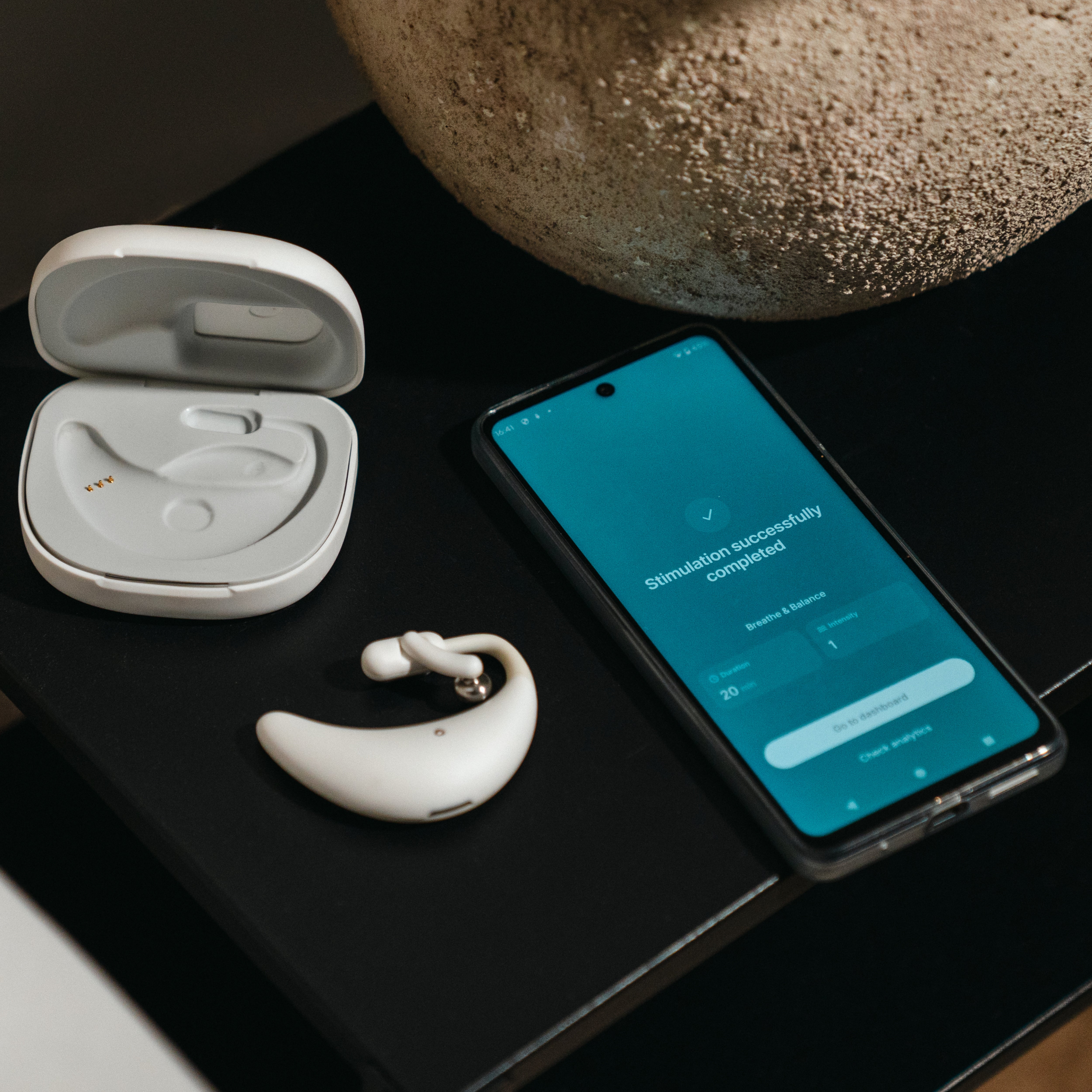
Breathwork trains your vagus nerve using only your lungs : but if you want to accelerate and personalise that process, SONA reads your HRV and respiration in real time and syncs gentle vagus nerve stimulation with your natural rhythm. Explore how personalised, AI-powered vagus nerve stimulation can complement your breathwork practice at sona.help. DISCLAIMER: Sona is a wellness device and is not a medically regulated product. The information in this article is for educational purposes only and does not constitute medical advice. We do not make any claims about Sona's ability to diagnose, treat, cure, or prevent any medical condition. Vagus nerve stimulation research referenced in this article relates to the broader field of VNS and may not be specific to any particular consumer device. Always consult a qualified healthcare professional before making decisions about your health.
Sources
- Balban, M. Y., et al. (2023). Brief structured respiration practices enhance mood and reduce physiological arousal. Cell Reports Medicine.
- Weil, A. : 4-7-8 breathing technique (drweil.com)
- Lehrer, P. & Gevirtz, R. (2014). Heart rate variability biofeedback: how and why does it work? Frontiers in Psychology

Share:
How Temperature Affects Stress: Hot, Cold and Staying Calm
Morning Light and Your Circadian Rhythm: A Practical Guid