

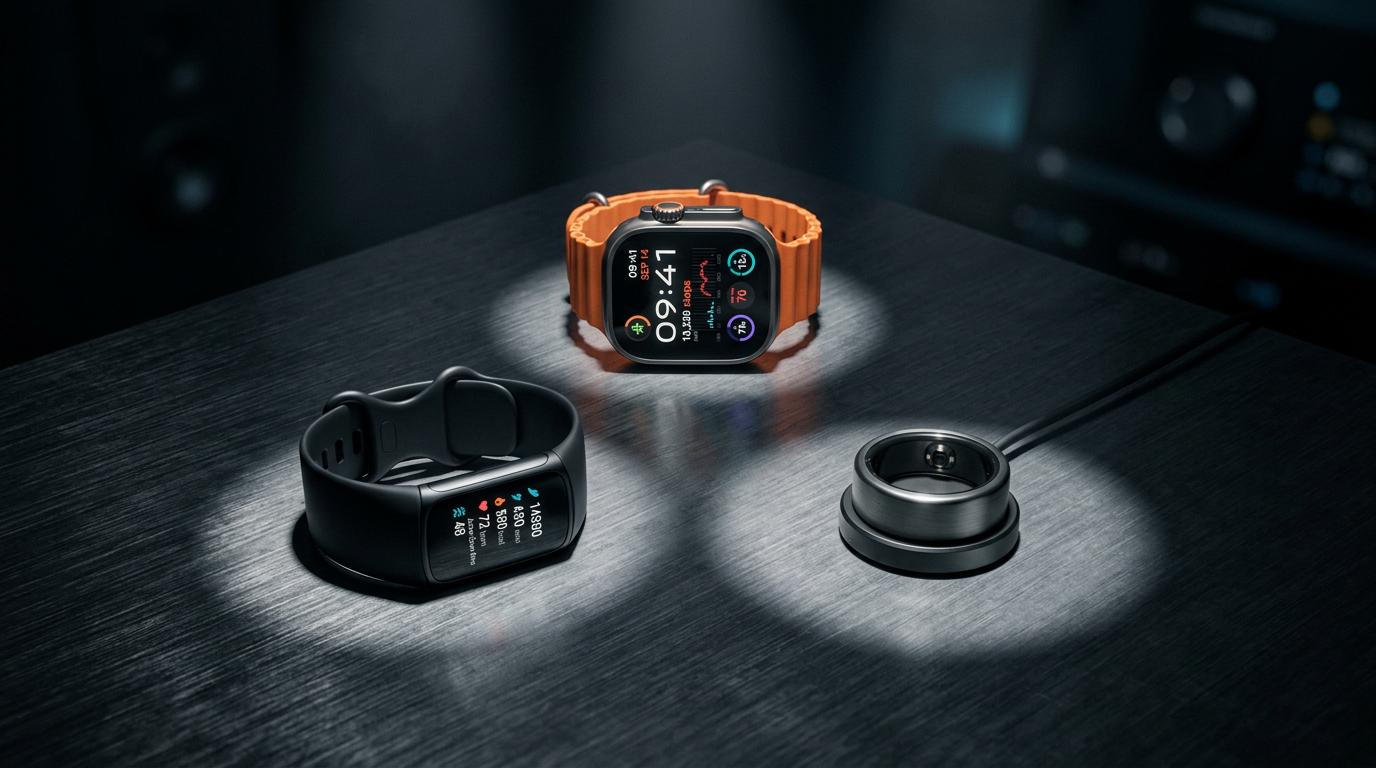
The best wellness wearable in 2026 depends on whether you want to measure your physiology or change it. For passive monitoring, the Oura Ring 4, WHOOP 5.0, and Garmin Fenix 8 lead on sleep, recovery, and HRV tracking. But a new tier has emerged: active intervention devices. Sona — an AI-powered vagus nerve stimulator — is our top pick here, because it doesn't just report your nervous system state, it works to shift it.
That distinction sits at the heart of this guide. For years, the wellness wearable market has been a race to measure more: more sleep stages, more heart-rate-variability data points, more readiness scores delivered each morning. And that data is genuinely useful. But there is a quiet frustration many long-term users share — you can watch your HRV drop, your resting heart rate creep up, and your sleep fragment, yet the device offers no lever to actually do anything about it.
So the central question of 2026 isn't simply "which wearable tracks the most metrics?" It's more fundamental: do you need awareness of your physiology, or do you need to actively change it? The answer determines which category — and which device — is right for you.
The wearable space has exploded accordingly. Rings, watches, patches, continuous glucose monitors, and now closed-loop neurostimulation devices all compete for space on (and around) your body. This guide covers product deep-dives, a scannable comparison table, buying-guide criteria, and an FAQ — evaluated against a transparent methodology, clinical evidence standards, and, importantly, no subscription bias.
Key Takeaways
- Wellness wearables in 2026 split into two tiers: passive monitoring (rings, watches, patches that measure) and active intervention (devices like Sona that aim to shift your physiology).
- For pure tracking, the Oura Ring 4 leads on sleep, WHOOP 5.0 on recovery coaching, and Garmin Fenix 8 on athletic depth and battery life.
- Sona occupies a distinct category — an AI-powered vagus nerve stimulator that reads HRV and respiration in real time and delivers personalised stimulation, with no subscription required.
- Subscription fatigue is real: WHOOP and (partially) Oura require ongoing fees, whilst Garmin, Apple Watch, and Sona offer core features without recurring costs.
- The right device is the one matched to your goal — sleep insight, stress and HRV awareness, athletic recovery, or active nervous-system regulation — not the one with the longest spec sheet.
How We Evaluated These Wearables
Our evaluation prioritised evidence over marketing — assessing each device against ten criteria and two distinct product tiers rather than forcing everything into a single ranking.
We scored every device across the metrics that matter for real health outcomes: sensor accuracy, clinical validation, personalisation capability, sleep tracking quality, stress and HRV monitoring, battery life, subscription model, data privacy, app quality, and form factor. Each of these carries different weight depending on your use case — a shift worker cares about sleep-stage accuracy in ways an ultra-runner may not.
The most important structural decision was recognising that not all devices compete in the same tier. Passive monitoring devices — the rings, watches, and patches — exist to give you awareness of your physiology. Active intervention devices exist to change it. Comparing a sleep-tracking ring to a closed-loop vagus nerve stimulator on "number of metrics tracked" would miss the point entirely; they answer different questions.
Our testing methodology combined four strands: real-world biometric comparison across several weeks of wear, hands-on app UX review, a peer-reviewed evidence audit of each manufacturer's validation claims, and analysis of community feedback from long-term users. We deliberately assessed devices against specific use cases — sleep, stress, chronic-condition support, and longevity — because "best overall" means little if it doesn't fit your life.
The 2026 space has shifted in three meaningful ways. FDA-cleared non-invasive biomarkers are moving from research labs into consumer wrists. AI personalisation has matured from novelty to genuine differentiator. And nervous-system intervention — once confined to clinical settings — has entered mainstream consumer wellness. For readers focused specifically on neurostimulation, our companion guide to the best vagus nerve stimulation devices 2026 goes deeper on that category.
Best Wellness Wearables 2026: Quick Comparison Table
Here is the space at a glance. Note that Sona sits in its own Active Intervention / VNS Wearable category — it's included not because it competes on tracking, but because it addresses outcomes the other devices only measure.
| Device | Category | Best For | Key Technology | Price | Subscription Required | Battery Life | App Rating |
|---|---|---|---|---|---|---|---|
| Sona | Active Intervention / VNS Wearable | Actively regulating the nervous system | AI-personalised, closed-loop vagus nerve stimulation + sound + breath | £695 (~$950) | No | Multi-session per charge | 4.7★ |
| Oura Ring 4 | Passive monitoring (ring) | Sleep & readiness | Infrared PPG, temperature sensing | ~£349 | Yes (~£5.99/mo) | 7-8 days | 4.6★ |
| WHOOP 5.0 | Passive monitoring (band) | Recovery & strain coaching | Continuous HRV, skin temp | Hardware bundled | Yes (subscription-only) | 14 days | 4.5★ |
| Apple Watch Series 10 | Passive monitoring (watch) | All-rounder & ECG | Optical + electrical heart sensor | ~£399 | No (core features) | ~18 hrs | 4.8★ |
| Garmin Fenix 8 | Passive monitoring (watch) | Athletes & endurance | Multi-band GPS, Elevate HR | ~£849 | No | 16+ days | 4.7★ |
| Samsung Galaxy Ring | Passive monitoring (ring) | Samsung ecosystem sleep | PPG, skin temp | ~£399 | No | 6-7 days | 4.3★ |
| Withings ScanWatch 2 | Passive monitoring (hybrid) | Long battery & ECG | Medical-grade ECG, temp | ~£319 | No | 30 days | 4.4★ |
Footnote: Prices are indicative and vary by region and retailer. Sona occupies a different product tier to the trackers listed — it is a wellness device that delivers stimulation rather than a passive sensor. It appears in this table because for many readers the real goal isn't more data, but a genuine change in how their nervous system responds to stress and sleep.
Best Overall Passive Monitoring Wearable: Oura Ring 4
For most people who simply want accurate, comfortable, all-day physiological awareness, the Oura Ring 4 remains the strongest passive monitoring pick of 2026.
The appeal is quietly practical. A ring disappears on your finger in a way a watch never does on your wrist — and that unobtrusiveness matters, because the best wearable is the one you actually keep wearing. Oura's sleep staging has been independently benchmarked against polysomnography in published validation work, and whilst no consumer device matches a sleep lab, its accuracy for total sleep time and sleep timing is among the best available.
Where Oura earns its place is the coherence of its insights. Rather than drowning you in raw numbers, it distils overnight HRV, resting heart rate, respiratory rate, and body temperature into a morning Readiness score. That translation from data to decision is genuinely useful — it nudges you toward rest on the days your body is asking for it.
The caveat is the subscription. Oura's core hardware is capable, but its richer insights sit behind a monthly fee. For a device you buy outright, ongoing payments to read your own data remain a point of friction for many users. If you want to understand what HRV is actually telling you, our guide to heart rate variability: what it is and how to improve it unpacks the metric that sits at the centre of nearly every wearable's insights.
Best Wellness Wearable for Sleep Tracking
For dedicated sleep tracking, the choice comes down to accuracy, comfort, and whether you want insight alone or a way to actually improve your nights.
Among passive trackers, the Oura Ring 4 and Withings ScanWatch 2 lead. Oura's finger-based sensor sits closer to a strong pulse signal than a wrist device, giving it an edge in detecting the subtle heart-rate and temperature shifts that mark sleep-stage transitions. Withings offers medical-grade ECG and an exceptional 30-day battery, making it the low-maintenance choice for people who forget to charge things.
But here is the limitation every sleep tracker shares: they tell you how badly you slept the morning after, when the night is already gone. That's where the active-intervention tier changes the conversation. Vagus nerve stimulation before bed is designed to shift the body out of sympathetic "fight or flight" activation and toward the parasympathetic state that precedes sleep. The mechanism is elegant — you're working with your physiology rather than simply observing it.
Research into VNS for sleep is promising, though still emerging. Studies indicate that vagal activation can support the autonomic shift required for restful sleep, and we explore this evidence in depth in our science-backed guide to vagus nerve stimulation for sleep. If your frustration is not knowing why you slept poorly, a tracker will help. If your frustration is actually falling asleep, an intervention device belongs in the conversation. Many users pair the two.
Best Wellness Wearable for Stress & HRV Monitoring
For stress and heart-rate-variability monitoring, WHOOP 5.0 offers the most sophisticated continuous tracking — but Sona is the only device on this list designed to actively raise your vagal tone rather than merely chart it.
Heart rate variability — the beat-to-beat variation in your heart rhythm — is the clearest window we have into autonomic balance. Higher HRV typically indicates strong vagal tone and better resilience, whilst chronically low HRV suggests sympathetic dominance and a nervous system stuck in overdrive. WHOOP tracks this continuously and contextualises it with strain and recovery scores, making it the standout passive monitor for stress-aware individuals and athletes.
Yet monitoring reveals a hard truth: you can watch your HRV plummet during a stressful week and feel utterly powerless to change it. This is where the two tiers diverge most sharply. Sona reads your HRV and respiration in real time and delivers time-locked vagus nerve stimulation — synchronising pulses with your heart rhythm and breathing, rather like pushing a swing at exactly the right moment for maximum effect.
This closed-loop personalisation is Sona's core differentiator. Rather than a one-size-fits-all pulse, its AI adapts each session to your physiology in the moment. The broader research on transcutaneous VNS suggests it can influence HRV and support parasympathetic activation — findings we cover in our review of the science. To understand the mechanism, The Science Behind SONA walks through how time-locked, multi-modal stimulation works, and our guide on how to improve HRV naturally covers the foundational habits that complement any device.
Best Budget Wellness Wearable 2026
On value, the Withings ScanWatch 2 delivers the most health capability per pound — medical-grade ECG, temperature sensing, and a genuinely category-leading 30-day battery, all with no subscription.
Budget in wearables is rarely about the lowest sticker price; it's about total cost of ownership. A cheaper device that locks its best features behind a monthly fee often costs more over three years than a pricier one you own outright. This is why subscription models deserve scrutiny before purchase, not after.
The ScanWatch 2 sidesteps that trap. It looks like a conventional analogue watch, hides its sensors discreetly, and asks nothing of you beyond charging it once a month. For someone who wants meaningful health data — heart rhythm, sleep, activity — without the ecosystem lock-in or recurring costs, it is the sensible entry point.
That said, "budget" and "active intervention" don't overlap yet. If your goal is to change your physiology rather than track it, no low-cost tracker delivers that — the closest analogue is investing once in an intervention device you own permanently. It's worth being honest about what a given budget can and cannot buy.
The Active Intervention Tier: Where Sona Stands Apart
Every device above measures. Sona intervenes — and that single distinction places it in a category the trackers simply don't occupy.
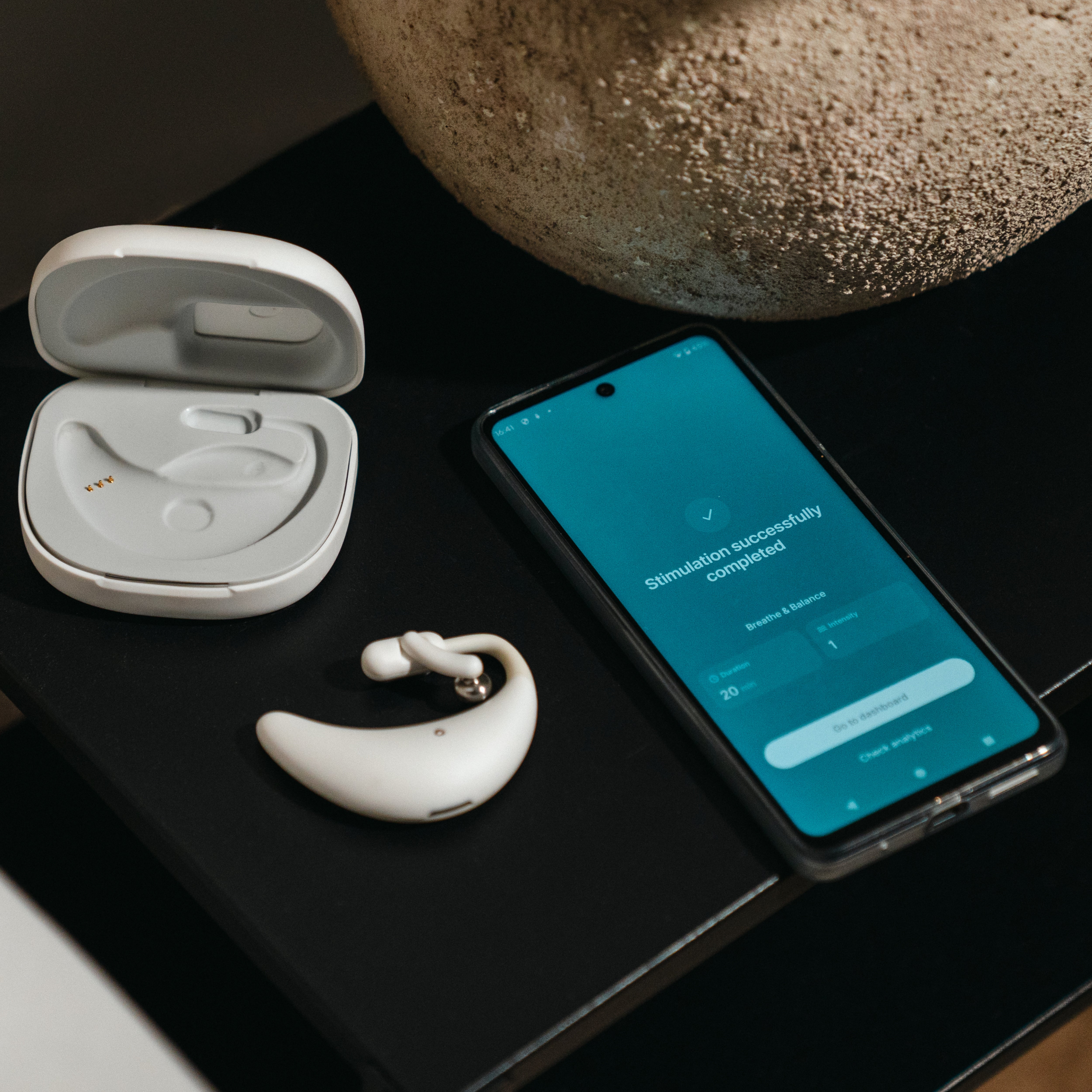
Think of the difference this way. A passive tracker is like a fuel gauge: invaluable for telling you the tank is low, but incapable of adding petrol. Sona is closer to the pump. It's the world's first truly personalised, AI-powered vagus nerve stimulator, built on a closed-loop system that reads your biometric signals and adapts in real time.
Four features define how it works. First, AI-driven personalisation — it reads HRV and respiration and tailors stimulation to you, not to a population average. Second, a closed-loop design that optimises every session rather than repeating a fixed programme. Third, time-locked delivery, synchronising pulses with your heart rhythm and breathing for maximum vagal effect. Fourth, a multi-modal approach combining gentle electrical stimulation with sound and breath guidance.
Importantly, there is no subscription — lifetime app access is included, which stands in deliberate contrast to the recurring-fee models common among trackers. Developed at the London Institute for Healthcare Engineering with a science team spanning neuroscience, HRV biofeedback, and AI, Sona reflects a rigorous evidence-first ethos. To be clear about what this means: Sona is a wellness device, and the broader VNS research we reference relates to the field, not to specific claims about this product. If you'd like to see it in detail, Explore SONA or read more about the personalisation principle in why personalised vagus nerve stimulation is a breakthrough.
Wellness Ring vs. Wellness Watch vs. Intervention Device: Which Should You Choose?
Form factor shapes behaviour — so the right choice depends less on specs and more on what you'll actually wear and use every day.
Rings (Oura, Samsung Galaxy Ring) win on comfort and sleep tracking. They're unobtrusive, excellent overnight, and ideal if you find watches bulky or already wear a traditional timepiece. The trade-off is a smaller screen — effectively none — so all insight lives in the app.
Watches (Apple Watch Series 10, Garmin Fenix 8, Withings ScanWatch 2) offer richer sensor arrays, on-wrist feedback, GPS, and ECG. They suit athletes, people managing cardiovascular awareness, and anyone who wants data at a glance. The cost is comfort during sleep and, for the more powerful models, battery anxiety.
Intervention devices (Sona) aren't an either/or with the above — they're a complement. A ring or watch tells you your nervous system is dysregulated; an intervention device gives you a tool to respond. Many of the most engaged users we've observed pair a monitor for awareness with Sona for action, using the tracker's HRV trend to gauge whether their nervous-system training is working over time. The key is consistency: think of it as strength training for your nervous system.
Key Features to Look for in a Wellness Wearable
When choosing a wellness wearable in 2026, prioritise validated accuracy, an honest subscription model, transparent data privacy, and — increasingly — whether the device can act on what it measures.
Use this checklist before you buy:
- Sensor accuracy & clinical validation: Has the manufacturer published or referenced peer-reviewed validation against gold-standard measures like polysomnography or ECG? Marketing claims are not evidence. - Subscription model: Is the price a one-time purchase, or does core functionality require ongoing fees? Calculate the three-year total cost, not the sticker price. - Data privacy: How does the brand store, share, or monetise your biometric data? Your HRV and sleep patterns are among the most intimate data you generate — read the policy, not just the homepage. - Battery life & charging friction: A device you forget to charge is a device that stops collecting data. Multi-day battery meaningfully improves adherence. - App quality & interoperability: Does it integrate with Apple Health, third-party longevity apps, and — where relevant — your other devices? Data trapped in a silo is less useful. - Personalisation capability: Does the device adapt to you, or apply the same algorithm to everyone? This is where AI-driven systems increasingly separate from the pack. - Actionability: Perhaps the most overlooked question of all — once the device tells you something is wrong, what can you actually do about it?
That final point is why the monitoring-versus-intervention distinction runs through this entire guide. Data without a lever is only half the story.
New Wellness Wearable Technologies to Watch in 2026
Three technologies are reshaping the wellness wearable category in 2026: non-invasive biomarker sensing, mature AI personalisation, and mainstream nervous-system intervention.
Non-invasive glucose and metabolic sensing has been the industry's long-promised frontier. Progress toward optical, needle-free glucose monitoring is real, though at the time of writing, fully validated, FDA-cleared non-invasive continuous glucose monitoring in a mainstream consumer wearable remains an emerging capability rather than a settled one. Treat bold marketing claims here with appropriate caution and look for regulatory clearance, not press releases.
AI personalisation has crossed from gimmick to genuine differentiator. The most interesting devices no longer just apply population averages — they learn your individual baseline and adapt. In the intervention tier, this is the entire premise: Sona's closed-loop system tailors stimulation to your real-time physiology rather than a generic setting.
Nervous-system intervention entering consumer wellness is arguably the biggest structural shift of all. For years, influencing the vagus nerve meant breathwork, cold exposure, or clinical devices. Now non-invasive, transcutaneous approaches have moved into the home. We track the peer-reviewed space in our transcutaneous vagus nerve stimulation literature review, which is the best starting point if you want to separate the evidence from the hype.
Data Privacy: What Happens to Your Biometric Data?
Your biometric data is deeply personal — and how each wearable brand stores, shares, or monetises it should influence your purchase as much as any feature.
This is the industry's quietest and most important question. Sleep patterns, HRV trends, menstrual data, and stress markers reveal an extraordinary amount about your health and behaviour. When that data leaves your device, where does it go? Some brands anonymise and aggregate for research; others have faced scrutiny over data-sharing arrangements. The uncomfortable reality is that a "free" or heavily-discounted device is sometimes subsidised by the value of your data.
Before buying, ask three concrete questions. Does the company sell or share biometric data with third parties? Is your data stored on-device, in the cloud, or both — and can you export and delete it? And does a subscription lapse mean losing access to your own historical data?
Devices with no subscription and local-first data handling generally give you more control. It's one reason we weight subscription-free ownership models highly — when you own the device outright and aren't the product, your incentives and the manufacturer's are better aligned. Whatever you choose, read the privacy policy before the marketing page; it tells you more about a company's priorities than any spec sheet.
Who Should Buy a Wellness Wearable (And Who Should Skip It)?
A wellness wearable is worth it if you'll act on the data — and a waste of money if it becomes anxiety-inducing background noise you learn to ignore.
Buy a passive monitor if you want to understand your patterns: how alcohol wrecks your sleep, how training load affects recovery, or how your HRV trends across a stressful month. If you're the kind of person who responds to feedback by changing behaviour, tracking pays for itself in insight.
Consider an active intervention device if your problem isn't a lack of information but a lack of a lever. If you already know you're stressed, sleeping poorly, or stuck in a dysregulated state — and you want a tool to actively support the shift toward calm — this is where devices like Sona belong. This is especially relevant for people managing burnout, high-pressure work, or chronic stress, though always alongside professional care where appropriate.
Skip wearables altogether if you notice tracking makes you more anxious rather than more informed — a genuine phenomenon sometimes called "orthosomnia," where sleep-tracking worry worsens the very thing it measures. For some people, awareness helps; for others, it harms. Know which you are.
For specific populations — athletes over 50, seniors, or those managing chronic conditions — the right pairing usually combines an accurate, low-friction monitor with, where suitable, an intervention tool matched to the specific goal. There is no universal best; there is only the best fit for your physiology and your life.
Frequently Asked Questions
What is the best wellness wearable in 2026?
It depends on your goal. For passive monitoring, the Oura Ring 4 leads on sleep and readiness, WHOOP 5.0 on recovery coaching, and Garmin Fenix 8 on athletic depth. For active intervention — actually changing your nervous-system state rather than just measuring it — Sona, an AI-powered vagus nerve stimulator, is our top pick because it reads your HRV and respiration and responds in real time.
Is the Oura Ring still worth buying in 2026?
Yes, for sleep and readiness tracking the Oura Ring 4 remains among the best passive wearables available, thanks to its comfortable form factor and strong sleep-staging accuracy. The main drawback is the ongoing subscription required for its richer insights, which raises the total cost of ownership compared with subscription-free alternatives.
What is the difference between a fitness tracker and a wellness wearable?
A fitness tracker focuses on activity metrics like steps, workouts, and calories. A wellness wearable takes a broader view of health — including sleep quality, HRV, stress, recovery, and temperature. A newer category, active intervention devices such as vagus nerve stimulators, goes a step further by attempting to influence your physiology rather than only measuring it.
Are wellness wearables actually accurate for health tracking?
Accuracy varies by device and metric. Consumer wearables are generally reliable for resting heart rate, sleep timing, and HRV trends, and some offer medical-grade ECG. They are less precise than clinical equipment for exact sleep staging or absolute measurements. Look for devices with published, peer-reviewed validation rather than relying on marketing claims.
Do wellness wearables require a monthly subscription?
Some do and some don't. WHOOP is subscription-based, and Oura reserves richer insights behind a monthly fee. Garmin, Apple Watch, Withings, and Sona provide their core functionality without recurring costs. Because subscriptions significantly affect long-term price, always calculate the three-year total cost before buying.
What is the best wearable for sleep tracking in 2026?
For passive sleep tracking, the Oura Ring 4 leads on accuracy and comfort, with the Withings ScanWatch 2 a strong low-maintenance alternative thanks to its 30-day battery. If your goal is not just measuring poor sleep but supporting the autonomic shift toward rest, an active intervention approach like pre-sleep vagus nerve stimulation is worth considering alongside a tracker.
Which wearable has the best battery life in 2026?
The Withings ScanWatch 2 leads mainstream devices with roughly 30 days per charge, followed by Garmin Fenix 8 at 16+ days and WHOOP at around 14 days. Rings such as Oura typically last 7-8 days, while smartwatches like the Apple Watch require near-daily charging.
How is Sona different from a wellness tracker like Oura or WHOOP?
Trackers like Oura and WHOOP passively measure your physiology and report it back to you. Sona is an active intervention device — an AI-powered vagus nerve stimulator that reads your HRV and respiration in real time and delivers personalised, time-locked stimulation to support a shift toward a calmer nervous-system state. It occupies a different product tier: monitors measure, Sona intervenes.
Conclusion
The best wellness wearable of 2026 isn't a single device — it's the one matched to a clear-eyed answer to one question: do you need awareness of your physiology, or the ability to change it? For awareness, the Oura Ring 4, WHOOP 5.0, and Garmin Fenix 8 are excellent, each strong in its own lane of sleep, recovery, and athletic depth. But if your frustration is that tracking has told you everything and changed nothing, the active-intervention tier is where the conversation moves next. Sona sits at the head of that emerging category — reading your nervous system in real time and responding, rather than simply keeping score. Data is valuable, but a lever is transformative. Many of the most satisfied users we've observed pair the two: a monitor to see the trend, and an intervention device to move it. Whichever path you choose, prioritise validated accuracy, honest pricing, and genuine control over your own data — because the right wearable should serve your health, not the other way around.
Ready to move from measuring your nervous system to actively supporting it? Explore SONA — the world's first truly personalised, AI-powered vagus nerve stimulator, with no subscription and lifetime app access — or dive into The Science Behind SONA to see how closed-loop, time-locked stimulation works. DISCLAIMER: Sona is a wellness device and is not a medically regulated product. The information in this article is for educational purposes only and does not constitute medical advice. We do not make any claims about Sona's ability to diagnose, treat, cure, or prevent any medical condition. Vagus nerve stimulation research referenced in this article relates to the broader field of VNS and may not be specific to any particular consumer device. Always consult a qualified healthcare professional before making decisions about your health.
Sources
- https://ouraring.com
- https://www.whoop.com
- https://www.withings.com
- https://www.garmin.com
- https://www.fda.gov



Share:
Best App for Burnout in 2026: Sona vs Calm, Headspace, Woebot & More
Vagus Nerve Stimulation for Tinnitus: Clinical Evidence, How It Works & What to Expect