If you are exhausted in a way that sleep no longer fixes, you are not failing — your nervous system is asking for a different kind of help. The best app for burnout depends on your stage and need: Sona targets the nervous system directly via vagus nerve stimulation and HRV regulation; Calm and Headspace support early-stage and recovery-phase burnout through mindfulness; Woebot delivers CBT-grounded cognitive support; and Oura provides physiological monitoring. There is no single winner. The right choice depends on your burnout stage (early, full, or recovery), how much cognitive energy you have available, and whether your primary need is regulation, reflection, or tracking. Below, you will find a comparison table, a stage-by-stage guide, individual deep-dives, and answers to the questions people ask most.
Key Takeaways
- The best app for burnout depends on your stage: early, full, or recovery — not on which app is most popular.
- Most burnout apps target cognition and behaviour (meditation, journaling, CBT) but do not address the underlying nervous system dysregulation that defines burnout.
- Sona is the only tool in this comparison that works directly on vagal tone through personalised vagus nerve stimulation and real-time HRV feedback.
- When your cognitive energy is depleted, low-effort tools that regulate the body (VNS, breath guidance) often work better than tools that demand focus.
- The most effective recovery often combines tools — a physiological regulator, a cognitive support, and a tracker — as a burnout recovery stack.
The Best Apps for Burnout Recovery: A Direct Answer
The best app for burnout depends on your stage and your primary need. Sona targets the nervous system directly via vagus nerve stimulation and HRV regulation; Calm and Headspace support early-stage and recovery-phase burnout through mindfulness; Woebot delivers CBT-grounded cognitive support; and Oura provides physiological monitoring.
The honest answer is that no single app wins for everyone. Your best match depends on three things: which burnout stage you are in (early, full, or recovery), how much cognitive availability you have on a given day, and whether your core need is regulation, reflection, or tracking.
To help you decide, this article works through a comparison table, a stage-by-stage guide, individual deep-dives of each tool, and a set of clear FAQ answers.
What Is Burnout — and Why Most Apps Only Scratch the Surface
Burnout is a physiological state, not a character flaw — and that distinction matters when you choose a tool. The World Health Organization's ICD-11 defines burnout as an occupational phenomenon resulting from chronic workplace stress that has not been successfully managed, characterised by three dimensions: exhaustion, cynicism or mental distance from work, and reduced professional efficacy. Importantly, the WHO classifies it as an occupational phenomenon rather than a medical condition, which distinguishes it from clinical depression.
How do I know if I have burnout and not just stress? The simplest test is rest. Stress is acute and resolves when the demand lifts — a weekend or a good night's sleep restores you. Burnout persists even after rest, because the underlying nervous system state has not reset.
Underneath the symptoms sits a physiological mechanism. Chronic stress drives sustained sympathetic nervous system dominance — the fight-or-flight branch stays switched on. Over time this suppresses heart rate variability (HRV), dysregulates cortisol rhythms, and erodes vagal tone, the capacity of your parasympathetic system to bring you back to calm. This is why burnout feels like being wired and depleted at the same time.
Here is the content gap most "best app" lists miss: nearly every burnout app targets cognition and behaviour — meditation, journaling, mood tracking, CBT. Those approaches have real value. But they ask a depleted brain to do more work, and they rarely touch the autonomic dysregulation that defines the state. Research into vagus nerve stimulation and stress reduction points to a different route — working directly with the body's regulatory hardware rather than through the thinking mind.
Effective recovery, then, is about matching the tool to the mechanism: nervous system regulation, cognitive reframing, or physiological tracking. Get the match wrong and even a well-designed app will feel like one more thing you are failing at.
Best Apps for Burnout at a Glance: Comparison Table
Use this table to match a tool to your stage and energy level — not to whichever app has the most downloads. When cognitive availability is low, prioritise tools in the "no" column for cognitive effort. Prices reflect annual or one-time cost so you can compare value later in the article.
| App | Primary mechanism | Best burnout stage | Key feature | Price | Requires cognitive effort |
|---|---|---|---|---|---|
| Sona | Vagus nerve stimulation + HRV regulation | Full burnout & recovery | AI-personalised, closed-loop VNS synced to your heart rhythm | £695 one-time (no subscription) | No |
| Calm | Meditation & sleep content | Early & recovery | Sleep Stories, guided relaxation | ~£40/year | Yes |
| Headspace | Structured mindfulness | Early & recovery | Guided courses, focus sessions | ~£50/year | Yes |
| Woebot | CBT chatbot | Early to full (cognitive) | Conversational cognitive reframing | Free / varies | Yes |
| Oura | Physiological tracking | All stages (monitoring) | HRV, sleep & readiness scores | ~£5.99/mo + ring cost | Low |
| Insight Timer | Meditation library | Early & recovery | Vast free meditation catalogue | Free / ~£60/year | Yes |
| Bearable | Symptom & mood tracking | All stages (monitoring) | Correlate habits with mood/energy | Free / ~£30/year | Yes |
Nervous system focus: Of every option here, only Sona works directly on vagal tone. Trackers like Oura and Bearable measure your physiology; meditation and CBT apps work through the mind. Sona is the sole tool designed to intervene at the level of the autonomic nervous system itself.
Match the App to Your Burnout Stage
The single biggest mistake in burnout recovery is using a recovery-stage tool during full burnout. Match the tool to where you actually are, not where you wish you were.
Early burnout: you still have cognitive capacity
At this stage you are stretched but functional — irritable, over-caffeinated, sleeping poorly, but still able to concentrate. This is where mindfulness and cognitive tools earn their place. Headspace and Calm help you build a daily pause before the pattern deepens, and Woebot can catch the cynical, catastrophising thoughts early. A tracker like Oura is valuable here too, because it can reveal the HRV decline before you consciously feel it. Pairing early awareness with breathwork that calms your nervous system fast is often enough to change course.
Full burnout: your cognitive fuel is gone
This is the stage where meditation apps quietly stop working — not because they are bad, but because they ask a depleted brain to focus, and focus is exactly what you have lost. Sitting still to "clear your mind" can even amplify agitation when you are in sympathetic overdrive or, worse, a dorsal vagal shutdown. Here, low-effort, body-first tools matter most. Vagus nerve stimulation requires no concentration — you simply wear the device while it does the regulatory work. Our nervous system approach to burnout recovery explains why bottom-up regulation often has to come before any top-down cognitive work is possible.
Recovery phase: rebuilding resilience
As capacity returns, the toolset widens again. This is the moment to layer approaches: continue nervous system training to rebuild vagal tone, reintroduce mindfulness for maintenance, and use tracking to confirm the trend is real. Think of this stage as training your nervous system to thrive under pressure — the goal is not just to feel better, but to raise your baseline resilience so the next demand does not tip you back over.
Sona: Best for Nervous System Regulation
Sona is the only tool in this comparison built to regulate the nervous system directly, which makes it distinctively suited to full burnout and recovery. Rather than working through the thinking mind, it targets the physiological state underneath the symptoms.
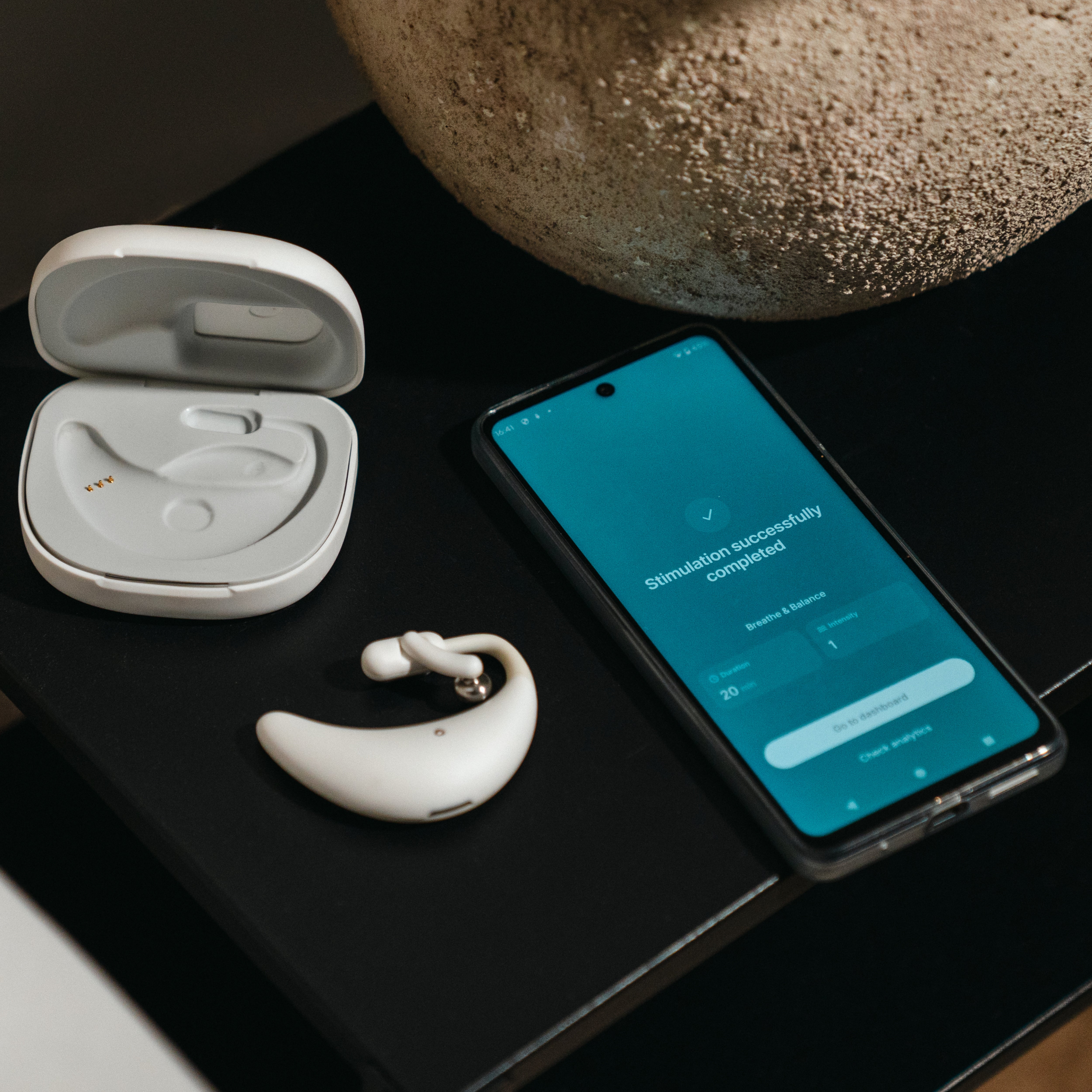
Sona is an AI-powered, personalised vagus nerve stimulator. It reads biometric signals — HRV and respiration — and adapts its stimulation in real time. This closed-loop design is the core differentiator: instead of a fixed, one-size-fits-all pulse, Sona time-locks its delivery to your heart rhythm and breathing. Our science team describes it as "pushing a swing at the right time": stimulation delivered in sync with your physiology is more efficient than stimulation delivered at random.
Why does this matter for burnout specifically? Because burnout is fundamentally a state of low vagal tone and sympathetic dominance. Broad research on transcutaneous vagus nerve stimulation (tVNS) indicates it can increase HRV and support a shift toward parasympathetic activity — the exact regulatory capacity burnout erodes. You can read a fuller account in our science-backed guide to VNS for burnout and the deeper mechanism in the neuroscience of burnout.
The practical advantages for a depleted person are real. It requires no cognitive effort — you are not being asked to concentrate, journal, or perform. It combines electrical stimulation with sound and breath guidance, so it works multi-modally. And it carries no subscription: a one-time £695 device with lifetime app access, which changes the long-term cost picture considerably.
The honest limitation: Sona is a hardware purchase with a higher upfront cost than a meditation subscription, and it is a wellness device rather than a medical treatment. It is not a therapist and does not replace clinical care. What it offers is something no app on this list does — a way to work with your body's innate regulatory wisdom rather than against your depleted attention. Explore SONA or read The Science for the full evidence base.
Calm & Headspace: Best for Mindfulness and Early Prevention
Calm and Headspace are the strongest choices for early-stage burnout and for maintenance during recovery, when you still have the cognitive bandwidth to engage with guided practice.
Headspace excels at structure. Its guided courses build meditation as a skill progressively, which suits people who want a clear path rather than an open library. Calm leans toward relaxation and sleep, with its well-known Sleep Stories and soothing soundscapes — useful when burnout is disrupting rest. For a detailed head-to-head on the sleep dimension, see our comparison of the best sleep apps of 2026.
Is Headspace or Calm better for burnout? Neither is definitively better — they solve slightly different problems. Choose Headspace if you want structured skill-building and daytime focus; choose Calm if your main issue is winding down and sleep. Both share the same fundamental limitation for burnout: they require you to focus, which is precisely the resource full burnout depletes. That is why they are better positioned as prevention and maintenance tools than as rescue tools for someone already flat on the floor. We cover the wider category in our roundup of wellness apps for stress relief.
Woebot & CBT Apps: Best for Cognitive Reframing
Woebot is the pick when the dominant feature of your burnout is distorted, cynical thinking rather than physical depletion. It delivers cognitive support grounded in evidence-based therapy.
Woebot is a conversational chatbot built on cognitive behavioural therapy (CBT) principles. It helps you notice cognitive distortions — the all-or-nothing thinking, catastrophising, and self-criticism that thread through burnout's cynicism dimension — and gently reframe them. Because CBT is one of the most evidence-supported psychological frameworks, apps built on it tend to outperform general wellness apps on the cognitive dimension specifically. Research on digital CBT tools suggests they can meaningfully reduce symptoms of stress and low mood, though effects vary by engagement.
The caveat is the same one that runs through this whole comparison: CBT is a top-down, cognitive intervention. It works well when you have enough capacity to reflect and engage, which is more realistic in early or moderate burnout than in the fully depleted state. And a chatbot is not a substitute for a human therapist when burnout tips toward clinical depression — a distinction worth taking seriously.
Oura, Insight Timer & Bearable: Best for Tracking and Free Access
These three cover the supporting roles in a burnout stack — physiological monitoring and low-cost access — rather than direct intervention.
Oura is a tracking tool, not a treatment. Its ring monitors HRV, sleep, and a daily readiness score, giving you objective evidence of the physiological decline burnout causes and the recovery that follows. Seeing your HRV trend can be genuinely motivating, and it pairs naturally with any active intervention. For a broader look at the category, see our guide to the best HRV tracking devices of 2026 and our explainer on what your heart rate variability reveals.
Insight Timer answers the "are there free apps for burnout?" question well. It offers an enormous free library of meditations and talks, making it the best no-cost entry point for mindfulness — with the same cognitive-effort caveat as Calm and Headspace.
Bearable is a flexible symptom and mood tracker. It lets you correlate habits, energy, and mood over time, which is useful for spotting the patterns that feed your burnout. Like Oura, it measures rather than intervenes — most powerful when paired with a tool that actively shifts your state.
Building a Burnout Recovery Stack
The most effective approach rarely relies on a single app — it combines a regulator, a reflector, and a tracker into a recovery stack matched to your stage.
Think of the three roles this way. A regulator shifts your physiological state (vagus nerve stimulation, breathwork). A reflector works on thoughts and behaviour (Woebot, journaling, meditation). A tracker provides feedback so you know whether it is working (Oura, Bearable). Most "best app" lists treat each tool as a standalone winner; in practice, they play different positions on the same team.
A practical full-burnout stack might look like: Sona for daily nervous system regulation, Oura to confirm HRV is recovering, and — once capacity returns — Headspace or Woebot layered in for cognitive maintenance. The sequencing matters. Regulate the body first, then engage the mind; asking a dysregulated nervous system to do cognitive work is like trying to reason with someone mid-panic.
On cost and ROI: a stack of subscriptions adds up quietly. Calm, Headspace, Oura, and Bearable together can exceed £150 a year, every year. Sona's £695 one-time cost with no subscription reframes the maths over a multi-year horizon — and remains a fraction of the cost of ongoing private therapy or coaching, which it complements rather than replaces.
Frequently Asked Questions
What is the best app for burnout recovery?
There is no single best app for everyone — it depends on your stage and need. Sona is best for nervous system regulation via vagus nerve stimulation, Headspace and Calm for early-stage and recovery mindfulness, Woebot for CBT-based cognitive support, and Oura for physiological tracking. In full burnout, low-effort body-first tools tend to outperform apps that demand focus.
Can an app really help with burnout?
Yes, but with limits. Apps and devices can support recovery by regulating your nervous system, reframing unhelpful thoughts, or tracking your physiology. They work best matched to your burnout stage and combined into a stack. They are not a replacement for professional care when burnout overlaps with clinical depression or when symptoms are severe.
Is Headspace or Calm better for burnout?
Neither is definitively better; they solve different problems. Choose Headspace for structured meditation skill-building and daytime focus, and Calm for relaxation and sleep support. Both require cognitive effort, which makes them better suited to early burnout and recovery-phase maintenance than to full burnout, when concentration is depleted.
What app helps with exhaustion and low motivation?
When exhaustion and low motivation dominate, low-effort tools that regulate the body work better than those requiring focus. Vagus nerve stimulation devices like Sona require no concentration and target the low vagal tone underlying burnout fatigue. A tracker like Oura can help you see recovery objectively, which itself supports motivation.
Are there free apps for burnout?
Yes. Insight Timer offers a large free meditation library, Woebot provides free CBT-based chat support, and Bearable has a free mood-tracking tier. Free apps are a good entry point for mindfulness and cognitive support, though tools that intervene directly at the physiological level, such as VNS devices, involve a hardware cost.
How do I know if I have burnout and not just stress?
The clearest sign is whether rest restores you. Stress is acute and resolves after a break or good sleep. Burnout persists even after rest because the underlying nervous system state has not reset — marked by ongoing exhaustion, cynicism, and reduced efficacy, per the WHO ICD-11 definition.
What is the difference between burnout and depression apps?
Burnout apps target an occupational, physiological state — exhaustion, cynicism, and low efficacy — often through regulation, mindfulness, or tracking. Depression is a clinical mental health condition, and apps addressing it are typically CBT-based or clinically supervised. If your symptoms extend beyond work into pervasive hopelessness, consult a healthcare professional rather than relying on an app.
Conclusion
Burnout is not a willpower problem, and it will not be solved by adding one more demanding habit to an already empty tank. The best app for burnout is the one matched to where you actually are: mindfulness apps like Calm and Headspace for early prevention and recovery maintenance, Woebot for cognitive reframing, Oura for objective tracking, and Sona for the piece almost everything else misses — direct regulation of the nervous system itself. If there is one takeaway, it is this: regulate the body first, then engage the mind. Recovery follows the mechanism, not the marketing.
If your exhaustion no longer responds to rest, your nervous system may need direct support rather than more effort. Explore SONA to see how AI-personalised vagus nerve stimulation works, or dig into The Science Behind SONA to understand the evidence for yourself. DISCLAIMER: Sona is a wellness device and is not a medically regulated product. The information in this article is for educational purposes only and does not constitute medical advice. We do not make any claims about Sona's ability to diagnose, treat, cure, or prevent any medical condition. Vagus nerve stimulation research referenced in this article relates to the broader field of VNS and may not be specific to any particular consumer device. Always consult a qualified healthcare professional before making decisions about your health.
Sources
- https://www.who.int/standards/classifications/frequently-asked-questions/burn-out-an-occupational-phenomenon
- https://icd.who.int/browse11/l-m/en


Share:
Best Vagus Nerve Stimulation Device for Sleep (2026): Sona vs Top VNS Options Compared
Best Wellness Wearable 2026: Trackers, Rings & Active Intervention Devices Compared