


Vagus nerve stimulation for tinnitus pairs brief electrical pulses to the vagus nerve with carefully chosen tones, driving the auditory cortex to reorganise itself and quieten phantom sound. Phase III trial data (EVOKE, MicroTransponder) showed statistically and clinically significant reductions versus sham stimulation. Most strong evidence comes from surgically implanted cervical VNS paired with sound therapy — though non-invasive alternatives are emerging fast.
That's the short version. But tinnitus is a genuinely misunderstood condition, and the logic behind why stimulating a nerve in your neck might silence a ringing in your ears is one of the more elegant stories in modern neuroscience. This article walks through the mechanisms, the clinical evidence, realistic timelines, costs, access routes, and how paired VNS compares to everything else on offer. If you want the foundations first, our overview of how vagus nerve stimulation works is a useful companion.
Key Takeaways
- Chronic tinnitus is primarily a brain problem — a maladaptive reorganisation of the auditory cortex — not simply an ear problem, which is why paired VNS targets cortical plasticity rather than the cochlea.
- The landmark EVOKE trial (Phase III) found paired VNS plus sound therapy produced statistically and clinically significant tinnitus reductions compared with sham, leading to FDA marketing authorisation for the Lenire device (Neuromod) in 2023.
- Improvement is gradual: most participants notice meaningful change over 6-12 weeks of daily use, not overnight.
- Invasive cervical VNS requires surgery; non-invasive transcutaneous options (auricular or cervical) are lower-risk and increasingly the practical route for most people.
- Pairing matters mechanistically — the vagal pulse must be time-locked with the tone so neuromodulators arrive at the exact moment the cortex is processing sound.
Vagus Nerve Stimulation for Tinnitus: The Short Answer
Does vagus nerve stimulation actually work for tinnitus? For many people, the evidence says yes — modestly but meaningfully. Vagus nerve stimulation for tinnitus combines paired electrical stimulation with tonal audio to drive neuroplastic reorganisation in the auditory cortex, gradually retraining the brain to stop over-representing phantom frequencies. The Phase III EVOKE trial showed statistically and clinically significant reductions versus sham stimulation.
Most of the strongest data comes from invasive cervical VNS paired with sound therapy, though non-invasive alternatives are emerging quickly. Below, we cover mechanisms, evidence, realistic timelines, costs, and how to access treatment. For the underlying biology, start with how vagus nerve stimulation works.
What Is Vagus Nerve Stimulation (VNS)?
Vagus nerve stimulation is the deliberate delivery of electrical pulses to the vagus nerve — the body's primary parasympathetic highway, running from the brainstem down through the neck and into the chest and abdomen. It is the longest cranial nerve, and it carries a continuous stream of signals between your organs and your brain, shaping heart rate, digestion, inflammation, and arousal.
There are two broad delivery routes. Invasive VNS uses a surgically implanted electrode wrapped around the cervical vagus nerve, wired to a pulse generator under the collarbone — the approach long used in epilepsy and treatment-resistant depression. Non-invasive VNS delivers current through the skin, either at the ear (transcutaneous auricular VNS, or taVNS) or the side of the neck (transcutaneous cervical VNS).
Mechanistically, the pulses travel up ascending vagal projections to key brainstem hubs — the locus coeruleus and nucleus basalis — which release neuromodulators such as acetylcholine and norepinephrine. These chemicals act as a plasticity gate: they briefly open a window in which the brain becomes more receptive to rewiring. That gating property is precisely what makes VNS interesting for tinnitus.
It's worth distinguishing tinnitus-specific VNS, which is paired with sound, from general therapeutic VNS used for epilepsy, depression, and autonomic regulation. The delivery hardware overlaps, but the therapeutic logic differs. Our complete guide to vagus nerve stimulation unpacks the broader applications, and the best vagus nerve stimulation devices comparison breaks down VNS device types. We'll dig into the tinnitus evidence in the sections below.
Why Does Tinnitus Happen? The Brain Reorganisation Problem
How does the vagus nerve relate to tinnitus? The connection makes sense only once you understand that chronic tinnitus is, at its core, a brain problem — not an ear problem. And if a distorted brain map generates the phantom sound, then a treatment that reshapes that map is mechanistically rational.
Tinnitus usually begins peripherally: damage to the cochlea — from noise exposure, ageing, or ototoxic drugs — reduces the input reaching the brain from specific frequencies. But the ringing itself is generated centrally. The auditory cortex, starved of input at the damaged frequencies, doesn't fall silent. Instead it does something maladaptive: neighbouring neurons expand to fill the gap, over-representing the deprived frequency range in a process called tonotopic map distortion.
This reorganised cortex becomes hyperactive and abnormally synchronised. Research indicates that tinnitus is associated with aberrant neural synchrony and elevated spontaneous gamma-band oscillations — bursts of coordinated firing that the brain interprets as sound, even though no sound exists. The phantom tone is the perceptual signature of a map that has rewired itself in the wrong direction.
This is why peripheral treatments only go so far. Hearing aids can help by restoring input and masking the percept, but they don't reverse the underlying map distortion. The cortical reorganisation persists. That's the crux: chronic tinnitus is a disorder of maladaptive plasticity, so the rational therapeutic target is plasticity itself. If you can pair a sound with a signal that opens the brain's rewiring window at exactly the right moment, you can — in principle — nudge the tonotopic map back toward normal. That is precisely what paired VNS attempts to do.
How Does VNS Work to Treat Tinnitus? The Power of Pairing
Paired VNS works by exploiting timing. The therapy delivers a brief vagal pulse at the exact instant a specific tone is played, and it's this precise pairing — not the stimulation alone — that produces the therapeutic effect.
Here's the sequence. When the vagal pulse fires, the locus coeruleus and nucleus basalis flood the auditory cortex with acetylcholine and norepinephrine, briefly heightening the brain's capacity for change. If a tone is presented in that same narrow window, the neurons responding to that tone are selectively strengthened — while the maladaptive, over-represented tinnitus frequency is deliberately excluded from the pairing. Repeated thousands of times over weeks, this drives a targeted rebalancing of the tonotopic map.
The foundational animal work came from the University of Texas at Dallas, where Engineer and colleagues (2011), published in Nature, showed that pairing VNS with tones reversed the physiological and behavioural signatures of tinnitus in noise-exposed rats. The key finding was specificity: the effect depended on the tone being time-locked to the stimulation. Unpaired stimulation didn't work.
This is why the analogy of "pushing a swing at the right time" is so apt — the same principle behind time-locked delivery in modern personalised VNS. A push at the wrong moment does nothing; a push at the peak of the arc adds energy efficiently. Neuroplasticity works the same way: the neuromodulators have to arrive precisely when the cortex is processing the target sound.
Importantly, this is a re-training model, not a masking one. Rather than covering up the ringing, paired VNS aims to change the neural circuitry producing it. That distinction matters for what you should realistically expect: gradual, cumulative change rather than instant relief.
What Does the Research Say? Clinical Trials and the EVOKE Study
The clinical picture for paired VNS in tinnitus is cautiously encouraging: early implanted trials were mixed, but a large sham-controlled study of a non-invasive paired system produced clear positive results.
Early pilot studies of invasive cervical VNS paired with tones — building directly on the Texas animal work — reported reductions in tinnitus severity in small groups of patients, but samples were tiny and effects varied. The bigger breakthrough came from bimodal (paired) non-invasive stimulation, which pairs sound delivered through headphones with mild electrical stimulation of the tongue (targeting the trigeminal and, in related designs, vagal pathways) to drive the same plasticity mechanism without surgery.
The EVOKE Trial: A Landmark Study. What is the EVOKE trial for tinnitus? EVOKE was a large, randomised, double-blind clinical trial of the Lenire bimodal neuromodulation device developed by Neuromod Devices. Results published by Conlon and colleagues (2020) in Science Translational Medicine followed more than 300 participants and found that paired sound-and-stimulation therapy produced statistically and clinically significant reductions in tinnitus symptom severity, with benefits sustained at 12 months in a large proportion of participants. High treatment adherence and strong safety were also reported.
Subsequent work — including further trials reported by the same research group — helped establish which stimulation parameters produced the strongest response, and in 2023 the device received FDA marketing authorisation for tinnitus in the United States, a notable regulatory milestone for the field.
Two honest caveats. First, paired VNS is not a cure — it reduces symptom burden and improves quality of life for many, but not everyone responds. Second, long-term data beyond 12 months, and relapse rates after treatment stops, remain relatively thin. Some participants maintain gains after the treatment period; others may benefit from periodic "top-up" sessions. The broader evidence base for transcutaneous approaches is reviewed in our transcutaneous vagus nerve stimulation literature review.
Invasive vs Non-Invasive Vagus Nerve Stimulation for Tinnitus
The core trade-off is straightforward: invasive VNS delivers precise, direct stimulation but requires surgery, while non-invasive VNS is far lower-risk and more accessible, at the cost of some precision.
Invasive cervical VNS involves implanting an electrode around the vagus nerve, connected to a pulse generator. It offers reliable, targeted activation and is the approach used in the earliest paired-VNS tinnitus studies. But it carries the risks of any surgery — infection, vocal changes, and the burden of a permanent implant — which is a high bar for a condition that, while distressing, is not life-threatening.
Non-invasive VNS delivers stimulation through the skin. Transcutaneous auricular VNS (taVNS) targets the vagal branch supplying part of the outer ear; transcutaneous cervical VNS targets the nerve at the neck. These approaches sidestep surgery entirely, can be used at home, and have a benign side-effect profile — typically mild tingling or skin irritation at the electrode site.
For tinnitus specifically, the most successful large trial (EVOKE) used a non-invasive bimodal system, which suggests surgery is not a prerequisite for meaningful benefit — provided the pairing between sound and stimulation is precise. That's the real determinant of success: not how deep the electrode sits, but how accurately the stimulation is time-locked to the sound.
This is where the wider VNS field is heading. Personalised, closed-loop systems that read your physiology and time each pulse precisely represent the natural evolution of non-invasive stimulation — a direction we explore in why personalised VNS is a breakthrough.
Who Is a Candidate for VNS Tinnitus Treatment?
Paired VNS is generally aimed at adults with chronic, bothersome tinnitus that hasn't responded adequately to first-line approaches — but candidacy always requires professional audiological assessment.
In clinical trials, participants typically had subjective tinnitus present for at least several months, of moderate-to-severe impact on quality of life, and were medically stable. The therapy is best suited to people whose tinnitus is genuinely disruptive — affecting sleep, concentration, or mood — rather than occasional, mild ringing that fades into the background.
Certain factors may make someone unsuitable, including pulsatile tinnitus (which can signal a treatable vascular cause and warrants separate investigation), untreated ear disease, or, for implanted systems, contraindications to surgery. Sudden, one-sided, or rapidly changing tinnitus always needs medical evaluation first, because it can point to an underlying condition.
Because tinnitus so often travels alongside anxiety, poor sleep, and chronic stress — each of which amplifies the perception of the sound — many people benefit from a nervous-system approach in parallel. Regulating vagal tone can dampen the arousal that makes tinnitus feel louder. Our guides to vagus nerve stimulation for anxiety and vagus nerve stimulation for sleep explore that overlap. Ultimately, a hearing specialist or ENT is the right person to confirm whether paired VNS fits your situation.
Risks and Side Effects of Vagus Nerve Stimulation
For non-invasive VNS, side effects are typically mild and transient; for surgically implanted systems, the risk profile is more substantial. This is a key reason non-invasive approaches dominate the tinnitus conversation.
Non-invasive (transcutaneous) VNS — used in most tinnitus devices — is well tolerated. Reported side effects are usually limited to tingling, mild skin irritation or redness at the electrode site, and occasionally a brief headache or dizziness. In the EVOKE studies, adherence was high and serious device-related adverse events were rare, which is one of the reasons the approach is considered suitable for home use.
Invasive cervical VNS carries the risks inherent to any implant and to stimulating a major nerve directly: voice hoarseness or changes (the vagus supplies the larynx), cough, throat discomfort, shortness of breath during stimulation, and surgical risks such as infection. These effects are often manageable by adjusting stimulation settings, but they are a meaningful consideration for a quality-of-life condition.
A sensible precaution across all forms of VNS: anyone with a cardiac condition, an implanted device such as a pacemaker, a history of seizures, or who is pregnant should seek medical clearance before beginning. Because the vagus nerve influences heart rate, stimulation parameters matter — and this is exactly why professional guidance is worthwhile.
How to Access VNS Therapy and What It Costs
Access depends heavily on where you live and which route you pursue — and how much does vagus nerve stimulation for tinnitus cost? varies widely, from a few hundred to several thousand pounds or dollars.
Clinically supervised bimodal therapy (such as FDA-authorised systems) is typically obtained through participating audiology or ENT clinics, often involving an initial fitting, a supervised treatment programme spanning several weeks to months, and follow-up. Costs commonly run into the low thousands, and because tinnitus treatments are frequently classified as elective, insurance coverage is inconsistent — many people pay out of pocket. It's worth confirming coverage and total programme cost upfront.
Clinical trials remain a valuable access route, particularly for investigational devices. Registries such as ClinicalTrials.gov list active tinnitus and VNS studies worldwide; a hearing specialist can help you identify centres currently recruiting.
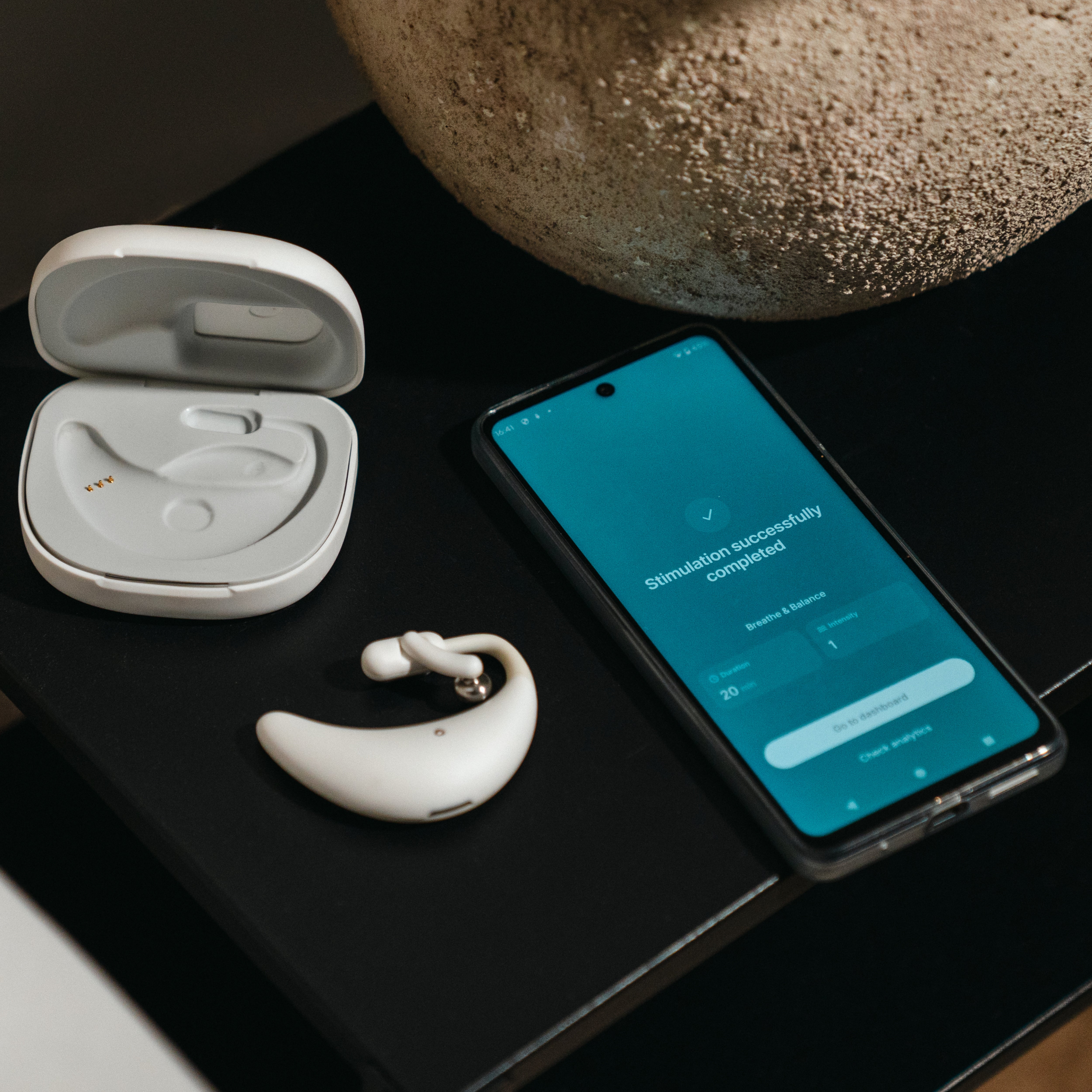
Consumer non-invasive VNS devices occupy a different tier entirely. These are wellness devices — not regulated tinnitus treatments — designed to support vagal tone, stress regulation, and sleep, all of which can influence how intrusive tinnitus feels. They are typically a one-off purchase in the few-hundred range rather than an ongoing clinical programme. The SONA device, for example, is a personalised, AI-powered non-invasive VNS system priced at £695 with no subscription — though it's important to be clear it is a wellness product, not a medical tinnitus treatment. For a broader comparison of what's available, see our best VNS devices guide.
How VNS Compares to Other Tinnitus Treatments
Paired VNS is best understood not as a replacement for existing tinnitus care, but as a mechanistically distinct addition — one that targets the cause rather than the perception.
Most established tinnitus management works by changing your relationship to the sound rather than the sound itself. Cognitive behavioural therapy (CBT) is the most evidence-backed intervention for reducing tinnitus distress; it doesn't lower the volume, but it reliably reduces suffering. Sound therapy and masking cover or partially neutralise the percept. Hearing aids restore input and are genuinely helpful when hearing loss is present. Tinnitus retraining therapy combines counselling with sound enrichment to promote habituation.
Paired VNS is different in kind: it aims to reverse the underlying cortical map distortion, addressing the generator rather than the interpretation. That's an appealing proposition — but it demands consistency, produces gradual change, and doesn't help everyone.
The pragmatic view is that these approaches are complementary. Someone might use hearing aids for input, CBT to reduce distress, sleep and stress regulation to lower arousal, and paired VNS to target the plasticity itself. Because stress and poor sleep measurably amplify tinnitus perception, general nervous-system regulation is a sensible foundation for any of these — the reason we so often return to vagal tone as a lever.
At-Home and Non-Invasive VNS: What to Expect on the Timeline
How long does vagus nerve stimulation take to work for tinnitus? Expect a gradual arc measured in weeks, not days — the therapy retrains neural circuitry, and rewiring takes repetition.
In the EVOKE trials, participants typically used the device for around an hour a day, and meaningful improvement generally emerged over roughly 6 to 12 weeks of consistent use. Early weeks may bring little perceptible change; benefit tends to accumulate, which is why adherence is one of the strongest predictors of response. Stopping early is the most common reason people don't benefit.
A realistic week-by-week picture looks something like this: weeks 1-2 are about establishing the habit and tolerating the sensation; weeks 3-6 are where subtle shifts — often in how much the tinnitus bothers you rather than its raw volume — begin to appear; weeks 6-12 are where clinically meaningful change tends to consolidate. Improvement is frequently reported first as reduced intrusiveness — the sound recedes into the background before it necessarily gets quieter.
Consumer non-invasive devices operate on a related principle of daily consistency, though for wellness goals rather than clinical tinnitus treatment. The idea is the same one that runs through all effective nervous-system work: think of it as strength training for your nervous system, where the results come from showing up repeatedly. Our vagus nerve stim cheatsheet sets out what to expect in the first weeks of any VNS routine, and the science behind SONA explains how personalised, time-locked stimulation aims to make each session count.
Frequently Asked Questions
Does vagus nerve stimulation actually work for tinnitus?
For many people, yes — modestly but meaningfully. The Phase III EVOKE trial of a non-invasive bimodal (paired) system found statistically and clinically significant reductions in tinnitus severity versus sham, with benefits sustained at 12 months in a large proportion of participants. It is not a cure, and not everyone responds, but paired VNS has stronger clinical evidence than most tinnitus interventions.
Is vagus nerve stimulation for tinnitus FDA approved?
A bimodal neuromodulation device (Lenire, by Neuromod Devices) received FDA marketing authorisation for tinnitus in 2023, based largely on the EVOKE clinical programme. This applies to that specific clinical device. General consumer VNS wellness devices are not FDA-approved treatments for tinnitus.
How long does vagus nerve stimulation take to work for tinnitus?
Improvement is gradual. In clinical trials, meaningful change typically emerged over roughly 6 to 12 weeks of daily use (around an hour per day). Early weeks may bring little perceptible difference; benefit accumulates, so consistency is one of the strongest predictors of response.
What is the success rate of VNS for tinnitus?
In the EVOKE trials, a large proportion of participants — commonly reported in the region of two-thirds — experienced clinically meaningful improvement in tinnitus symptom severity, with gains sustained at 12 months for many. Response varies by individual, and a minority see little change.
Can you stimulate the vagus nerve at home to help tinnitus?
Yes, non-invasive VNS can be used at home, and clinically authorised bimodal devices are designed for home-based programmes under professional guidance. Consumer wellness VNS devices can also be used at home to support vagal tone, stress and sleep — factors that influence how intrusive tinnitus feels — but these are not regulated tinnitus treatments.
What is the EVOKE trial for tinnitus?
EVOKE was a large, randomised, double-blind trial of the Lenire bimodal neuromodulation device by Neuromod Devices. Results (Conlon et al., 2020, Science Translational Medicine) followed over 300 participants and found paired sound-and-stimulation therapy produced significant, sustained reductions in tinnitus severity — a landmark result for the field.
How much does vagus nerve stimulation for tinnitus cost?
Clinically supervised bimodal therapy programmes commonly run into the low thousands of pounds or dollars, and insurance coverage is inconsistent because tinnitus treatment is often classified as elective. Consumer non-invasive wellness VNS devices are typically a one-off purchase in the few-hundred range. Confirm total programme cost and coverage before starting.
What are the side effects of vagus nerve stimulation for tinnitus?
Non-invasive VNS side effects are usually mild and temporary: tingling, skin irritation at the electrode site, and occasionally a brief headache or dizziness. Surgically implanted cervical VNS carries more substantial risks, including voice changes, cough, throat discomfort, and surgical complications. Anyone with a heart condition, pacemaker, seizure history, or who is pregnant should seek medical clearance first.
Conclusion
Vagus nerve stimulation for tinnitus represents one of the more intellectually satisfying stories in modern neuroscience: recognise that chronic tinnitus is a disorder of maladaptive brain plasticity, then use precisely timed stimulation to nudge that plasticity back toward balance. The EVOKE trial gave the approach genuine clinical credibility, and FDA authorisation of a bimodal device marked a real milestone. But the honest summary is this — paired VNS is a promising, evidence-backed tool that reduces symptom burden for many, gradually and with consistent use, without being a guaranteed cure. The lesson that runs beneath all of it is the same one that governs so much nervous-system health: results come from showing up, and from getting the timing right.
Curious how precisely timed, personalised vagus nerve stimulation works? Explore SONA to see how our AI-powered device reads your physiology and synchronises each pulse to your heart rhythm and breath — or dig into the science behind SONA to understand the research foundations. (Note: SONA is a wellness device, not a medical tinnitus treatment.)
Disclaimer
DISCLAIMER: Sona is a wellness device and is not a medically regulated product. The information in this article is for educational purposes only and does not constitute medical advice. We do not make any claims about Sona's ability to diagnose, treat, cure, or prevent any medical condition. Vagus nerve stimulation research referenced in this article relates to the broader field of VNS and may not be specific to any particular consumer device. Always consult a qualified healthcare professional before making decisions about your health.
Sources
- Engineer, N. D., et al. (2011). Reversing pathological neural activity using targeted plasticity. Nature. Https://www.nature.com/articles/nature09656
- Conlon, B., et al. (2020). Bimodal neuromodulation combining sound and tongue stimulation reduces tinnitus symptoms in a large randomized clinical study. Science Translational Medicine. Https://www.science.org/doi/10.1126/scitranslmed.abb2830
- U.S. Food and Drug Administration — De Novo / marketing authorisation records for tinnitus neuromodulation devices. Https://www.fda.gov
- ClinicalTrials.gov — registry of active tinnitus and vagus nerve stimulation studies. Https://clinicaltrials.gov




Share:
Best Wellness Wearable 2026: Trackers, Rings & Active Intervention Devices Compared