

Sona and Hoolest Verelief are both non-invasive vagus nerve stimulators built to calm your nervous system, but they solve different problems. Sona focuses on sleep and nighttime anxiety, using AI-driven personalisation that adapts to your HRV and breathing in real time. Verelief targets daytime stress and HRV improvement with a discreet, ear-based form factor. Your best choice comes down to your primary goal, your budget, and how you plan to use it.
Both devices tap into vagus nerve stimulation : the practice of gently activating the body's largest cranial nerve to shift you out of fight-or-flight and into rest-and-digest. But the way they do it, and the outcomes they prioritise, differ meaningfully. Below, we compare features, clinical evidence, pricing, and exactly who each device suits best, so you can make a confident decision in 2026.
Key Takeaways
- **Sona** is designed sleep-first, with a closed-loop AI system that reads your HRV and respiration and adapts stimulation every session : combining electrical stimulation, sound, and breath guidance.
- **Hoolest Verelief** is a compact, discreet, ear-based device built for daytime stress relief and on-the-go calm, using fixed stimulation parameters.
- **Pricing:** Sona is £695 (~$950) with no subscription and lifetime app access; Verelief sits at a lower entry price point but offers no real-time biometric adaptation.
- **Personalisation** is the key divide: Sona optimises to your physiology in real time, while Verelief delivers a consistent, one-size-fits-all signal.
- **Choose Sona** if sleep, nighttime anxiety, and data-driven personalisation matter most; **choose Verelief** if you want a portable, budget-friendly daytime stress tool.
What Is Sona?
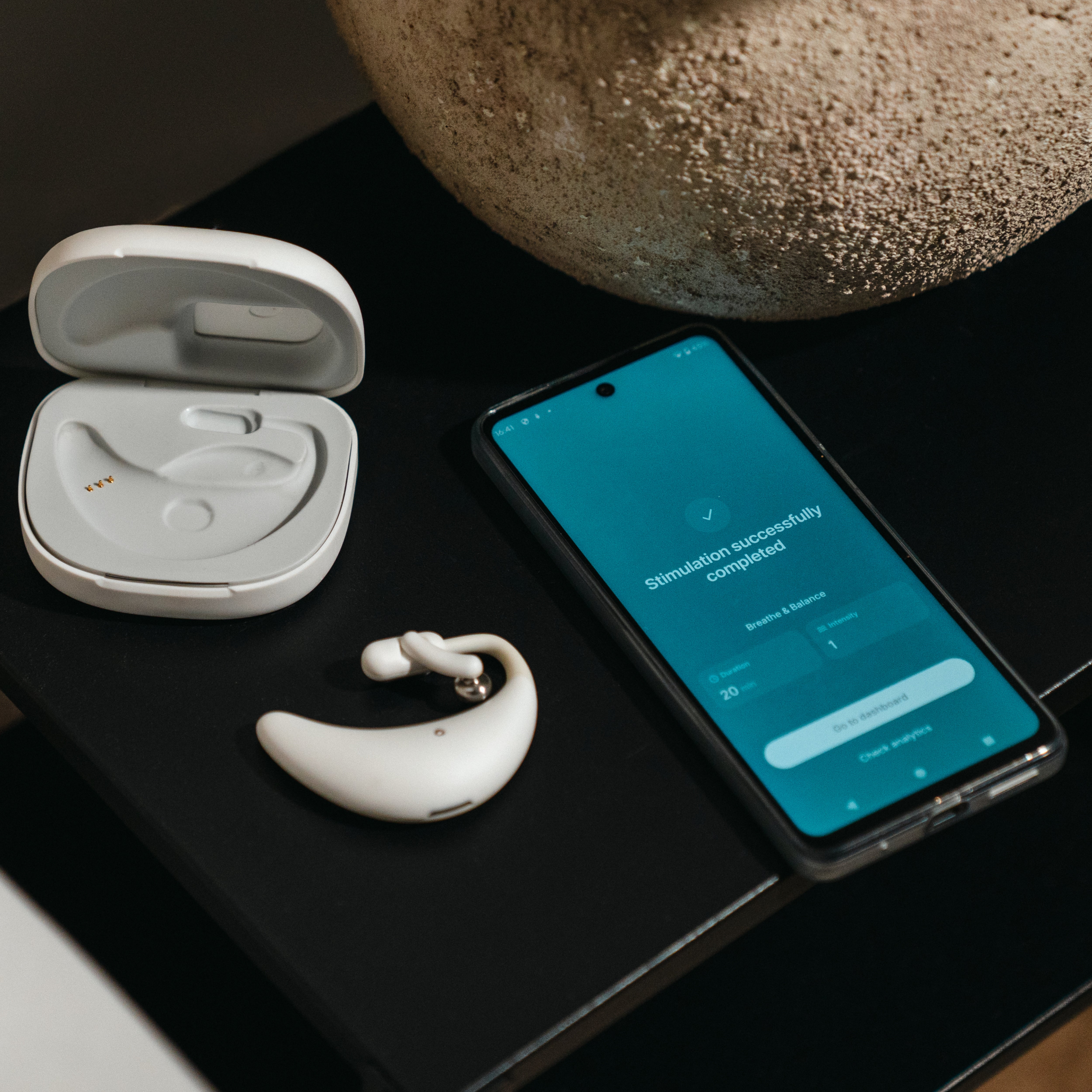
Sona is an AI-powered, non-invasive vagus nerve stimulator that adapts stimulation in real time to your HRV and breathing patterns. Developed by MindSpire Ltd in London, it's positioned as the world's first truly personalised VNS device.
What sets Sona apart is its closed-loop system. Rather than delivering the same signal to everyone, Sona reads your heart rate variability and respiration in real time and adjusts stimulation parameters throughout each session. Think of it as pushing a swing at exactly the right moment : the pulses are time-locked to your own heart rhythm and breath for maximum effect.
Sona is also multi-modal, combining electrical stimulation, sound, and guided breathing into a single experience. This layered approach reflects how the nervous system actually responds to multiple synchronised inputs rather than one isolated signal.
On credentials, Sona draws on serious scientific backing: advisory input from Professor Richard Gevirtz, a leading HRV biofeedback researcher, research ties to Imperial College, and £850K in pre-seed funding led by SFC Capital. Development takes place at the London Institute for Healthcare Engineering (LIHE).
Pricing is straightforward : £695 (~$950) with no subscription and lifetime app access. For a deeper look at where Sona sits in the wider market, see our roundup of the best vagus nerve stimulation devices.
What Is Hoolest Verelief?
The Hoolest Verelief is a non-invasive, ear-based vagus nerve stimulator used for daytime stress relief, HRV improvement, and everyday calm. It's built around portability and quick, in-the-moment use rather than a sleep-focused protocol.
Verelief delivers transcutaneous auricular VNS (taVNS) : stimulation applied to the ear's cymba conchae, an area rich in fibres from the auricular branch of the vagus nerve. By gently stimulating this point, the device aims to nudge the nervous system towards a calmer, more balanced state.
Its primary use cases centre on the acute stress response, focus, and daytime calm. Where Sona is engineered around sleep and nighttime recovery, Verelief is designed to be reached for during a stressful meeting, a commute, or a mid-afternoon slump.
The device's compact, discreet form factor is one of its biggest strengths : it's easy to slip into a bag and use on the go. However, Verelief uses a fixed-parameter approach: it delivers a consistent stimulation signal without real-time biometric adaptation. Pricing typically sits below Sona's, making it an accessible entry point for those new to VNS.
How Do They Work? Technology Compared
Both Sona and Verelief share the same underlying mechanism : transcutaneous auricular vagus nerve stimulation (taVNS) : but they diverge sharply in how intelligently they deliver it.
With taVNS, a mild electrical current is applied to the outer ear, where branches of the vagus nerve sit close to the skin. From there, signals travel to brainstem regions involved in mood, stress regulation, and autonomic balance. Research on taVNS suggests it can influence heart rate variability and markers of parasympathetic activity, though effects vary by individual and protocol.
Here's where the two devices part ways.
Sona's closed-loop, AI-driven approach: Sona doesn't just fire a fixed pulse. It continuously reads your HRV and respiration, then synchronises stimulation with your heart rhythm and breath. This time-locked delivery is the "pushing a swing at the right time" principle : stimulation lands at the physiological moment it's most likely to matter. Because the system adapts every session, no two sessions are identical; they track your changing state. This is why we describe Sona as truly personalised rather than merely adjustable. You can read more on our science page.
Verelief's fixed-parameter approach: Verelief delivers a consistent, pre-set signal. You control intensity and duration, but the device doesn't read your biometrics or adapt in real time. For many users, a simple, reliable signal is exactly what they want : especially for quick daytime use. But it means the stimulation isn't optimised to your moment-to-moment physiology.
In short: Verelief offers simplicity and consistency; Sona offers precision and personalisation. If you're curious how personalised VNS compares to manual devices more broadly, our Nurosym vs Sona comparison explores the same trade-off in detail.
Key Features Comparison
At a glance, the two devices reflect two different philosophies of nervous-system support: adaptive and multi-modal versus simple and portable.
| Feature | Sona | Hoolest Verelief |
|---|---|---|
| Mechanism | taVNS (ear-based) | taVNS (ear-based) |
| Personalisation | Real-time AI, closed-loop | Fixed parameters |
| Biometric tracking | HRV + respiration, live | None |
| Modalities | Electrical + sound + breath guidance | Electrical only |
| Primary focus | Sleep & nighttime anxiety | Daytime stress & focus |
| Form factor | Home/evening session device | Compact, discreet, portable |
| App ecosystem | Guided sessions + data tracking | Minimal / simpler |
| Subscription | None (lifetime access) | None |
| Price | £695 (~$950) | Lower entry price |
The headline difference is data. Sona's app captures HRV and respiration over time, turning each session into a feedback loop you can actually see. Verelief keeps things deliberately lightweight : fewer features, less to think about, faster to use.
Sona's multi-modal design is another meaningful gap. By layering sound and breath guidance on top of electrical stimulation, Sona engages several calming pathways at once, which mirrors how the nervous system responds best to synchronised inputs. Verelief focuses purely on the electrical signal.
Neither approach is universally "better" : it depends entirely on what you're optimising for. To Explore SONA and its full feature set, see the product page.
Clinical Evidence and Effectiveness
Both devices sit within the broader field of taVNS research, but the depth of scientific grounding and personalisation differs.
The wider evidence base for auricular vagus nerve stimulation is genuinely promising. Studies indicate that taVNS can increase heart rate variability and support parasympathetic ('rest and digest') activity. Research on VNS for stress and sleep suggests that stimulating the vagus nerve may help shift the autonomic nervous system towards a calmer state, though outcomes vary between individuals and study designs. For a complete overview, see our transcutaneous vagus nerve stimulation literature review.
It's important to be clear: most published taVNS research relates to the general method, not to any single consumer device. That applies equally to Sona and Verelief. Neither should be presented as a clinically proven treatment for a specific condition.
Where Sona differentiates itself is in the scientific principles behind personalisation. HRV biofeedback : championed by Sona advisor Professor Richard Gevirtz : has a substantial research literature supporting its role in stress regulation. Sona's closed-loop design is built to apply those biofeedback principles automatically, synchronising stimulation with your breathing and heart rhythm. The theory is compelling: research on HRV biofeedback and resonance breathing suggests that timing matters, and Sona is engineered around exactly that timing.
Verelief, by contrast, relies on the general taVNS evidence base without a real-time personalisation layer. It's a reasonable, research-informed approach : it simply doesn't adapt to you.
One honest gap for both products, and indeed most of the consumer VNS category, is a shortage of long-term, longitudinal outcome data from real-world users. This is an emerging field, and prospective buyers should treat bold effectiveness claims from any brand with healthy scepticism.
Price, Value, and What You Actually Get
On paper, Verelief is the cheaper device : but price and value aren't the same thing.
Sona is priced at £695 (~$950). Importantly, there's no subscription: you get lifetime app access, ongoing software updates, and the full closed-loop, multi-modal experience for a single upfront cost. Over months and years of use, the absence of recurring fees changes the total cost picture significantly.
Hoolest Verelief typically carries a lower upfront price, making it an accessible entry into VNS. For someone testing the waters, or wanting a simple daytime tool, that lower barrier is genuinely appealing.
A few value considerations worth weighing:
- Feature-per-pound: Sona bundles biometric tracking, AI personalisation, sound, and breath guidance. Verelief delivers a focused, single-modality experience. You're paying for capability, not just hardware. - Subscriptions: Neither device locks core functionality behind a paywall, which is refreshing in the wellness-tech space. - HSA/FSA and financing: Eligibility for HSA/FSA reimbursement varies by provider and region, and neither device should be assumed eligible without checking. If financing matters to you, confirm current options directly with each retailer, as availability changes.
If your goal is a low-cost, grab-and-go stress tool, Verelief wins on price. If you want a device that grows more useful the more it learns about you, Sona's value proposition is stronger over time.
Who Should Use Sona?
Sona is the better fit if your primary struggle is sleep, nighttime anxiety, or you simply want the most personalised experience available.
Consider Sona if you:
- Want a sleep-first device with app-guided evening sessions. - Struggle with nighttime anxiety or a racing mind at bedtime. - Value data : you like tracking HRV and respiration and seeing change over time. - Prefer a multi-modal approach that combines stimulation, sound, and breath. - Are willing to invest more upfront for real-time AI personalisation and no ongoing fees. - Appreciate strong scientific grounding, including HRV biofeedback principles and expert advisory input.
In our research and in user feedback, the people who get the most from Sona tend to be those who want their device to adapt to them rather than the other way around. If sleep and recovery are your priorities, our guide to vagus nerve stimulation for sleep is a useful next read.
Who Should Use Hoolest Verelief?
Verelief is the better fit if daytime stress and portability matter more to you than deep personalisation or sleep-focused protocols.
Consider Hoolest Verelief if you:
- Primarily want a tool for acute, daytime stress and quick calm. - Need something discreet and portable to use at work, on a commute, or between tasks. - Prefer simplicity : minimal setup, no data to interpret. - Are working with a tighter budget and want a lower entry price. - Don't feel you need real-time biometric adaptation.
Verelief's strength is friction-free, on-the-go use. If your day is punctuated by stress spikes and you want a straightforward device you can reach for in the moment, it makes a lot of sense. Just be clear-eyed that you're trading personalisation and multi-modal features for that simplicity and lower cost.
Safety and Side Effects
Non-invasive auricular VNS is generally well tolerated, though it's always sensible to understand what to expect.
taVNS is applied externally to the ear and doesn't involve any implant or surgery. Reported side effects across the taVNS literature tend to be mild and transient : things like a tingling sensation at the stimulation site, mild skin irritation, or occasional lightheadedness. Most users tolerate ear-based stimulation comfortably when they start at a low intensity and build up gradually.
A few practical safety notes:
- Start at a low intensity and increase slowly until stimulation feels present but comfortable, never painful. - Follow each manufacturer's guidance on session length and frequency. - If you have an implanted electronic device (such as a pacemaker), a heart condition, or you're pregnant, consult a healthcare professional before using any VNS device.
Importantly, Sona is a wellness device, not a medically regulated product. It's designed to support relaxation and nervous-system balance, not to treat medical conditions. The same caution applies when evaluating any consumer VNS product : including Verelief.
Frequently Asked Questions
What is the difference between Sona and Hoolest Verelief?
Sona is a sleep-first, AI-powered vagus nerve stimulator that reads your HRV and breathing and adapts stimulation in real time, combining electrical stimulation, sound, and breath guidance. Hoolest Verelief is a compact, ear-based device built for daytime stress relief using fixed stimulation parameters with no real-time biometric adaptation. Sona costs £695 (~$950); Verelief typically has a lower entry price.
Is Hoolest Verelief better than Sona?
Neither is universally better : it depends on your goal. Verelief is better for portable, budget-friendly daytime stress relief. Sona is better for sleep, nighttime anxiety, and users who want real-time AI personalisation, biometric tracking, and a multi-modal experience. Choose based on your primary need and budget.
What is the Hoolest Verelief used for?
Hoolest Verelief is used for daytime stress relief, HRV improvement, and everyday calm. It delivers transcutaneous auricular VNS to the ear's cymba conchae and is designed for quick, on-the-go use during stressful moments rather than sleep-focused evening sessions.
Does Sona really work for sleep or anxiety?
Sona applies the principles of taVNS and HRV biofeedback, both of which have research suggesting they can support parasympathetic activity and a calmer nervous state. However, Sona is a wellness device, not a medically regulated treatment, and individual results vary. It's designed to support relaxation and sleep, not to treat any diagnosed condition.
How much does Hoolest Verelief cost compared to Sona?
Sona is priced at £695 (~$950) with no subscription and lifetime app access. Hoolest Verelief typically sits at a lower upfront price point, making it a more accessible entry into VNS : though it offers fewer features and no real-time personalisation. Confirm current pricing directly with each retailer.
Are vagus nerve stimulators like Sona and Verelief safe to use?
Non-invasive auricular VNS is generally well tolerated. Reported side effects are usually mild and temporary, such as tingling or minor skin irritation at the ear. Start at low intensity and follow manufacturer guidance. If you have a pacemaker, heart condition, or are pregnant, consult a healthcare professional first.
Which vagus nerve device has the most clinical backing?
Most published taVNS research relates to the general method rather than specific consumer devices, so bold single-device claims should be treated cautiously. Sona is built around HRV biofeedback principles with expert advisory input (including Professor Richard Gevirtz) and research ties to Imperial College, giving it a strong scientific grounding within the consumer category.
Can I use my HSA or FSA to buy Sona or Hoolest Verelief?
HSA/FSA eligibility varies by provider and region, and neither device should be assumed eligible without checking. Confirm current eligibility and any financing options directly with each retailer and your benefits provider before purchasing.
Conclusion
The choice between Sona and Hoolest Verelief ultimately comes down to what you're trying to change. If your nights are the problem : restless sleep, a racing mind at bedtime, or a nervous system that won't downshift : Sona's sleep-first, closed-loop AI design is built precisely for that, adapting to your HRV and breathing in real time and layering stimulation with sound and breath guidance. If instead you want a simple, discreet, budget-friendly tool for daytime stress spikes, Verelief's compact ear-based design does that job with minimal fuss. Both are valid; they're just built for different moments. Our honest take: if you value personalisation and long-term data, Sona is the more capable, future-proof investment : but the right device is the one that matches your primary goal and how you'll actually use it.
Ready to experience truly personalised vagus nerve stimulation? Explore SONA to see how real-time AI adapts to your body, or dig into The Science behind the technology. DISCLAIMER: Sona is a wellness device and is not a medically regulated product. The information in this article is for educational purposes only and does not constitute medical advice. We do not make any claims about Sona's ability to diagnose, treat, cure, or prevent any medical condition. Vagus nerve stimulation research referenced in this article relates to the broader field of VNS and may not be specific to any particular consumer device. Always consult a qualified healthcare professional before making decisions about your health.
Sources
- https://www.frontiersin.org/articles/10.3389/fnhum.2020.00284/full
- https://www.ncbi.nlm.nih.gov/pmc/articles/PMC7305363/



Share:
Sona vs Zenowell: Which Vagus Nerve Stimulator Is Right for You?
Sona vs Vagustim: Which Vagus Nerve Stimulator Is Right for You?