

If you are weighing Sona vs Vagustim, the fastest way to decide comes down to how much personalisation you want. Sona is an AI-powered, closed-loop device that reads your heart rate variability and breathing in real time and adapts each pulse to your physiology. Vagustim delivers fixed, manually-set transcutaneous stimulation. Choose Sona for adaptive, biometric-guided sessions; choose Vagustim for a simpler, hands-on device at a different price point.
Both devices target the same physiological pathway : non-invasive, transcutaneous stimulation of the vagus nerve : so they compete directly in the same category. The distinction is not whether they stimulate the vagus nerve, but how intelligently they do it. This guide walks through mechanism, evidence, price, and use-case fit so you can match the device to the outcome you are actually chasing.
Key Takeaways
- Sona is a closed-loop, AI-powered VNS device that adapts pulse timing and intensity to your live HRV and respiration; Vagustim delivers fixed-parameter, manually-controlled stimulation.
- Sona is priced at £695 (~$950 USD) with lifetime app access and no subscription; Vagustim's pricing and app model vary by region and are less consistently published.
- Both are non-invasive, transcutaneous cervical VNS devices targeting the same nerve : the difference is intelligence and personalisation, not the underlying mechanism.
- Sona layers electrical stimulation with guided breathwork and acoustic cues; Vagustim focuses on user-configurable electrical parameters.
- Neither is a substitute for medical care : VNS research cited here relates to the broader field, not to any specific consumer device.
Sona vs Vagustim: The Short Answer
Is Sona or Vagustim better? It depends on what you value. Sona suits users who want AI-driven personalisation and closed-loop biometric adaptation : the device reads your HRV and respiration and adjusts stimulation in real time. Vagustim suits users who prefer a simpler, manually-controlled transcutaneous device where they set the parameters themselves.
The single biggest differentiator is this: Sona adapts moment-to-moment to your body's own rhythms, whilst Vagustim delivers fixed-parameter stimulation. Expect a price-tier and use-case split too : Sona sits in the premium, subscription-free bracket at £695, and both devices are non-invasive, transcutaneous cervical VNS tools competing in the same category.
What Is Sona and How Does It Work?
Sona is the world's first AI-powered, closed-loop vagus nerve stimulator, developed at the London Institute for Healthcare Engineering. Rather than delivering a preset pulse, it continuously reads your biometric signals and adapts stimulation to your physiology in real time : the same target nerve, approached with far more intelligence.
The closed-loop mechanism is the heart of the device. Sona measures your heart rate variability and respiration, then adjusts pulse timing and intensity to synchronise with your own cardiac and breathing rhythm. Think of it like pushing a swing: timing the push to the natural arc delivers far more effect than shoving at random. This is the principle behind how vagus nerve stimulation works when it is time-locked to your body rather than applied blindly.
Sona is also multi-modal. Electrical stimulation works in concert with guided breathwork and acoustic cues, so the nervous system receives coherent signals across several channels at once rather than a single isolated input. Layered on top is an AI personalisation engine: no two sessions are identical, and the device learns across sessions to refine what works for you specifically.
The credentials behind it matter. Sona was founded by Jane Ollis, a medical biochemist whose career spans NASA, Oxford, and the NHS, with a scientific advisory board that includes Professor Richard Gevirtz, a leading figure in HRV biofeedback. The company raised £850K in pre-seed funding and prices the device at £695 (~$950 USD) with lifetime app access and no subscription. For a fuller field view, see our roundup of the best vagus nerve stimulation devices in 2026.
What Is Vagustim and How Does It Work?
Vagustim is a transcutaneous vagus nerve stimulation device with manual or app-controlled stimulation parameters. It delivers electrical pulses to the vagus nerve via electrodes : the same physiological target as Sona : but leaves the settings in the user's hands rather than adapting them automatically.
In practice, "manual control" means you configure the session yourself: frequency, pulse width, and intensity are set to your chosen values and stay fixed for the duration. There is no biometric feedback loop reading your HRV or breathing and adjusting in response. This gives experienced users granular control, but it also means the device cannot self-optimise to match your nervous system in the moment.
On regulatory status and clinical data, public information is more limited. Buyers should verify current FDA or CE marking status directly with the manufacturer before purchase, as consumer VNS devices vary considerably in their regulatory positioning and the depth of published, device-specific clinical evidence. Where a company has not published peer-reviewed trials on its own hardware, it is fair to treat efficacy claims as drawing on the general VNS literature rather than device-specific proof.
Pricing and any app or subscription model for Vagustim also vary by region and retailer, and public figures are inconsistent : so confirm the current price and whether ongoing software access carries a recurring fee before committing.
Sona vs Vagustim: Key Differences at a Glance
Here is the quick comparison for readers who want the essentials before the detail. Both devices stimulate the same nerve non-invasively; they differ most in intelligence, modality, and commercial model.
| Feature | Sona | Vagustim |
|---|---|---|
| Personalisation | AI-driven, closed-loop; adapts in real time | Manual / app-set fixed parameters |
| Biometric feedback | Reads live HRV + respiration | No feedback loop |
| Modality | Electrical + breathwork + acoustic cues | Electrical stimulation |
| Learning across sessions | Yes | No |
| Price | £695 (~$950 USD) | Varies by region : verify |
| Subscription | None; lifetime app access | Varies : verify |
| Category | Transcutaneous cervical VNS | Transcutaneous VNS |
The headline takeaway is straightforward: Sona automates optimisation, whilst Vagustim hands optimisation to you. Neither approach is universally "better" : it depends on whether you want the device to do the tuning or prefer to do it yourself.
Design, Wearability, and Ease of Use
Design shapes whether a device actually earns a place in your daily routine : the most sophisticated stimulator is useless if it sits in a drawer. Both Sona and Vagustim are worn against the neck or ear region to reach the vagus nerve transcutaneously.
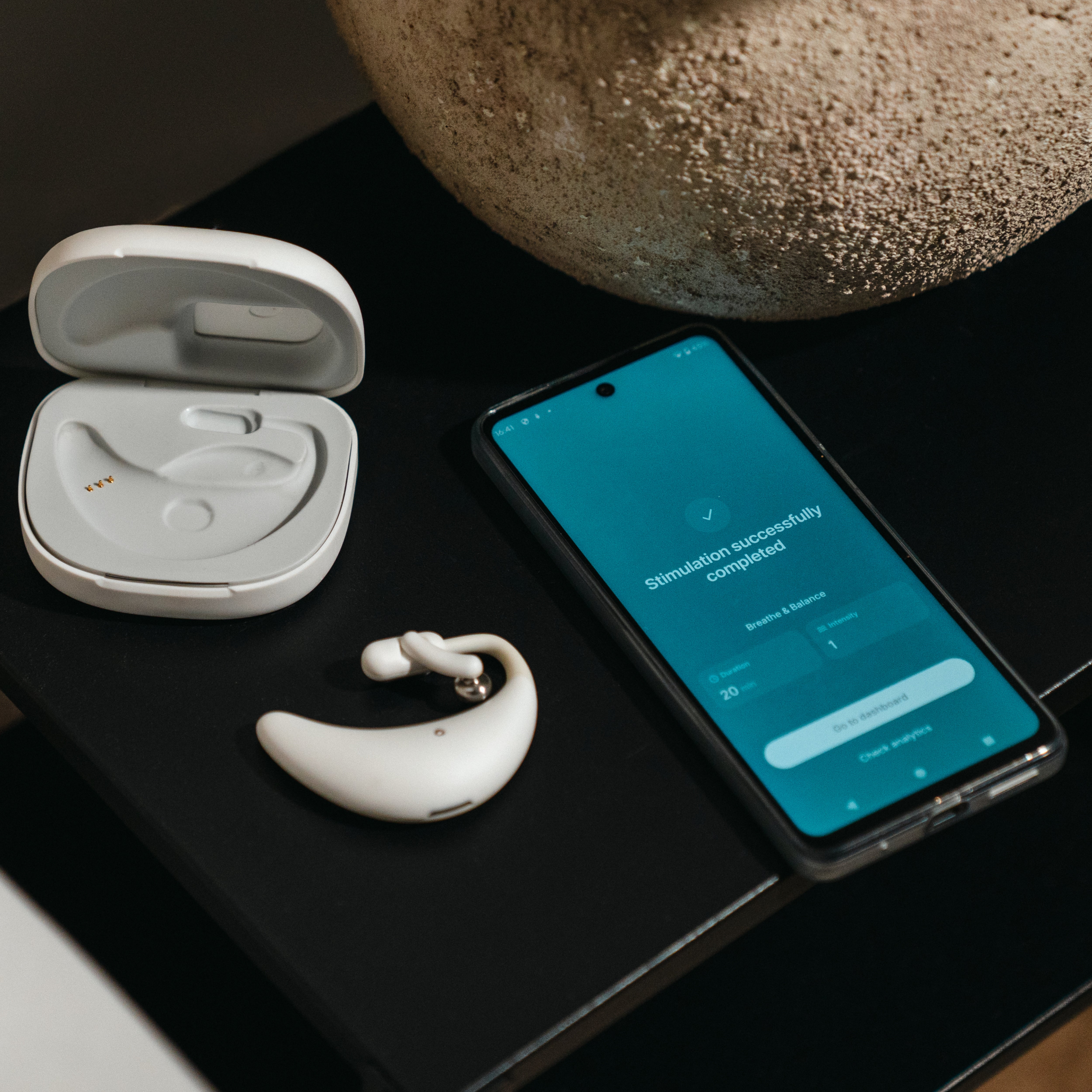
Sona is built around a low-friction session experience: the app guides you through breathwork and acoustic pacing whilst the stimulation adapts automatically, so there is little to configure once you begin. Because the AI handles parameter selection, the cognitive load on the user is minimal : you follow the guided session and the device does the tuning. For newcomers who find electrical-stimulation settings intimidating, this removes a common barrier to consistency.
Vagustim's manual model appeals to a different user. If you like control and understand frequency and pulse-width settings, configuring your own protocol can feel empowering and precise. The trade-off is a steeper learning curve and the responsibility of getting the parameters right yourself. Our vagus nerve stim cheatsheet is a useful primer on fit, intensity, and session length whichever device you land on.
Clinical Evidence and Research Behind Each Device
This is where honesty matters most: there are, to our knowledge, no published head-to-head clinical trials comparing Sona and Vagustim directly. What exists is a substantial body of research on transcutaneous vagus nerve stimulation as a modality, plus each company's own development work.
The broader VNS literature is genuinely promising. Research on transcutaneous vagus nerve stimulation suggests it can influence heart rate variability and autonomic balance, and reviews of the field describe measurable effects on markers of vagal tone. For a deeper dive into the evidence base, our transcutaneous vagus nerve stimulation literature review surveys the trials in detail, and the complete guide to vagus nerve stimulation covers methods and safety.
Sona's scientific positioning rests on the principle of biofeedback-timed stimulation. The rationale for synchronising input with cardiac and respiratory rhythms draws on the HRV biofeedback tradition associated with Professor Richard Gevirtz, who sits on Sona's advisory board : work that indicates paced, resonance-frequency breathing can meaningfully improve HRV. It is important to be precise here: this reflects the general science of paced, feedback-guided nervous-system work, not a specific medical claim about the Sona device. For Vagustim, buyers should look for device-specific peer-reviewed data and, where it is absent, treat efficacy as inferred from the general VNS field. A closed-loop, adaptive approach is a compelling hypothesis, but always distinguish mechanism from proven, device-specific outcomes.
Price and Value: Which Offers Better Bang for Your Buck?
Value in this category is not just the sticker price : it is the total cost over the life of the device, including any recurring software fees. Sona is priced at £695 (~$950 USD) with lifetime app access and no subscription, which means the upfront figure is the whole figure.
That matters more than it first appears. Many consumer wellness devices lock core features behind a monthly subscription, so a lower headline price can become more expensive over two or three years of use. Sona's no-subscription model front-loads the cost but removes ongoing charges entirely, and the AI personalisation is included rather than gated.
Vagustim's pricing varies by region and retailer, and public information on whether it carries an app or subscription fee is inconsistent : so the honest guidance is to confirm both the purchase price and any recurring cost directly before comparing. On HSA/FSA eligibility, insurance coverage, and financing, availability differs by country and neither device should be assumed to qualify; check with your provider. When you tally total cost of ownership rather than day-one price, the value picture can look very different from the shelf tag.
Who Should Choose Sona?
Sona is the stronger fit if you want the device to do the thinking for you. If you value real-time personalisation, dislike fiddling with settings, and want stimulation that synchronises with your own physiology, the closed-loop design is built for exactly that.
It also suits people drawn to a multi-modal, guided experience : the combination of electrical stimulation, breathwork, and acoustic cues appeals to those who want a structured session rather than a bare pulse generator. Users focused on stress resilience, HRV improvement, and recovery, and those who want to track change across sessions as the AI learns, tend to gravitate here. If a predictable, subscription-free cost is important to you, the lifetime-access model reinforces the case. To see the device itself, Explore SONA, and for the underlying rationale, read why personalised vagus nerve stimulation is a breakthrough.
Who Should Choose Vagustim?
Vagustim is the stronger fit if you want direct, manual control over your stimulation parameters. Experienced users who understand frequency, pulse width, and intensity : and who prefer to configure their own protocols : may find the hands-on approach more satisfying than automated tuning.
It can also appeal to those who prioritise a simpler mental model of the technology: set the parameters, run the session, done. If you already have a protocol you trust from prior VNS experience and simply want a device to execute it, manual control is an advantage rather than a limitation. As always, confirm current pricing, regulatory status, and any app fees before buying, and compare against the wider field using our guide to choosing a VNS device by use case.
Safety Profiles and Side Effects
Non-invasive, transcutaneous VNS is generally well tolerated, but no stimulation device is entirely without side effects. Understanding the typical profile helps you use either device sensibly.
Across the transcutaneous VNS literature, reported side effects are usually mild and transient : skin irritation or tingling at the electrode site, mild headache, or dizziness are the most commonly described. These effects generally resolve on their own and are dose-related, meaning lower intensities tend to reduce them. This is one practical advantage of an adaptive system: Sona's closed-loop design aims to keep stimulation within a comfortable, physiologically-appropriate range rather than relying on the user to guess.
Certain groups should exercise particular caution or avoid at-home VNS altogether : including people with implanted electrical devices such as pacemakers, those with cardiac arrhythmias, and anyone who is pregnant. This is general guidance for the category, not a claim about either specific device. Always consult a qualified healthcare professional before starting, especially if you have an underlying condition.
User Reviews and Real-World Results
Real-world reports are useful context, but they are not clinical evidence : treat them as directional rather than definitive. In our own research and user testing, people describe VNS as something that builds gradually rather than switching on overnight.
Users commonly report that consistency matters more than intensity: short, regular sessions over several weeks tend to be described more favourably than sporadic long ones. Many note improvements in perceived calm, sleep onset, and a sense of being better able to down-regulate after stress : outcomes that align with what the HRV and vagal-tone research would predict, though individual experiences vary widely. For Sona specifically, users often highlight the low-effort, guided nature of sessions as the reason they stick with it.
Because published, device-specific outcome data is limited for both products, we would encourage weighing reviews alongside the mechanism and the broader evidence rather than in isolation. A realistic expectation : measurable change over weeks, not hours : protects you from disappointment and sets you up to actually notice benefit.
How Sona and Vagustim Compare to Other VNS Devices
Sona and Vagustim are not the only options : the consumer VNS field has grown quickly, and it is worth situating both within it. Most competing devices fall on the same spectrum: manual, fixed-parameter tools at one end, and adaptive, guided systems at the other.
Devices such as truVaga, Apollo Neuro, and Pulsetto each take a distinct approach. Apollo Neuro uses gentle vibration rather than electrical stimulation, while truVaga and Pulsetto are electrical transcutaneous devices closer in category to Vagustim. Sona's differentiator across all of them is the closed-loop, biometric-adaptive engine plus its multi-modal design. If you want to see how these stack up, we have detailed side-by-side comparisons: Apollo Neuro vs Sona, Pulsetto vs Sona, Sona vs truVaga, and Nurosym vs Sona. Reading a couple of these alongside this comparison gives you a fuller map of where each device sits on the personalisation spectrum.
Frequently Asked Questions
Is Sona or Vagustim better for anxiety?
Neither device is a medical treatment for anxiety, and no head-to-head trial compares them for this use. Broader VNS research suggests transcutaneous stimulation may support autonomic balance and calm, and Sona's closed-loop, breathwork-integrated design is built around HRV-guided down-regulation. If you value guided, adaptive sessions, Sona may suit you better; if you prefer manual control, Vagustim is an option. Consult a healthcare professional for anxiety concerns.
How much does Vagustim cost compared to Sona?
Sona is priced at £695 (~$950 USD) with lifetime app access and no subscription. Vagustim's pricing varies by region and retailer, and public figures are inconsistent, so verify the current price and any recurring app or subscription fee directly with the manufacturer before comparing total cost of ownership.
Is Vagustim FDA-cleared?
Regulatory status for consumer VNS devices varies, and public information on Vagustim's specific clearances can be limited. Always confirm current FDA or CE marking status directly with the manufacturer before purchase. Note that Sona is a wellness device and is not a medically regulated product.
What is the difference between transcutaneous and implanted vagus nerve stimulators?
Implanted VNS involves a surgically placed device wired to the vagus nerve, typically prescribed for conditions like epilepsy or treatment-resistant depression. Transcutaneous VNS : the category both Sona and Vagustim belong to : stimulates the nerve non-invasively through the skin at the neck or ear, requiring no surgery.
Can you use Sona or Vagustim for chronic pain?
General VNS research has explored links between vagal tone, inflammation, and pain perception, but neither Sona nor Vagustim is a medical treatment for chronic pain and neither should be used as one. If you live with chronic pain, speak to a qualified healthcare professional about evidence-based options before trying any device.
How long does it take to see results from vagus nerve stimulation devices?
Most users describe gradual change over weeks of consistent use rather than immediate effects. Research and real-world reports suggest short, regular sessions tend to outperform occasional long ones. A realistic expectation is measurable change over several weeks, with consistency mattering more than intensity.
Conclusion
The Sona vs Vagustim decision ultimately comes down to a single question: do you want the device to optimise for you, or do you want to optimise it yourself? Sona automates the tuning with a closed-loop AI engine that reads your HRV and breathing, layers in breathwork and acoustic cues, and learns across sessions : all with a subscription-free, lifetime-access model at £695. Vagustim offers manual, fixed-parameter control that experienced users may prefer, though public pricing and clinical data are less consistently available. Both target the same nerve non-invasively; the difference is intelligence and personalisation, not the underlying mechanism. Whichever you choose, weigh the general VNS evidence, confirm regulatory and pricing details, and set realistic expectations of gradual change over weeks. The best device is the one you will actually use consistently.
Curious what adaptive, biometric-guided stimulation feels like? Explore SONA to see how closed-loop personalisation works, or dig into the research at The Science behind the device. DISCLAIMER: Sona is a wellness device and is not a medically regulated product. The information in this article is for educational purposes only and does not constitute medical advice. We do not make any claims about Sona's ability to diagnose, treat, cure, or prevent any medical condition. Vagus nerve stimulation research referenced in this article relates to the broader field of VNS and may not be specific to any particular consumer device. Always consult a qualified healthcare professional before making decisions about your health.
Sources
- https://pubmed.ncbi.nlm.nih.gov/
- https://www.ncbi.nlm.nih.gov/pmc/




Share:
Sona vs Hoolest Verelief: Which Vagus Nerve Stimulator Is Right for You?
Sona vs Neuvana Xen: Which Vagus Nerve Stimulator Is Right for You?