


Vagus nerve stimulation (VNS) for professionals is about using the body's "rest and digest" system to manage the chronic stress, shallow recovery and fading focus that come with demanding work. VNS will not make you smarter, but by supporting vagal tone and heart rate variability it may help high performers shift out of constant "fight or flight" and recover faster between pressures. Here is a practical, evidence-based look at how it fits into a working life in 2026.
The modern professional operates in a near-permanent state of low-grade activation: notifications, decisions, meetings and deadlines, each a small demand on the stress response. Individually they are trivial; together, sustained over months, they erode the very capacities high performers rely on : clear thinking, steady mood and deep, restorative sleep.
This guide looks at what VNS realistically can and cannot do for professionals, why heart rate variability is worth tracking, and how to fit nervous-system recovery into a busy schedule : from free breathing techniques to personalised, AI-guided devices like Sona.
Key Takeaways
- Sustained work pressure keeps the sympathetic "fight or flight" system dominant, which erodes focus, sleep and recovery over time.
- The vagus nerve is the body's brake on that response; supporting vagal tone helps shift towards recovery.
- Heart rate variability (HRV) is a useful early-warning marker of accumulating strain before burnout sets in.
- VNS is not a cognitive enhancer or a cure for burnout, but it can support the calm, recovered state that good thinking depends on.
- Breathing and movement help; transcutaneous VNS devices such as Sona add HRV-guided, personalised sessions that fit into a workday.
What Is Vagus Nerve Stimulation?
The vagus nerve is the longest cranial nerve and the main pathway of the parasympathetic nervous system : the branch responsible for calm, recovery and digestion. It runs from the brainstem to the major organs, carrying signals in both directions, which is why its influence reaches far beyond any single symptom.
Vagus nerve stimulation is any method that activates this nerve to encourage a recovery-oriented state, from clinical implanted devices to non-invasive at-home tools that stimulate the nerve's branches in the ear, and everyday practices such as slow breathing.
For the underlying mechanisms and the broader evidence, see our complete guide to vagus nerve stimulation. This article focuses on what that means for people whose work places sustained demands on their nervous system.
The Professional's Nervous System: Why High Performers Burn Out
The knowledge worker's day is a steady drip of small stressors: a full calendar, a pinging inbox, decisions that never quite stop. Each one briefly engages the sympathetic nervous system : the "fight or flight" branch that sharpens you in the moment. The problem is not any single spike; it is that the system rarely gets the chance to switch off.
Over time, that leaves high performers wired but tired: alert when they want to rest, foggy when they need to focus. Burnout is the end point of the cycle, and it is not simply about working too many hours. It is a state of nervous-system dysregulation in which the body has lost its ability to recover.
That reframing changes the solution: the goal is not just less work, but better recovery. We explore this in depth in the neuroscience of burnout.
How VNS Works: Tipping the Balance Toward Recovery
The autonomic nervous system has two branches. The sympathetic branch mobilises you for performance; the parasympathetic branch, driven by the vagus nerve, restores you afterwards. Health and performance depend on moving flexibly between the two : spiking when needed, then returning to baseline.
Stimulating the vagus nerve nudges that balance back towards recovery and is associated with improved vagal tone over time. For professionals, the practical value is in shortening the time it takes to come down from a stress response, so a tense morning does not bleed into an unproductive afternoon.
This is also why VNS pairs naturally with measurement: because its effect is on your physiological state, that state can be tracked : most usefully through heart rate variability.
VNS for Focus and Cognitive Performance
Can vagus nerve stimulation improve focus? It is worth being precise: VNS is not a nootropic and will not directly raise your IQ or attention span. What it can do is remove a brake on performance.
Concentration suffers when the nervous system is over-activated. Racing thoughts, restlessness and the inability to settle into deep work are stress signatures, not focus failures. By supporting a calmer baseline, VNS may make it easier to drop into the focused states where real cognitive work happens.
Approached this way, nervous-system regulation becomes a foundation for performance rather than a competitor to it. For a complementary, learning-focused method, see our 4-step protocol for rewiring your brain.
VNS for Stress and Resilience at Work
Resilience is often misunderstood as the ability to tolerate more stress. Physiologically, it is closer to the opposite: the ability to recover from stress quickly : to respond when you need to and then return to calm. That recovery capacity is exactly what vagal tone supports.
Building it is less about a single dramatic intervention and more about regular, brief nervous-system resets across the week. A few minutes of exhale-led breathing between meetings, a short device session at lunch, a protected wind-down in the evening : small, repeatable actions compound.
Our guide to VNS for stress covers the practical methods in more detail, including breathing patterns and timing.
HRV as an Early-Warning Metric
Heart rate variability : the variation in time between heartbeats : is one of the most useful objective measures a professional can track. Higher HRV generally reflects a nervous system that recovers well; a steady decline in your HRV trend is often one of the earliest signals that strain is accumulating, frequently before you consciously feel it.
That early warning is valuable precisely because high performers are prone to overriding the softer signals of fatigue. A downward HRV trend is harder to argue with than a vague sense of being tired, and it lets you intervene with rest and recovery before a crash rather than after.
To understand the metric, see what your HRV reveals about stress and how to improve HRV naturally.
Recovery, Sleep and Performance
For high performers, sleep is the highest-use recovery tool : and it is usually the first casualty of an over-activated nervous system. Lying awake replaying the day, or waking at 3am unable to switch off, are classic signs of a sympathetic system that has not stood down.
Poor sleep then compounds: slower thinking, worse decisions and lower tolerance for stress the next day, which in turn makes the following night harder. Because the vagus nerve governs the body's wind-down response, supporting it in the evening directly targets this cycle.
The link between rest and output is concrete; we unpack the warning signs in poor sleep and productivity.
Fitting VNS Into a Workday
When should a busy professional use VNS? The honest answer is that consistency matters more than the exact slot, but three windows work particularly well.
A short morning session sets a calm, regulated baseline before the day's demands begin. A mid-day reset between high-pressure blocks helps discharge accumulated tension rather than carrying it forward. An evening session supports wind-down and protects sleep after a stimulating day.
Timing can be tailored to your goal : alertness, recovery or sleep : and we cover the trade-offs in timing your vagus nerve stimulation for maximum impact.
Natural Techniques vs Devices
You can support your vagus nerve for free. Slow, exhale-led breathing is the most accessible method; brief cold exposure and regular movement help too. For many professionals these are enough to take the edge off a stressful day.
The limitation is consistency and feedback. Busy schedules crowd out unstructured habits, and without a measure it is hard to know whether they are working. This is where devices earn their place: they provide a repeatable session and, when paired with HRV, a clear signal of response.
The most pragmatic approach for most professionals is to combine the two : breathing as a free daily baseline, with device sessions added when workload spikes or recovery slips.
Choosing a Device
If you do opt for a device, the key question is whether it adapts to you. Traditional transcutaneous VNS devices apply a fixed protocol and leave you to guess at settings. The newer generation personalises stimulation based on real-time biometrics.
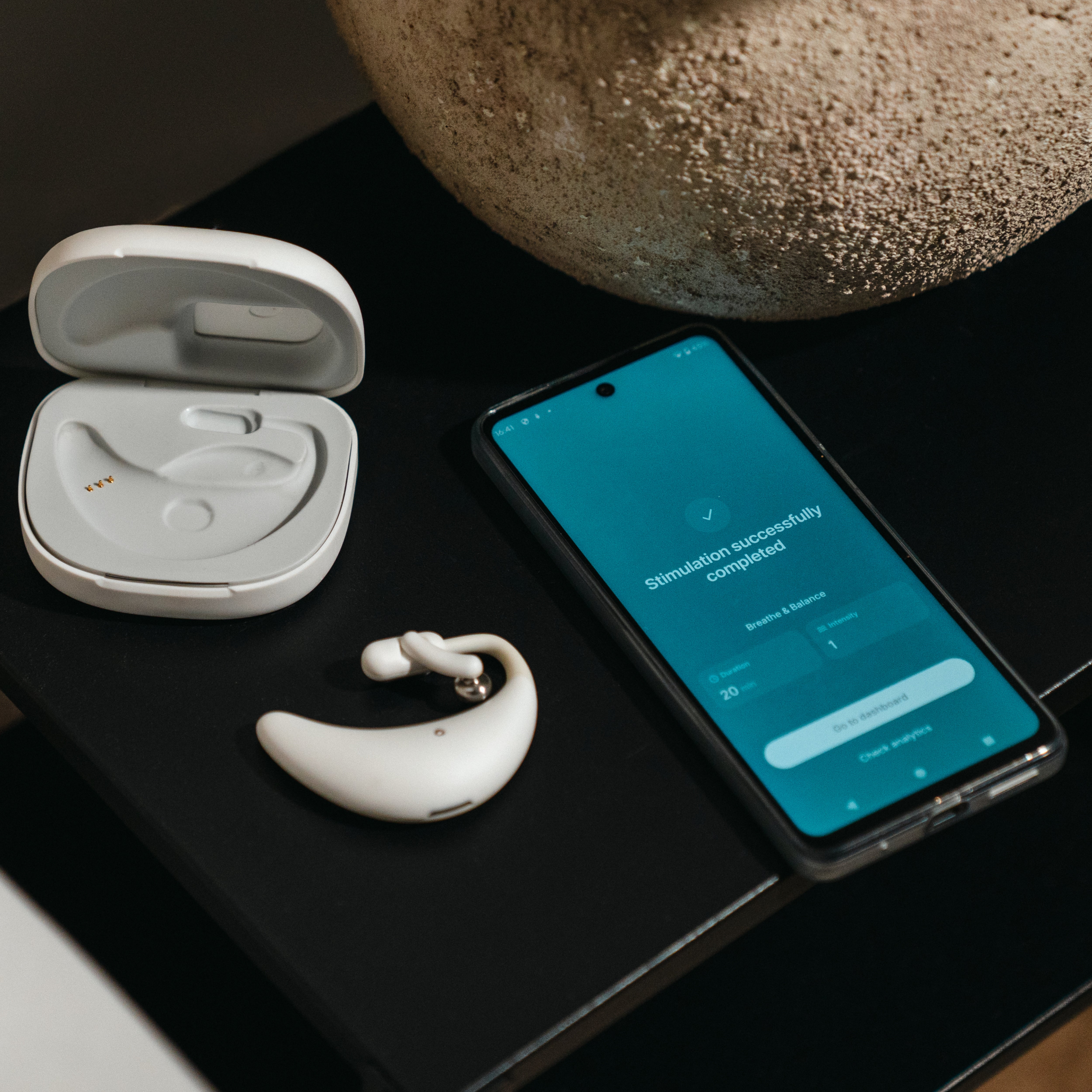
Sona is an AI-powered, personalised tVNS device (£695) that adapts each session to your real-time HRV, so the stimulation matches your nervous system's current state rather than a one-size-fits-all setting. For people who want measurable, repeatable recovery, that adaptiveness is the difference between a gadget and a tool.
Whatever you choose, treat the device as one part of a wider strategy that also includes sleep, workload and boundaries : not a substitute for them.
Common Mistakes Professionals Make
The first mistake is treating recovery as something to get to once the work is done. For a high performer, recovery is not the reward for performance; it is the precondition for it. Scheduling it deliberately, rather than hoping for leftover time, is what separates sustainable output from burnout.
The second is chasing intensity over consistency : a single long session when overwhelmed, then nothing for a fortnight. Brief, regular nervous-system resets do far more than occasional heroic efforts.
The third is ignoring the data. If your HRV trend is falling week on week, that is information, not noise. Acting on it early is cheaper than recovering from a crash.
What to Expect and Building Consistency
Set realistic expectations. The immediate calming effect of a breathing exercise or a device session is usually noticeable within minutes; the more meaningful gains : a steadier mood, sharper focus, a higher HRV baseline : accrue over weeks of consistent practice.
A workable starting routine for a professional might be five minutes of exhale-led breathing in the morning, a short reset at lunch, and a protected wind-down in the evening, with device sessions layered in during the most demanding periods. Tracking HRV alongside how you feel turns this from a vague intention into a feedback loop.
Performance, in the end, is downstream of recovery. Investing a little each day in your nervous system is one of the more rational things a high performer can do.
Frequently Asked Questions
Can vagus nerve stimulation improve focus at work?
VNS is not a cognitive enhancer, but by supporting a calmer, more balanced nervous state it may reduce the stress and mental noise that interfere with concentration. Many professionals use it to reset between demanding tasks rather than to "boost" focus directly.
When is the best time for a busy professional to use a VNS device?
Common windows are the morning to set a calm baseline, between high-pressure meetings to reset, or the evening to support wind-down and sleep. Consistency matters more than the exact slot.
How is HRV relevant to high performers?
HRV is a marker of how well your nervous system recovers from stress. For professionals under sustained pressure, a declining HRV trend can be an early sign of accumulating strain before burnout sets in.
Does vagus nerve stimulation help prevent burnout?
VNS is not a treatment for burnout. But because burnout is partly a state of chronic nervous-system overactivation, supporting vagal tone and recovery is a sensible part of a wider strategy that also includes workload, sleep and boundaries.
Is vagus nerve stimulation safe to use at work?
Non-invasive transcutaneous VNS is considered low-risk for most healthy adults, with side effects usually limited to mild tingling at the stimulation site. Anyone with a pacemaker, an implanted electronic device or a heart-rhythm condition should consult a clinician first.
Conclusion
For professionals, performance is downstream of recovery. The vagus nerve is the system that governs that recovery, and supporting it : through breathing, sleep and, optionally, personalised stimulation : is one of the more rational investments a high performer can make.
Vagus nerve stimulation is not a shortcut to focus or a fix for burnout, and it works best as part of a wider strategy that respects workload, sleep and boundaries. What it offers is a way to spend more of your day in the regulated state where good work actually happens.
Start simply: a few minutes of exhale-led breathing, a protected wind-down, and honest attention to your HRV trend. Add a personalised device if you want measurable, repeatable recovery.
The professionals who last are not the ones who push hardest, but the ones who recover best. Building that capacity is well within reach.
Want recovery you can measure? Explore Sona at sona.help : the world's first AI-powered, personalised vagus nerve stimulation device, built to adapt to your nervous system in real time.
Sources
- Cleveland Clinic : Vagus Nerve (overview of anatomy and function)
- Harvard Health : Heart rate variability as a marker of autonomic balance
- World Health Organization : Burn-out as an occupational phenomenon (ICD-11)
Disclaimer
DISCLAIMER: Sona is a wellness device and is not a medically regulated product. The information in this article is for educational purposes only and does not constitute medical advice. We do not make any claims about Sona's ability to diagnose, treat, cure, or prevent any medical condition. Vagus nerve stimulation research referenced in this article relates to the broader field of VNS and may not be specific to any particular consumer device. Always consult a qualified healthcare professional before making decisions about your health.


Share:
Choosing a VNS Device: Best Picks by Use Case (2026)
Vagus Nerve Stimulation for Women's Health: A 2026 Guide