

Sona and Neuvana Xen are both earphone-based transcutaneous vagus nerve stimulators designed to reduce stress and anxiety through gentle electrical pulses delivered via the ear. The core difference is personalisation: Sona uses real-time AI to read your heart rate variability and breathing, adapting each session to your physiology, while Neuvana Xen delivers established, fixed stimulation programmes. Both are wellness devices, not medical treatments, and individual results vary.
In this comparison, we'll look closely at how each device works, what they cost, how they feel to wear, and what the science actually supports. If you're weighing up two of the best-known vagus nerve stimulation earphones on the market in 2026, this side-by-side will help you decide which approach fits your nervous system, your routine, and your budget.
Key Takeaways
- Sona is the more advanced, personalised option: it reads HRV and respiration in real time and synchronises pulses to your heartbeat and breath, combining stimulation with sound and guided breathwork.
- Neuvana Xen is an established consumer device with fixed stimulation programmes, broad brand recognition, and a lower entry price.
- Sona costs £695 (~$950) with no subscription and lifetime app access; Neuvana Xen typically sits at a lower one-off price point.
- Neither device is an FDA-cleared medical treatment : both are wellness devices, and results differ from person to person.
- Choose Sona if you want data-driven, adaptive sessions; choose Neuvana Xen if you want a simpler, budget-friendly entry into taVNS.
Sona vs Neuvana Xen: The Quick Answer
Both Sona and Neuvana Xen are earphone-based transcutaneous vagus nerve stimulators (taVNS) that aim to ease stress and anxiety by delivering gentle electrical pulses through the ear. Sona differentiates itself with real-time AI personalisation, a closed-loop system that reads your HRV and respiration, and time-locked pulse delivery synchronised to your heartbeat and breathing cycle. Neuvana Xen is an established consumer device built around fixed stimulation programmes and strong brand recognition.
Neither is a medical treatment; both are wellness devices, and individual results vary. In short: Sona suits people who want an adaptive, biometrically guided experience and don't mind paying more for it. Neuvana Xen suits those who want a proven, lower-cost, straightforward device to explore vagus nerve stimulation without a data-driven layer.
What Is Vagus Nerve Stimulation and How Does It Work?
The vagus nerve is the longest cranial nerve in the body and the central highway of your parasympathetic nervous system : the 'rest and digest' branch that regulates heart rate, inflammation, digestion, and mood. When it's working well, it acts as a brake on your stress response, helping you return to calm after a challenge.
Transcutaneous auricular VNS (taVNS) is a non-invasive way to engage this system. A small electrode placed in the ear delivers gentle electrical pulses to the auricular branch of the vagus nerve, which has a surface presence in parts of the outer ear. Because it's delivered through the skin, there's no surgery and no implant involved.
The proposed physiological pathway looks something like this: taVNS stimulates the auricular branch, which signals the brainstem (particularly the nucleus tractus solitarius), which in turn can influence heart rate variability, downregulate the sympathetic 'fight or flight' response, and support a calmer nervous system state. If you're new to the topic, our VNS cheatsheet for beginners walks through fit, intensity, and timing. You can also read more on how vagus nerve stimulation works.
Does vagus nerve stimulation actually work for stress relief? Research suggests taVNS can shift the nervous system towards a more relaxed state, with studies indicating improvements in heart rate variability and reductions in perceived stress. However, the evidence base is still developing, effect sizes vary between individuals, and consumer earphone devices like Sona and Neuvana Xen are wellness products : not FDA-cleared medical treatments, unlike some implantable clinical VNS systems used for epilepsy or depression.
Overview: Sona Vagus Nerve Stimulator
Sona is a next-generation taVNS device developed by MindSpire Ltd at the London Institute for Healthcare Engineering. It was founded by Jane Ollis, a medical biochemist and environmental scientist whose career spans NASA, Oxford, and the NHS, with a particular focus on stress, burnout, cortisol, and women's health.
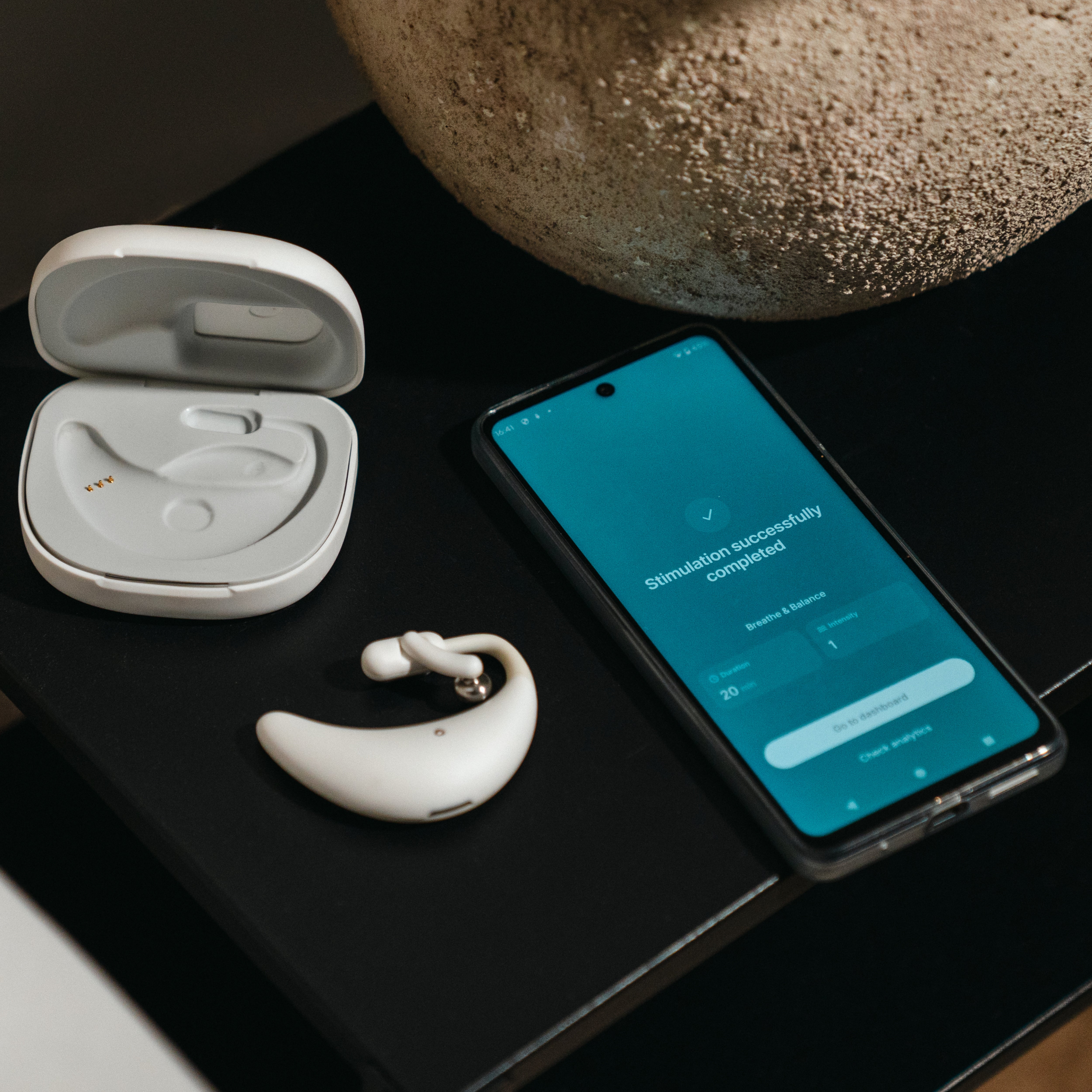
What sets Sona apart is its AI-powered closed-loop system. Rather than delivering the same fixed pulse to everyone, Sona reads your heart rate variability and respiration in real time and adapts the stimulation intensity and timing to your physiology, session by session. The idea is that no two nervous systems are the same, so no two sessions should be identical either.
Sona also uses time-locked delivery, synchronising pulses with your heartbeat and breathing cycle. We describe this as the 'pushing a swing at the right time' principle: a small, well-timed push does far more than a large, mistimed one. This precision is the heart of Sona's design philosophy.
The experience is multi-modal, combining electrical stimulation with binaural, immersive sound and guided breathwork in a single integrated session : so the device works with your breath and attention, not just your ear. You can Explore SONA to see how these elements fit together, or dig into The Science behind the approach.
Sona is priced at £695 (~$950) as a one-off purchase, with no subscription and lifetime app access. It's backed by a credentialed team including Chief Science Officer Tony Steffert (a neuroscientist specialising in neurofeedback and HRV) and an advisory board featuring HRV biofeedback expert Professor Richard Gevirtz and cognitive neuroscientist Professor David Wilkinson. For a closer look at why an adaptive approach matters, our article on why personalised VNS is a breakthrough goes deeper.
Overview: Neuvana Xen Vagus Nerve Stimulator
Neuvana Xen is one of the more recognisable consumer taVNS devices on the market. It pairs a set of earphones with a handheld controller and a companion app, delivering electrical stimulation through the left ear to engage the auricular branch of the vagus nerve.
The Xen is built around fixed stimulation programmes. You choose from preset intensity levels and can sync the stimulation to music, so the pulses ride along with your audio. It's a simple, approachable model: pick a setting, put the earbuds in, and stimulate. There's no biometric reading or real-time adaptation : the device delivers a consistent, user-selected experience rather than one that responds to your physiology.
Neuvana has strong brand recognition in the consumer wellness space and has built a following among people looking for an accessible entry point to vagus nerve stimulation. Its price point typically sits below Sona's, making it attractive for those wanting to try taVNS without a premium outlay.
Like Sona, Neuvana Xen is marketed as a wellness device, not a medical treatment. It is not an FDA-cleared therapy for anxiety, depression, or any other condition, and the company frames its benefits in general relaxation and stress-management terms. If you want to see how Sona stacks up against other devices in this category, our comparisons with Nurosym and Apollo Neuro offer additional context.
Key Differences Between Sona and Neuvana Xen
The short version: Sona is adaptive and data-driven, while Neuvana Xen is fixed and music-synced. Here's how the two devices differ across the areas that matter most.
- Personalisation: Sona reads HRV and respiration in real time and adapts every session; Neuvana Xen uses preset programmes with manually selected intensity. - Timing: Sona synchronises pulses to your heartbeat and breath (closed-loop, time-locked); Xen delivers stimulation at a steady, user-set level, optionally synced to music. - Modality: Sona integrates electrical stimulation + immersive sound + guided breathwork; Xen focuses on stimulation paired with your own audio. - Feedback: Sona provides biometric feedback and session data; Xen offers a simpler control-and-play experience. - Science team: Sona's development is led by researchers with HRV, neurofeedback, and biofeedback credentials; Neuvana is a consumer-first brand. - Price model: Sona is £695 with no subscription and lifetime app access; Xen sits at a lower one-off price.
If you value closed-loop precision and want your device to respond to your body, Sona is the more sophisticated tool. If you prefer simplicity and a lower cost of entry, Neuvana Xen keeps things straightforward. Our guide to choosing a VNS device by use case can help you match features to your goals.
Price Comparison: Sona vs Neuvana Xen
On upfront cost, Neuvana Xen is the cheaper option; on long-term value, the picture is more nuanced. Here's how the two compare.
Sona is priced at £695 (~$950) as a single purchase. Importantly, there's no subscription : you get lifetime access to the app and its software updates, so the sticker price is the total price. For a device built around continuously improving AI, that no-subscription model matters, because you benefit from future software refinements without recurring fees.
Neuvana Xen typically retails at a lower one-off price than Sona, positioning it as a more affordable entry into taVNS. This makes it appealing if you want to experiment with vagus nerve stimulation before committing to a premium device.
The honest way to frame the value question: you're paying more for Sona because you're getting real-time biometric personalisation, multi-modal sessions, and a research-led design, rather than fixed programmes. Whether that premium is worth it depends on how much you value adaptive, data-driven sessions versus simplicity and cost. If budget is your main constraint, our roundup of the best VNS devices in 2026 covers options across the price spectrum.
Ease of Use, Setup, and Comfort
Both devices are designed for home use with a companion app, but they differ in how much guidance and adaptation they provide during a session.
Neuvana Xen keeps setup minimal: charge the controller, fit the earbuds, connect the app, select an intensity, and optionally sync to music. It's a low-friction experience aimed at people who want to press play and relax. Because the earbuds sit in the ear like standard in-ear headphones, comfort largely depends on how well the tips fit you : a consideration common to all in-ear taVNS devices.
Sona involves a slightly richer setup, because the device is reading your physiology. Once configured, each session becomes a guided, adaptive experience: the app pairs stimulation with breathwork cues and immersive sound while the closed-loop system adjusts to your HRV and breathing. For many users this feels less like using a gadget and more like following a structured relaxation session.
On comfort, getting the fit right is essential for any auricular device : a secure, comfortable contact point improves both the sensation and the effectiveness of the stimulation. Our VNS cheatsheet for beginners covers how to dial in fit, intensity, and session length so your early sessions feel comfortable rather than fiddly. As a general safety note, both devices deliver gentle stimulation that should never feel painful; if you experience discomfort, lower the intensity.
Effectiveness for Stress and Anxiety Relief
Both devices aim at the same outcome : a calmer nervous system : but their mechanisms for getting there differ. Here's what to keep in mind, framed around the broader VNS evidence rather than claims about either specific product.
Research on transcutaneous vagus nerve stimulation suggests it can nudge the autonomic nervous system towards a parasympathetic-dominant, more relaxed state, with studies indicating improvements in heart rate variability and reductions in perceived stress and anxiety. This is general taVNS research and should not be read as a claim that any consumer earphone device treats anxiety.
The theoretical case for Sona's approach is precision. Because the vagus nerve interacts closely with your cardiac and respiratory rhythms, delivering stimulation at the right moment in each cycle : the 'pushing a swing at the right time' principle : may make each pulse more efficient. Sona's closed-loop system is built around this idea, adapting to your HRV in real time. You can read more about the HRV connection in our guide to heart rate variability and what it reveals.
Neuvana Xen relies on fixed intensity and music-synced stimulation. For some people, a simple, consistent programme is enough to produce a noticeable sense of calm. The trade-off is that it doesn't respond to whether your nervous system is already relaxed or highly activated on a given day.
How long does it take to feel results? In our research and in user reports across taVNS more broadly, some people notice a subtle shift in a single session, while measurable changes in sleep and HRV often build over two to four weeks of consistent use. Results vary considerably between individuals : see our 4-week VNS protocol for sleep for a realistic timeline.
App Experience and Customisation
The app is where Sona and Neuvana Xen diverge most sharply, because it's the layer that makes Sona adaptive rather than fixed.
Neuvana Xen's app functions primarily as a controller. You select intensity levels, choose or sync music, and start a session. It's clean and easy to manage, and the music-sync feature is a genuinely nice touch for people who like stimulation woven into their listening. What it doesn't do is read your body or reshape sessions based on your physiology.
Sona's app is central to the whole experience. It captures HRV and respiration, drives the closed-loop personalisation, delivers guided breathwork, and layers in immersive sound. Over time, the AI refines how it works with your nervous system, so the experience is designed to evolve with you rather than stay static. Because there's no subscription, these software improvements come at no extra cost. To understand how the sound, breath, and stimulation elements reinforce one another, see syncing the senses to amplify Sona's power.
In practice, the choice comes down to how much you want your device to think alongside you. If you want a simple controller, Xen's app is more than adequate. If you want an intelligent, data-informed session that adapts to your state, Sona's app is where its premium price becomes tangible.
Clinical Evidence and Scientific Backing
It's important to separate what the broader VNS field shows from what any single consumer device claims. Neither Sona nor Neuvana Xen is an FDA-cleared medical treatment.
The scientific foundation for transcutaneous auricular VNS is growing. A body of research has explored taVNS for stress, mood, and autonomic regulation, with reviews indicating potential effects on heart rate variability and parasympathetic activity. As with much early-stage research, study quality and effect sizes vary, and larger, well-controlled trials are still needed. For a deeper dive, see our transcutaneous vagus nerve stimulation literature review.
Sona's approach is grounded in the science of HRV biofeedback and closed-loop stimulation, an area reflected in its team and advisory board. Chief Science Officer Tony Steffert specialises in neurofeedback and HRV, and advisor Professor Richard Gevirtz is a recognised HRV biofeedback researcher. The rationale for time-locked, respiration-synchronised stimulation draws on the well-documented relationship between breathing, heart rhythm, and vagal tone : you can explore this in breathe like you mean it: the secret rhythm behind HRV.
Neuvana positions Xen on the general premise that taVNS supports relaxation, drawing on the same broad category of vagus nerve research rather than device-specific clinical trials.
A fair summary: both devices sit within a promising but still-maturing field. Sona's differentiator is a research-led, physiologically synchronised design; Xen's is an accessible, established consumer implementation. For the full picture, our complete guide to vagus nerve stimulation covers methods, benefits, and safety in depth.
Who Should Buy Sona vs Who Should Buy Neuvana Xen?
The right choice depends on what you want from a taVNS device and how much you're willing to invest.
Choose Sona if you: - Want real-time, AI-driven personalisation that adapts to your HRV and breathing - Value a multi-modal session combining stimulation, sound, and guided breathwork - Are interested in tracking and understanding your nervous-system response over time - Prefer a no-subscription model with lifetime app access and ongoing software improvements - Are focused on stress, burnout, sleep, or nervous-system resilience and want a research-led tool
Choose Neuvana Xen if you: - Want a lower-cost entry point into vagus nerve stimulation - Prefer a simple, press-play experience without biometric complexity - Like the idea of syncing stimulation to your own music - Value strong brand recognition and a well-established consumer product
If you're a professional or high-performer looking to build resilience, our guide to VNS for professionals may help you decide which feature set matters most for your routine.
Final Verdict: Which One Is Worth Your Money?
In the Sona vs Neuvana Xen comparison, the decision really comes down to personalisation versus simplicity. Neuvana Xen is a capable, recognisable, and affordable device that delivers a straightforward taVNS experience with a likeable music-sync feature : a sensible choice if you want to explore vagus nerve stimulation without a premium spend.
Sona is the more advanced device. Its closed-loop AI, time-locked delivery, and multi-modal sessions are designed to make each stimulation more precise and each session more responsive to your body. For people who want their device to adapt rather than repeat : and who see the value in a research-led, no-subscription tool : Sona is the stronger long-term investment.
Neither is a shortcut or a medical treatment; both are wellness devices that work best as part of a consistent nervous-system routine alongside breathwork, sleep, and movement. If precision and personalisation matter to you, Sona is where the extra outlay pays off. You can Explore SONA or read The Science to go deeper.
Frequently Asked Questions
Is Neuvana Xen or Sona better for anxiety?
Both are wellness devices, not anxiety treatments, so neither can be claimed to treat anxiety. Broadly, Sona's real-time AI personalisation, HRV-driven closed-loop stimulation, and guided breathwork make it the more adaptive choice for people who want sessions that respond to their nervous system. Neuvana Xen offers a simpler, fixed-programme experience. Results vary by individual; consult a healthcare professional for clinical anxiety.
How does Sona compare to Neuvana Xen in terms of price?
Sona costs £695 (~$950) as a one-off purchase with no subscription and lifetime app access. Neuvana Xen typically retails at a lower one-off price, making it the cheaper upfront option. Sona's higher price reflects its real-time biometric personalisation, multi-modal sessions, and research-led design rather than fixed programmes.
Does vagus nerve stimulation actually work for stress relief?
Research on transcutaneous vagus nerve stimulation suggests it can shift the nervous system towards a more relaxed, parasympathetic-dominant state, with studies indicating improvements in heart rate variability and reductions in perceived stress. The evidence base is still developing, effect sizes vary between individuals, and consumer earphone devices are wellness products rather than FDA-cleared medical treatments.
What are the side effects of using Neuvana Xen or Sona?
taVNS is generally well tolerated, but some users report mild, temporary sensations such as tingling, skin irritation at the contact point, or slight discomfort if intensity is set too high. Both devices deliver gentle stimulation that should never feel painful. Lower the intensity if you feel discomfort, and consult a healthcare professional if you have a heart condition, a pacemaker, or other medical concerns before use.
Can you use Sona or Neuvana Xen while sleeping?
These devices are designed for active sessions rather than continuous overnight wear, and in-ear stimulation while asleep isn't generally recommended. Many people use taVNS as part of a wind-down routine before bed to support relaxation. Always follow each manufacturer's usage guidance and consult a healthcare professional if you have specific concerns.
Is the Neuvana Xen FDA cleared?
Neuvana Xen is marketed as a wellness device, not an FDA-cleared medical treatment for any condition. The same applies to Sona. FDA-cleared VNS therapies are typically implantable clinical systems used for conditions such as epilepsy and treatment-resistant depression, which are distinct from consumer earphone devices.
How long does it take to feel results from vagus nerve stimulation headphones?
It varies. Some people notice a subtle sense of calm within a single session, while more measurable changes in sleep quality and HRV often build over roughly two to four weeks of consistent use. Consistency matters more than any single session, and individual responses differ significantly.
Are there cheaper alternatives to Sona and Neuvana Xen?
Yes. The taVNS and broader VNS market includes several devices across different price points, from lower-cost consumer units to more advanced systems. Free, no-cost methods such as slow diaphragmatic breathing, cold exposure, and humming also stimulate vagal activity. Our roundups of the best VNS devices for 2026 compare options across the price spectrum.
Conclusion
Sona and Neuvana Xen represent two philosophies of vagus nerve stimulation: one adaptive and data-driven, the other simple and accessible. Neuvana Xen is a proven, affordable device for people who want an easy way into taVNS. Sona is the premium, research-led choice for those who want their device to read their physiology and respond in real time. Whichever you choose, remember that both are wellness tools that work best as part of a consistent nervous-system routine : not a quick fix. The key takeaway: match the device to how much personalisation, data, and precision you actually want.
Ready to experience truly personalised vagus nerve stimulation? Explore SONA to see how real-time AI adapts each session to your body, or dive into The Science Behind SONA to understand the research behind our closed-loop approach. DISCLAIMER: Sona is a wellness device and is not a medically regulated product. The information in this article is for educational purposes only and does not constitute medical advice. We do not make any claims about Sona's ability to diagnose, treat, cure, or prevent any medical condition. Vagus nerve stimulation research referenced in this article relates to the broader field of VNS and may not be specific to any particular consumer device. Always consult a qualified healthcare professional before making decisions about your health.
Sources
- https://www.ncbi.nlm.nih.gov/pmc/articles/PMC6371734/
- https://www.frontiersin.org/articles/10.3389/fnhum.2020.568051/full




Share:
Sona vs Vagustim: Which Vagus Nerve Stimulator Is Right for You?
How to Lower Cortisol Naturally: A Science-Backed Daily Routine