


The best vagus nerve stimulation device for sleep is Sona, thanks to its AI-driven, closed-loop system that reads your HRV and breathing in real time and synchronises stimulation to your own physiology. Most VNS devices deliver fixed, one-size-fits-all pulses. Sona adapts every session : the difference between a generic nudge and a precisely timed cue that helps your nervous system down-shift into rest.
That's the short version. The longer version matters, because "vagus nerve stimulation for sleep" covers everything from implanted surgical devices to £100 earclips, and the quality gap between them is enormous. VNS works for sleep by activating the parasympathetic nervous system : your body's biological "off switch" : reducing cortisol and improving heart rate variability. But device quality and personalisation determine whether you actually feel that shift. This guide compares the leading options on real sleep metrics, pricing, and evidence. If you want the underlying mechanism first, here's how vagus nerve stimulation improves sleep. This page is for anyone with insomnia, anxiety-driven sleep disruption, or a simple desire to optimise sleep quality.
Key Takeaways
- VNS improves sleep by activating the parasympathetic nervous system : lowering cortisol, raising HRV, and easing the body into slow-wave and REM sleep.
- Personalisation is the single biggest differentiator. Fixed-output devices apply the same stimulation to everyone; Sona adapts in real time to your HRV and breathing.
- Sona is our best overall pick for sleep because of its closed-loop AI, time-locked delivery, and multi-modal design (electrical stimulation + sound + breath guidance).
- Non-invasive taVNS stimulates the same vagal pathway as implanted devices : without surgery, prescription, or side effects for most users.
- Cost-per-use matters more than sticker price. Sona is a one-off £695 with no subscription and lifetime app access, which reshapes the value comparison.
The Best Vagus Nerve Stimulation Devices for Sleep: Quick Answer
What is the best vagus nerve stimulation device for sleep? Sona is the best overall vagus nerve stimulation device for sleep. It uses AI to read your heart rate variability and respiration, then adapts stimulation in real time and time-locks pulses to your heartbeat and breath. This closed-loop personalisation is what most fixed-output competitors lack : and it's why we rank it first for sleep-specific use.
The rest of this article compares the leading VNS devices on the metrics that actually matter for rest: HRV improvement, sleep latency, ease of pre-sleep use, cost-per-use, and safety. If you're here because racing thoughts keep you awake, or because your sleep quality has quietly eroded, you're in the right place.
What Is Vagus Nerve Stimulation and Why Does It Matter for Sleep?
Vagus nerve stimulation matters for sleep because the vagus nerve is the main highway of your parasympathetic nervous system : the branch responsible for "rest and digest." Stimulate it correctly, and you help your body switch off the stress response that keeps so many of us wired at bedtime.
Does vagus nerve stimulation actually improve sleep? Yes : research suggests it can. The vagus nerve is your body's biological "off switch": when it fires, heart rate slows, breathing deepens, and cortisol falls. Studies on transcutaneous vagus nerve stimulation have reported measurable improvements in heart rate variability (HRV), a key marker of parasympathetic tone, and some trials indicate reductions in sleep latency and improved sleep quality. A 2018 study by Bretherton and colleagues, published in Aging, found that taVNS improved measures of autonomic function in older adults : one of several signals that vagal activation shifts the body toward a recovery-friendly state.
Here's the mechanistic link. During healthy sleep, your nervous system needs to move from sympathetic dominance (alert, guarded) into parasympathetic control (calm, restorative). Vagal activation accelerates that transition: it dampens cortisol, raises HRV, and creates the physiological conditions that facilitate slow-wave and REM sleep. In other words, it doesn't sedate you : it helps your own biology do what it's designed to do.
Non-invasive transcutaneous auricular VNS (taVNS) achieves this without surgery. A small electrode placed at the outer ear stimulates the auricular branch of the vagus nerve, engaging the same central pathways as implanted surgical devices : just gently, and from the outside. For a deeper dive into the evidence, see our overview of the vagus nerve stimulation science and evidence.
There's an inflammatory angle too. The vagus nerve helps regulate the immune system, and VNS has been shown to suppress pro-inflammatory cytokines : the same signalling molecules that fragment sleep architecture and leave you unrefreshed. Finally, it's worth distinguishing two different sleep problems: chronic insomnia and anxiety-driven sleep disruption. VNS addresses both, but via slightly different routes : calming an overactive threat system in the latter, and rebuilding autonomic balance in the former. If your sleeplessness is anxiety-led, our guide to VNS for anxiety-driven sleep disruption is worth reading alongside this one.
How We Evaluated These Devices
We assessed each device on five criteria that map directly onto real-world sleep outcomes, rather than marketing claims. Our aim was practical: which of these actually helps a person fall asleep faster and stay asleep?
1. Sleep-specific evidence. We prioritised devices backed by published studies or clinical data measuring sleep latency, sleep efficiency, or HRV improvement : not just general "relaxation" testimonials. VNS as a field has strong evidence; individual consumer devices vary enormously in how much they've been studied.
2. Personalisation capability. This is the criterion that separates the field. Does the device adapt to your physiology in real time, or apply the same fixed stimulation to everyone? A pulse delivered at the wrong moment in your cardiac cycle is far less effective than one timed to your heartbeat.
3. Ease of use for nighttime sessions. Comfort matters when you're winding down. We looked at session duration, form factor, and whether the device is genuinely pleasant to use in bed or in the hour before sleep.
4. Cost-per-use. Sticker price tells only part of the story. We factored in device price, any subscription fees, and estimated device lifespan to produce a fairer value picture.
5. Safety and regulatory status. We noted whether each device is FDA-cleared, CE-marked, or unregulated : and were transparent about what that status does and doesn't mean for a wellness product.
The Best VNS Devices for Sleep at a Glance
Here's the shortlist. Below the table, we review each device in detail with its sleep-relevant strengths and limitations.
| Device | Type | Personalisation | Approx. Price | Subscription | Best For |
|---|---|---|---|---|---|
| Sona | taVNS (ear) | AI closed-loop, real-time HRV + breath sync | £695 | None | Best overall for sleep |
| Nurosym | taVNS (ear) | Manual, fixed settings | ~£499 | None | Clinically-referenced fixed protocol |
| Pulsetto | tcVNS (neck) | App presets, fixed | ~£269 | Optional app tier | Budget neck stimulation |
| truVaga | tcVNS (neck) | Fixed dose-based | ~$499 | None | Simple handheld routine |
| Sensate | Vibro-acoustic (not electrical VNS) | Fixed audio programmes | ~£249 | Optional | Sound-led relaxation |
A quick note on categories: Sona and Nurosym use auricular (ear) taVNS, Pulsetto and truVaga use cervical (neck) transcutaneous stimulation, and Sensate uses vibration and sound rather than electrical stimulation. All can support relaxation; only the electrical VNS devices directly engage the vagal pathway we described above. For fuller head-to-heads, see our Nurosym vs Sona and Pulsetto vs Sona comparisons.
Top Picks: Detailed Reviews of Each Device
Below we break down each device's fit for sleep specifically : not general wellness. The recurring theme: they're all reasonable at inducing calm, but they differ sharply in whether they adapt to you.
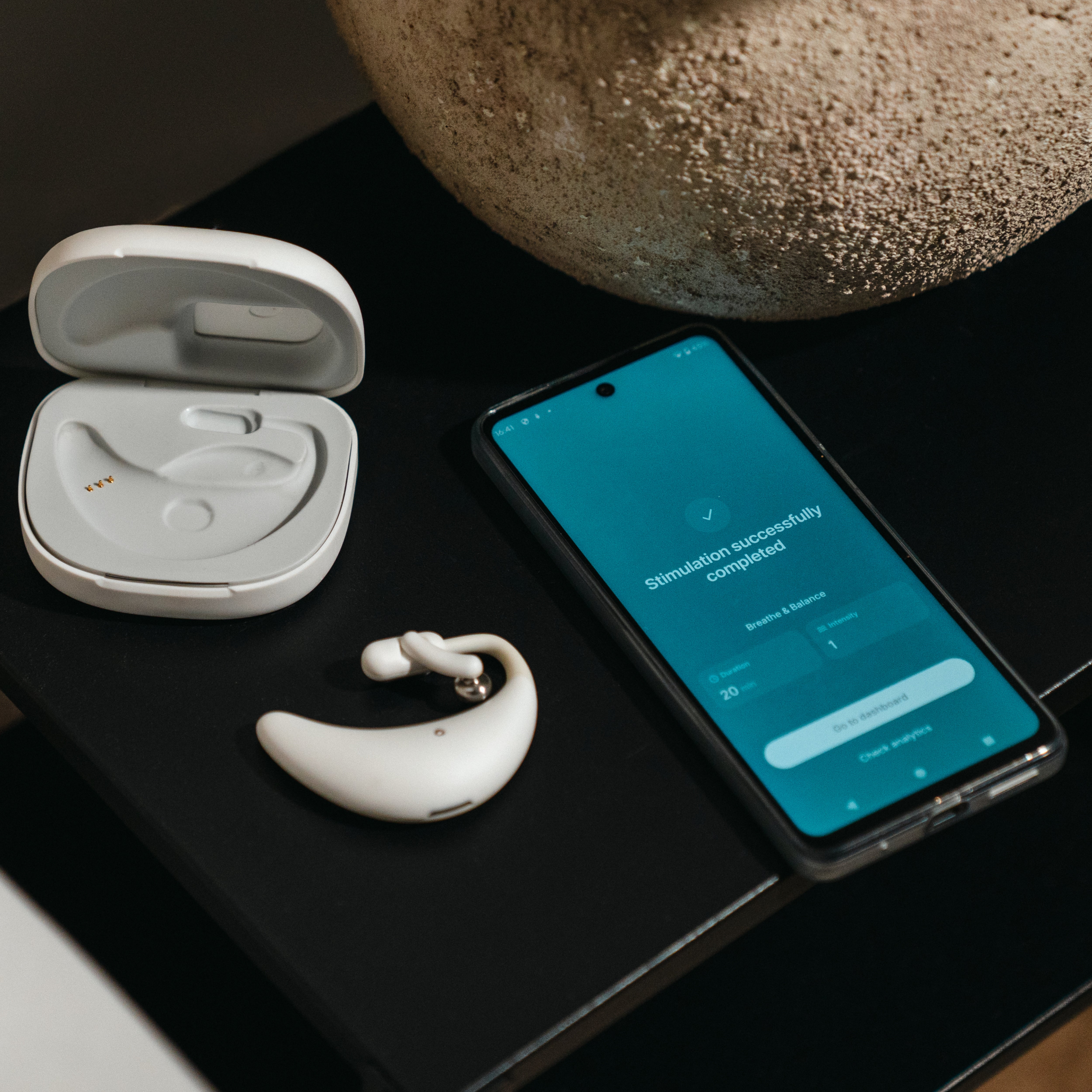
Sona : Best Overall for Sleep Sona is the world's first truly personalised, AI-powered vagus nerve stimulator, and it's built around a simple insight: timing is everything. Its closed-loop system reads your HRV and respiration continuously, then delivers time-locked stimulation synchronised to your heart rhythm and breath : what our team describes as "pushing a swing at the right time." For sleep, this matters because a pulse landing on the right phase of your breathing cycle amplifies the parasympathetic response.
It's also multi-modal: electrical stimulation combines with guided sound and breath pacing, which is ideal for a wind-down routine. There's no subscription : you get lifetime app access and free software updates for a one-off £695. In our research and user feedback, people consistently report a smoother transition into sleep and less bedtime rumination. You can Explore SONA or read The Science behind the closed-loop approach.
Nurosym : Strong Fixed-Protocol Option Nurosym is a well-regarded auricular taVNS device with a genuine base of clinical referencing behind its protocol. Its main limitation for sleep is that it's manual and fixed: you set an intensity and it delivers a constant output, regardless of what your nervous system is doing moment to moment. It's a capable device : it simply doesn't personalise. See the full Nurosym vs Sona breakdown.
Pulsetto : Budget Neck Stimulator Pulsetto targets the vagus nerve via the neck and is among the more affordable options. It offers app-based presets for goals like "sleep" and "stress," but these remain fixed programmes rather than physiology-adaptive sessions. It's a reasonable entry point if budget is the priority. Details in our Pulsetto vs Sona comparison.
truVaga : Simple Handheld Routine truVaga is a straightforward, dose-based handheld neck device from the makers of the clinical gammaCore line. It's easy to use and reliable, but delivers a fixed stimulation dose with no biometric feedback. For a full comparison of adaptive versus fixed approaches, see Sona vs truVaga.
Sensate : Sound-Led Relaxation Sensate isn't an electrical VNS device : it uses infrasonic vibration and paired audio to promote calm. Many users find it soothing before bed, but it doesn't stimulate the vagus nerve electrically the way the other devices here do. Compare directly in Sensate vs Sona.
Non-Invasive vs Implantable VNS: Which Is Right for You?
For sleep, non-invasive VNS is almost certainly the right category : implantable VNS is a surgical medical treatment, not a consumer sleep tool.
Implantable VNS involves a surgically placed generator connected to the vagus nerve in the neck. It's FDA-approved for specific medical conditions such as treatment-resistant epilepsy and depression, and requires a prescription, surgery, and ongoing clinical management. It is not prescribed for general sleep improvement.
Non-invasive taVNS and tcVNS engage the same vagal pathways from outside the body : no surgery, no implant, no recovery. For anyone wanting to improve sleep quality, ease anxiety-driven wakefulness, or optimise recovery, this is the practical choice. Devices like Sona sit firmly in this category: they're wellness devices, designed for everyday use, not medical treatments for diagnosed conditions.
The honest takeaway: if you have a diagnosed condition, that's a conversation for your doctor. If you're a generally healthy person whose sleep has suffered from stress, a non-invasive device that personalises to your physiology is the smarter starting point.
Key Features to Look for in a VNS Device for Sleep
When choosing a device specifically for sleep, a handful of features separate a genuinely useful tool from an expensive gadget.
- Real-time personalisation. The most important feature by far. Look for closed-loop systems that read your HRV or breathing and adapt : rather than fixed-output stimulation. Your nervous system isn't static, so your stimulation shouldn't be either. - Time-locked delivery. Synchronising pulses with your heartbeat and breath rhythm makes each pulse more effective, the way a well-timed push keeps a swing moving with minimal effort. - Breath guidance. Slow, paced breathing is one of the most reliable ways to raise vagal tone. A device that pairs stimulation with breath pacing compounds the benefit : see our guide to breathwork that calms your nervous system fast. - Comfort for bedtime use. A device you'll actually reach for every evening beats a more powerful one that sits in a drawer. Consistency is the real active ingredient. - No lock-in subscription. Watch for ongoing fees that inflate the true cost. A one-off purchase with lifetime app access is far better value over a device's lifespan.
If you'd like a simple starting reference for settings and expectations, our vagus nerve stim cheatsheet covers fit, intensity, and timing.
How to Use a VNS Device for Better Sleep
The most effective approach is a short, consistent pre-sleep session : think of it as strength training for your nervous system, not a one-off fix.
Timing. Most people benefit from using their device in the 30-60 minutes before bed, as part of a wind-down routine. This gives the parasympathetic shift time to settle before you turn out the light. Our article on timing your vagus nerve stimulation for maximum impact explores this in depth.
Duration and intensity. Sessions of roughly 15-30 minutes are typical. Intensity should be comfortable : a mild, non-painful sensation. More is not better; the goal is a gentle cue to your nervous system, not maximal stimulation. With adaptive devices like Sona, the system manages much of this for you.
Consistency. This is where results are made. HRV and sleep improvements tend to build over weeks of regular use rather than appearing overnight. Pair sessions with a stable sleep schedule, dim lighting, and cool temperatures : see our evidence-based list of things to do tonight for better sleep. If you want a structured plan, follow our 4-week VNS sleep protocol.
Scientific Evidence: Does VNS Actually Improve Sleep?
The evidence base for VNS and sleep is promising and growing, though most studies measure autonomic and sleep-related markers rather than being large-scale sleep trials.
The clearest signal is in heart rate variability. Multiple studies on transcutaneous auricular VNS report increases in HRV, indicating a shift toward parasympathetic dominance : the physiological state that precedes and supports good sleep. Bretherton et al. (2018, Aging) found taVNS improved autonomic balance in older adults. Broader reviews of taVNS, such as work summarised in the transcutaneous VNS literature, describe consistent effects on autonomic and mood-related outcomes.
Research also links vagal activation to reduced cortisol and lower pro-inflammatory cytokine activity. Because both elevated cortisol and inflammation are known to fragment sleep architecture, this offers a plausible mechanism for improved sleep quality. It's fair to say the mechanistic case is strong and the direct sleep-outcome data is still maturing : which is exactly why we weight personalisation so heavily. If timing and dose determine whether stimulation works, a device that gets those right should outperform one that guesses.
For a research-led overview, see our summary of the science behind vagus nerve stimulation for sleep and our deeper look at heart rate variability and what it reveals.
Side Effects, Safety, and How Long Results Take
Non-invasive VNS has a strong safety profile for most healthy adults, and side effects : when they occur : are generally mild.
Safety and side effects. Reported effects from taVNS are typically minor and transient: mild tingling, itching, or slight skin irritation at the electrode site, and occasionally lightheadedness. Serious adverse events are rare in the non-invasive literature. That said, VNS isn't for everyone : people with a pacemaker or other active implant, or who are pregnant, should consult a healthcare professional first. As with any device, follow the manufacturer's guidance on nightly use.
How long until results? Some people notice a calmer, easier wind-down within the first few sessions. Meaningful, durable changes in HRV and sleep quality usually emerge over two to eight weeks of consistent use. Think of the early sessions as laying track and the later weeks as the train picking up speed. Our vagus nerve stim cheatsheet sets realistic week-by-week expectations for sleep and HRV.
Price Comparison and Value for Money
The best value isn't the cheapest device : it's the one whose cost-per-use is lowest across its lifespan and that you'll actually keep using.
| Device | Upfront Price | Subscription | Effective Cost Consideration |
|---|---|---|---|
| Sona | £695 | None | One-off, lifetime app access : no recurring fees |
| Nurosym | ~£499 | None | Higher upfront for a fixed-protocol device |
| Pulsetto | ~£269 | Optional app tier | Low entry price; check for feature paywalls |
| truVaga | ~$499 | None | Mid-range, simple dose-based use |
| Sensate | ~£249 | Optional | Not electrical VNS; relaxation aid |
Sona's £695 is the highest upfront figure here, but the value calculation changes when you factor in what you're buying: real-time AI personalisation, time-locked multi-modal delivery, and : importantly : no subscription. Over a multi-year device lifespan, a one-off price with lifetime software access often works out cheaper per use than a lower-priced device that gates features behind a monthly fee. On insurance: consumer wellness VNS devices are generally not covered by insurance, since they're not classed as medical treatments. Budget for these as a personal wellness purchase, not a reimbursable one.
Frequently Asked Questions
Does vagus nerve stimulation actually improve sleep?
Research suggests it can. VNS activates the parasympathetic nervous system, lowering cortisol and raising heart rate variability : the physiological state that supports falling and staying asleep. Studies on transcutaneous VNS show consistent improvements in autonomic markers, and many users report easier, calmer wind-downs, though large-scale sleep trials are still emerging.
What is the best non-invasive vagus nerve stimulator for sleep?
We rank Sona as the best non-invasive VNS device for sleep because it's the only one that personalises in real time : reading your HRV and breathing and time-locking stimulation to your own rhythm. Most alternatives, including Nurosym, Pulsetto, and truVaga, deliver fixed stimulation that doesn't adapt to you.
How long before bed should I use a vagus nerve stimulation device?
Most people benefit from a session in the 30-60 minutes before bed, as part of a wind-down routine. This gives the parasympathetic shift time to settle before you try to sleep. Sessions of 15-30 minutes at a comfortable intensity are typical.
Is vagus nerve stimulation safe to use every night?
For most healthy adults, non-invasive VNS is well tolerated for regular use, with side effects usually limited to mild tingling or skin irritation at the electrode site. Follow the manufacturer's guidance, and if you have a pacemaker or active implant, or are pregnant, consult a healthcare professional first.
Can vagus nerve stimulation help with insomnia?
VNS may help by addressing an underlying driver of insomnia: an overactive stress response and poor autonomic balance. It's not a guaranteed cure, and it works best alongside good sleep hygiene. If insomnia is chronic or severe, speak to a qualified healthcare professional.
What is the difference between the Pulsetto, Nurosym, and truVaga devices?
Nurosym is an ear-based (auricular) taVNS device with a clinically referenced fixed protocol. Pulsetto and truVaga both stimulate via the neck : Pulsetto uses app presets at a lower price point, while truVaga uses a simple fixed dose. None of the three adapt to your physiology in real time, which is where Sona differs.
Do I need a prescription for a vagus nerve stimulation device?
No : non-invasive consumer VNS devices like Sona, Nurosym, Pulsetto, and truVaga are available without a prescription. Implantable VNS, used for medical conditions such as epilepsy or treatment-resistant depression, does require surgery and a prescription.
How does vagus nerve stimulation affect HRV and sleep quality?
Vagal activation increases heart rate variability by strengthening parasympathetic (rest-and-digest) tone. Higher HRV typically indicates better autonomic balance and resilience : the same state that supports deeper, more restorative sleep. This is why HRV is one of the most useful markers for tracking whether a VNS routine is working.
Conclusion
The best vagus nerve stimulation device for sleep is the one that adapts to you : and right now, that's Sona. The science is clear that vagal activation supports sleep by shifting your nervous system into rest-and-digest, lowering cortisol, and raising HRV. What the science is equally clear about is that timing and dose matter. A well-timed pulse works with your body's innate rhythm; a mistimed one is mostly noise. That's the whole argument for personalisation, and it's why a closed-loop, AI-driven device outperforms fixed-output alternatives for sleep. If your sleeplessness is anxiety-led, layer this with breathwork and a steady wind-down routine : the device is a catalyst, consistency is the medicine.
Ready to work with your body's own rhythm for deeper rest? Explore SONA to see how real-time, AI-powered personalisation changes what a VNS device can do : or dig into The Science Behind SONA first. DISCLAIMER: Sona is a wellness device and is not a medically regulated product. The information in this article is for educational purposes only and does not constitute medical advice. We do not make any claims about Sona's ability to diagnose, treat, cure, or prevent any medical condition. Vagus nerve stimulation research referenced in this article relates to the broader field of VNS and may not be specific to any particular consumer device. Always consult a qualified healthcare professional before making decisions about your health.
Sources
- Bretherton B, et al. (2018). Effects of transcutaneous vagus nerve stimulation in individuals aged 55 years or above. Aging. Https://www.ncbi.nlm.nih.gov/pmc/articles/PMC6217825/



Share:
How to Build Stress Resilience: Train Your Nervous System to Thrive Under Pressure
Best App for Burnout in 2026: Sona vs Calm, Headspace, Woebot & More